EFEM Wafer Handling SystemWafer handling in front of your process tools, now with a local Taiwan option
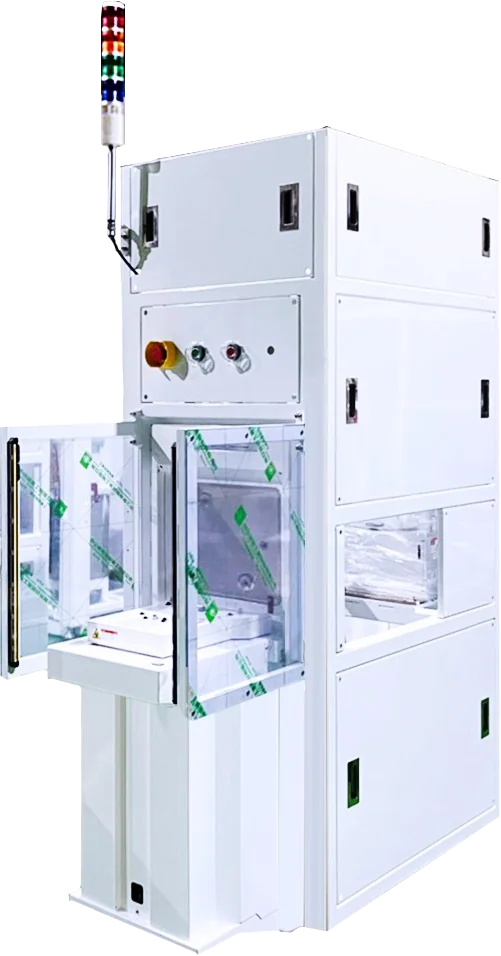
An EFEM (Equipment Front End Module) is the wafer handling module mounted in front of a process or metrology tool: it takes wafers out of the FOUP, feeds them into the tool, and puts them back when processing is done. We offer a Made-in-Taiwan (MIT) EFEM as a local second source alongside imported equipment. It supports SEMI E84/E87/E90, connects to your fab's OHT/AGV automated material handling, and can be fitted with micro-contamination control, wafer inspection and vision modules to suit the process.
ESG positioning: G (Governance)SDG 9Industry & InnovationHow DEYly approaches ESG →
- Proven benefits
- Local design, manufacturing and technical support in Taiwan reduce the supply risk of relying on a single overseas source for critical equipment (G).
- Limits
- MTBF, MTTR and uptime are equipment spec targets; actual performance depends on the process, maintenance and the fab's material handling conditions, and is defined in the acceptance criteria at deployment.
Where it fitsWhere does the EFEM sit in a fab, and what does it handle?
Nearly every process and metrology tool in a fab has an EFEM in front of it. An overhead hoist transport (OHT) or automated guided vehicle (AGV) delivers the FOUP to the load port; the EFEM opens the door and scans each slot for a wafer (wafer mapping), then the robot feeds the wafers into the tool one by one and returns them to the original FOUP when done. Further reading: FOUP vs. FOSB, front-end process flowcharts.
- 01FOUP arrivesThe OHT/AGV hands off via E84 and sets the FOUP on the load port
- 02Door open & mappingOpens the FOUP automatically and scans the wafer status of every slot
- 03Read wafer IDConfirms each wafer's identity and reports it to the host
- 04Load into toolThe robot picks each wafer and feeds it into the process or metrology module
- 05Return to FOUPWafers go back to their original slots and the OHT/AGV picks up the FOUP
What it doesWhat can a Taiwan-made EFEM do?
Local second source
Can replace some imported EFEMs, with locally supplied equipment and technical support. You don't have to replace everything at once; start with one tool type or one line.
Customized to your process and space
Mechanics, software and system integration are designed around the customer's process, tool footprint and automation needs.
Expandable modules
Add micro-contamination control, wafer inspection and vision functions as the process requires.
Smart factory integration
Supports SEMI E84/E87/E90 and connects to the fab's OHT/AGV automated material handling system.
FOUP/FOSB loading and unloading
Supports automatic FOUP/FOSB loading/unloading and wafer mapping.
300 mm wafers
Automated handling of 300 mm (12-inch) wafers.
SEMI standardsWhat are SEMI E84, E87 and E90?
An EFEM has to "speak the same language" as the fab's OHTs, AGVs and host system, and that common language comes from SEMI's automation standards. These three are the ones customers ask about most:
These are plain-language summaries; actual interfaces follow the SEMI standard texts and the customer's tool specifications.
Evaluating a second sourceWhat should you check before switching to a local EFEM?
When a critical module comes from a single overseas supplier, the usual pain points are waiting on lead times, spare parts and on-site support. A local second source is about giving customers another option. When evaluating, we suggest checking the following first:
Tool interface
Check that the mechanical interface, communication method and load port specs on the process tool side allow direct integration.
Fab automation
OHT/AGV handshake (E84) and host connectivity requirements.
Acceptance criteria
Set acceptance standards and trial-run methods in advance for MTBF, MTTR, wafer ID read rate, unattended operation rate and other items.
SpecificationsSpec
| Wafer size | 300 mm (12-inch) |
|---|---|
| Carrier | Automatic FOUP/FOSB loading/unloading and wafer mapping |
| Automation standards | SEMI E84 / E87 / E90 |
| Material handling integration | OHT / AGV |
| MTBF (mean time between failures) | ≥ 2,000 hr |
| MTTR (mean time to repair) | ≤ 2 hr |
| Wafer ID read rate | ≥ 99.5% |
| Unattended operation rate | ≥ 99.5% |
| Equipment uptime | ≥ 99.5% |
| Expandable modules | Micro-contamination control, wafer inspection, vision |
| Number of load ports, dimensions | Designed to the customer's tool and space requirements |
Specs are reference values for the standard configuration. The actual design depends on product, carrier and line conditions and is confirmed against your requirements before deployment.
FAQCommon questions
What is an EFEM?
An EFEM (Equipment Front End Module) is the wafer handling module mounted in front of a process or metrology tool. It takes wafers out of the FOUP, feeds them into the tool and puts them back when processing is done, and typically includes load ports, a wafer handling robot and a control system.
How is an EFEM different from a wafer sorter?
An EFEM is part of the process tool and moves wafers into and out of it. A wafer sorter is standalone equipment dedicated to transferring, splitting and sequencing wafers between wafer boxes; it doesn't connect to a process tool.
Which SEMI standards does this EFEM support?
It supports SEMI E84 (handoff handshake), E87 (carrier management) and E90 (substrate tracking), and connects to the fab's OHT/AGV automated material handling system.
Can we replace just the EFEM and keep the process tool?
We can evaluate it. The EFEM has to match the process tool's mechanical interface, communication and space, so we confirm the tool specs first, then define the customization scope and acceptance method.
What do MTBF ≥ 2,000 hr and MTTR ≤ 2 hr mean?
MTBF is the average time between failures; MTTR is the average time to repair a failure. Both are equipment spec targets. Actual performance depends on the process, maintenance and site conditions, and both are written into the acceptance criteria at deployment.
Can I buy directly from DEYly? Who handles quotations and after-sales service?
Yes. This equipment is sold by DEYly, and DEYly handles both quotations and after-sales service. Before quoting, we evaluate your products, throughput and line conditions. You can send your requirements directly through the inquiry form.