Key takeaways: What is an electronic label?
"Electronic label" is an umbrella term for three products. Electronic shelf labels (ESL) use e-paper to display prices, product names or part numbers. A back-end system updates them wirelessly through base stations, and they are meant to be read by people. RFID tags contain a chip and an antenna. A reader uses radio waves to read their ID, with no need for line of sight, and it can read many tags at once. They are meant to be read by machines, and the eTag used for highway ETC is one example. Pick-to-light systems (DPS) are quantity displays mounted on storage locations. They light up based on the order to show the operator which slot to pick from and how many items to take. Choose ESL if you need the shop floor to see changing information. Choose RFID if you need to track item locations and movements automatically. Choose a pick-to-light system or ESL with indicator lights if you need to guide picking.
"Electronic label" actually means 3 different things
People searching for "electronic labels" may be looking for retail price tags, RFID stickers, or light-up picking equipment for a warehouse. The three share a name but work in completely different ways and serve different purposes. The simplest way to tell them apart: is it read by people or by machines?
| Type | What it looks like | How it works | Who reads it | Common uses |
|---|---|---|---|---|
| Electronic shelf labels (ESL) | E-paper display showing price, product name or part number | Back-end data updates the display wirelessly via base stations | people | Retail price changes, factory rack and storage location labeling |
| RFID tags | Sticker or hard-case tag containing a chip and antenna, with no display | A reader emits radio waves and reads the ID stored in the tag | Machines (readers) | Asset tracking, inventory counts, access control, highway ETC eTags |
| Pick-to-light systems (DPS) | Quantity displays mounted on storage locations, usually with indicator lights and confirm buttons | The system lights up locations based on the order and shows how many to pick | people | Picking in distribution centers and warehouses, kitting for production lines |
So start by asking which problem you need to solve: information changes often (prices, part numbers, status), items keep going missing or counts are inaccurate, or pickers often grab the wrong items or work too slowly. Each option is explained below.
Electronic shelf labels (ESL): keeping shelf information in sync with your system
Electronic shelf labels display content on e-paper and only use power when the screen changes, so a label battery can last up to 5 years. The back end connects to POS or ERP, and when a price changes, the update is pushed wirelessly to the shelf through base stations. One base station can manage up to 2,500 labels.
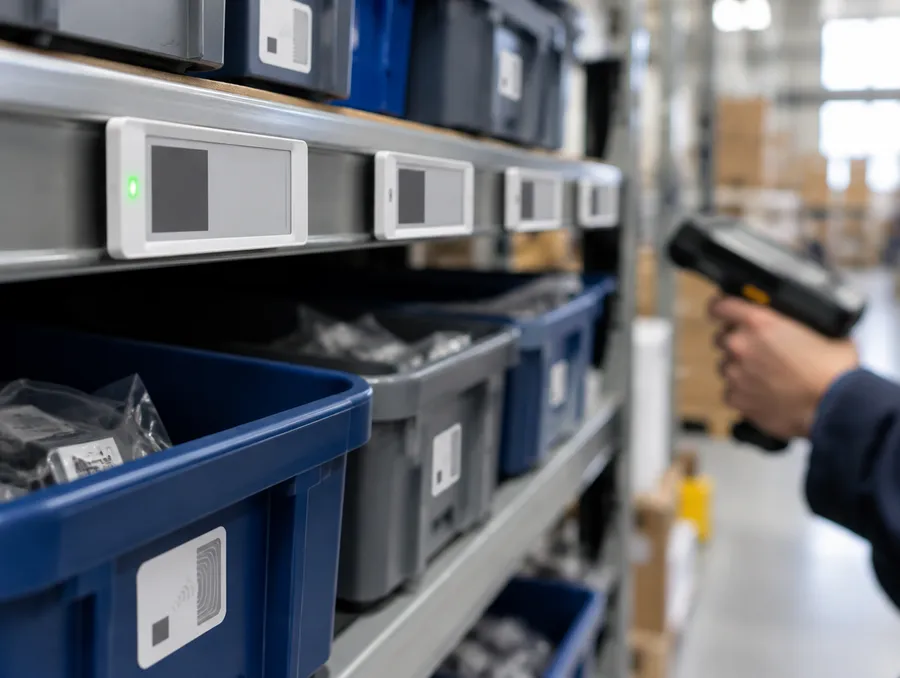
Retailers adopt them mainly to cut the labor of changing prices and to avoid pricing errors. According to TechNews, PX Mart plans to roll out electronic labels in its 1,250 stores across Taiwan within 3 years. Its first store to adopt them, the PX Mart superstore in Qingpu, has deployed 40,000 labels, and total spending including systems and store upgrades could reach NT$4 billion (TechNews).
The same labels work in factories and warehouses too. Mounted on racks, storage locations and material bins, they show part numbers, lot numbers and status. When the system changes, the labels on the floor change with it, so there's no need to reprint and relabel.
RFID tags: no line of sight needed, read a whole batch at once
RFID tags have no display and only store an ID. A reader emits radio waves, and every tag within range sends back its ID, so tags can be read without line of sight, even when they're out of view, and many can be read at once. Asset tracking typically uses UHF (ultra-high frequency) RFID, which has a longer read range than short-range technologies like phone NFC.
RFID suits items that are reused, high-value, often searched for or frequently counted, such as fixtures, tools, returnable totes and high-value spare parts. For single-use consumables, every batch would need new tags, so barcodes are usually more cost-effective. Tags placed on metal need to be on-metal tags, and read rates should be tested on site before rollout. For how to approach implementation and estimate costs, see "RFID Asset Tracking Solutions".
Pick-to-light systems: lights show you which slot to pick from
A pick-to-light system, also called a digital picking system (DPS), puts a display on each storage location. The system lights up the locations to pick from based on the order and shows the quantity. Operators pick accordingly and press confirm when done, with no need for paper pick lists. Hitachi's logistics glossary also notes that the system cannot verify whether the quantity actually picked is correct, so it still needs checks to prevent shipping errors (Hitachi).
Electronic shelf labels with LED lights can also turn racks into "light-guided" picking racks: when a part needs to be picked, the label on that location lights up and shows the part number and quantity, and the rest of the time it works as a location label. Detecting whether the part was actually taken (for example, with weight sensors or light curtains) is a separate system and should be evaluated alongside it.
How should factories and warehouses choose? Start with the problem you need to solve
- Part numbers, prices or status change often, and floor labels don't match→Electronic shelf labels (ESL)
- Fixtures, tools and spare parts keep going missing, and inventory counts take too long→RFID tags
- Pickers often go to the wrong location, and new staff take a long time to learn→A pick-to-light system, or ESL racks with indicator lights
- Low-cost, single-use materials→Stick with barcodes, using handheld terminals or barcode scanners
The three can also be combined: ESL on racks to show part numbers and guide picking with lights, RFID on totes to log movements automatically, and barcodes for consumables. For the barcode layer, see "How to Choose a 1D or 2D Barcode Scanner" and "How to Use an Inventory Scanner". Whichever you choose, we recommend piloting it on one row of racks or one area first, and expanding once the workflow runs smoothly.
FAQ
Are electronic labels the same as RFID?
Not exactly. RFID is one type of electronic label. It uses radio waves to read the ID stored on a chip and has no display. The electronic labels that show prices on retail shelves are e-paper electronic shelf labels (ESL), which are a different product.
What type of electronic label does PX Mart use?
Electronic shelf labels (ESL) that display prices on the shelf. They use e-paper to show prices and are updated wirelessly from the back end, keeping shelf prices in sync with checkout prices. They are not RFID.
How much do electronic labels cost?
For electronic shelf labels, cost mainly depends on the number and size of labels, the number of base stations, mounting hardware and system integration. For RFID, it depends on the tag type (standard or on-metal), the number of items, the reading equipment and system integration. For either one, we recommend counting quantities and running a small pilot first, then estimating based on the actual scale.
Do e-paper labels need constant power?
No. E-paper only uses power when the screen changes and draws almost nothing while the display stays the same. That's why electronic shelf labels can run for up to 5 years on a coin cell battery, depending on how often they're updated.
Can a factory use ESL and RFID together?
Yes. They do different jobs. ESL lets floor staff see part numbers, lot numbers and status, and guides picking with lights. RFID lets the system automatically record where items are and when they move. A common setup is ESL on racks and RFID on reusable totes or fixtures.