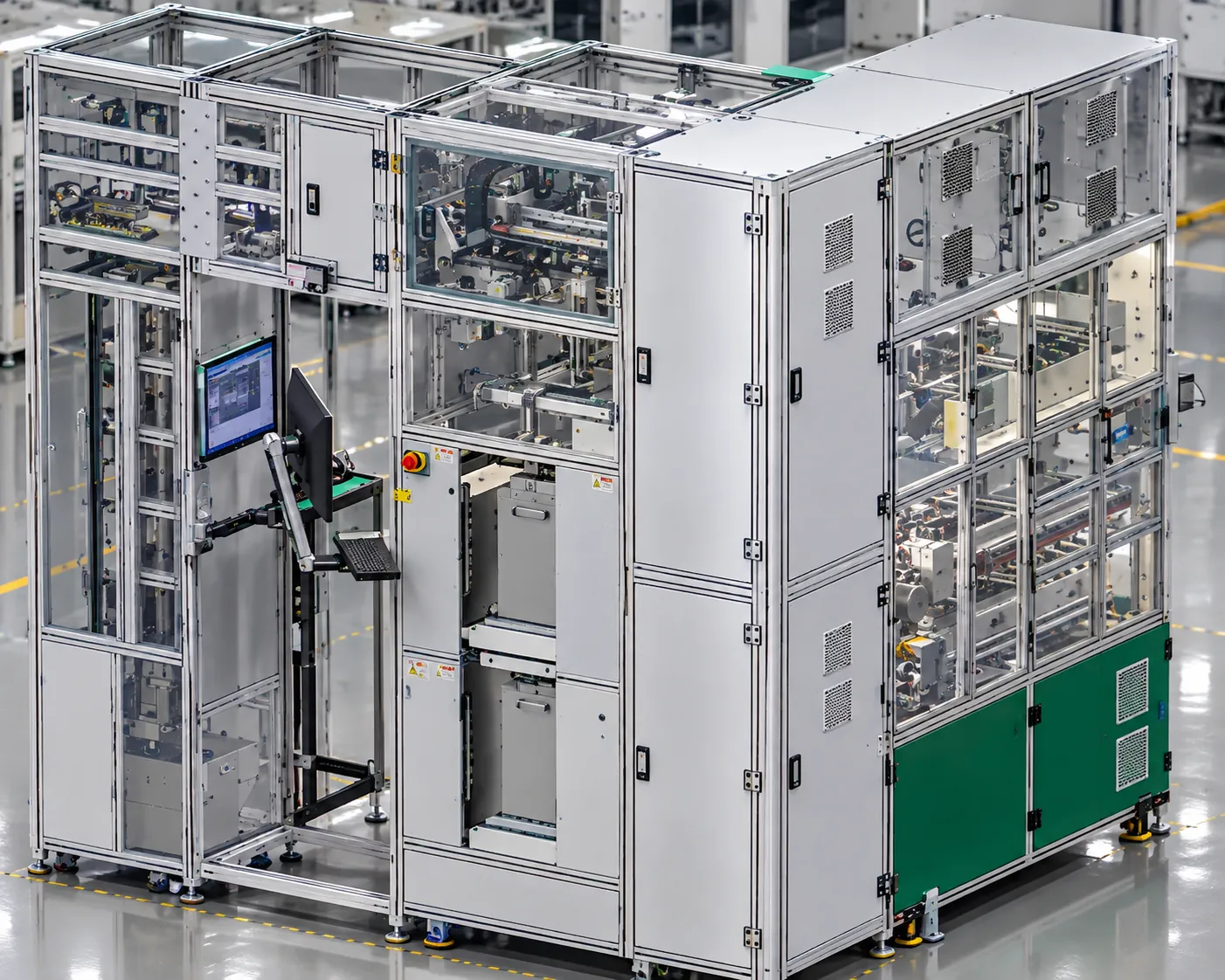
M/D Auto Loader/UnloaderMagazine loading and unloading, cleaning, inspection and record checks, with no one tending the tool
The M/D Auto Loader/Unloader is automated material handling equipment installed before and after assembly and test process tools. A six-axis robot with a fork picks and places magazines, integrating WIP/buffer storage with loading/unloading (LD/ULD). Before carriers enter the process, they go through DUC dry cleaning and top/bottom AOI inspection, and barcodes verify the magazine/carrier identity against the move-in information. Unreadable or abnormal material is sent automatically to the reject area.
ESG positioning: E (Environmental) + S (Social)SDG 9Industry & InnovationSDG 8Decent WorkHow DEYly approaches ESG →
- Proven benefits
- DUC dry cleaning uses no water or chemicals and removes particles before carriers enter the process (E); magazine handling and loading/unloading move to the robot, reducing manual carrying and waiting (S).
- Limits
- Transfer time, cleaning time and overkill rate are standard-configuration specs. Labor benefits use pre- and post-deployment shift staffing as the baseline; automation isn't layoffs.
How it worksWhat does the machine do when a magazine comes in?
- 01Conveyor infeedMagazines/carriers arrive on the conveyor (CV)
- 02Barcode check1D barcodes identify the magazine/carrier and confirm the move-in information
- 03DUC dry cleaningCarriers (pin racks) are cleaned automatically before entering the process: 20 in ≤ 330 sec
- 04Top/bottom AOIImage inspection for product defects, with automatic judgment and sorting
- 05Buffer and loadingWIP/buffer storage; the robot loads the tool at takt
- 06Unloading and rejectFinished product is unloaded; abnormal or unreadable material goes to the reject area automatically
Operators only need to replenish material, remove finished product and handle exceptions in the reject area. Moving, waiting and checking between tools are left to the equipment.
FeaturesWhat does the M/D Auto Loader/Unloader integrate?
Six-axis robot + fork
A six-axis robot with a fork automatically picks and places magazines, integrating WIP/buffer storage and LD/ULD handling for unattended material flow.
Conveyor integration
Integrates conveyors, the robot and loading/unloading mechanisms to automate magazine/carrier infeed, outfeed and transport between processes, reducing manual handling and wait time.
DUC dry cleaning
Carriers (pin racks) are cleaned automatically before entering the process, reducing particle and micro-contamination risk.
AOI automated optical inspection
Top/bottom AOI image inspection with automatic sorting, automatically judging product defects.
Barcode record matching
Automatic 1D/2D barcode recognition: material is released only when the magazine/carrier identity matches the move-in information, reducing the risk of wrong or mixed material.
Reject-area error-proofing
Abnormal or unidentifiable material is automatically routed to the reject area and never mixes into the process.
What is overkillWhat does an AOI "overkill rate ≤ 2%" mean?
AOI can make two kinds of errors: passing a defective part is an escape (missed defect), and flagging a good part as defective is overkill (false reject). When overkill runs too high, good product gets pulled for re-inspection or scrapped, and staff end up back at the review station. This machine's final AOI overkill rate spec is ≤ 2%.
Overkill and escape rates pull against each other: tighten the threshold and escapes drop, but overkill rises. At deployment we tune the judgment criteria with actual products and defect samples, then set the acceptance standard. To learn how AOI captures images and makes judgments, see AOI optical inspection.
SpecificationsSpec
| Handling | Six-axis robot + fork picks and places magazines |
|---|---|
| Robot transfer time | ≤ 90 sec/transfer |
| Clean | DUC dry cleaning |
| DUC cleaning time | ≤ 330 sec/20 carriers |
| AOI | Top/bottom image inspection, automatic sorting |
| Final AOI overkill rate | ≤ 2% |
| Record matching | 1D/2D barcodes; magazine/carrier identity and move-in information verified |
| Exception handling | Abnormal or unidentifiable material automatically routed to the reject area |
| Buffer | WIP/buffer storage |
| Dimensions and power | Designed to the line layout and tool interface |
Specs are reference values for the standard configuration. The actual design depends on product, carrier and line conditions and is confirmed against your requirements before deployment.
FAQCommon questions
What does the M/D Auto Loader/Unloader do?
Installed before and after assembly and test process tools, it automatically loads and unloads magazines/carriers and integrates buffering, DUC dry cleaning, AOI inspection and barcode record matching to reduce manual handling and waiting.
What is DUC dry cleaning?
Before carriers (pin racks) enter the process, they are cleaned automatically by a dry method that uses no water or chemicals, reducing particle and micro-contamination risk. Cleaning 20 carriers takes ≤ 330 seconds.
What does an AOI overkill rate ≤ 2% mean?
Overkill means a good part is misjudged as defective. An overkill rate ≤ 2% means that, of the products AOI finally judges defective, the share that were misjudged is kept within 2%. Actual results are tuned to the product and judgment criteria.
What happens if a barcode can't be read or the part number is wrong?
The equipment uses 1D barcodes to confirm the magazine/carrier identity and move-in information. Abnormal or unidentifiable material is sent automatically to the reject area and never mixes into the process.
Can it be added to existing process tools?
We can evaluate it. We first confirm the tool's loading/unloading interface, magazine specs and line flow, then design the robot, conveyor and buffer layout.
Can I buy directly from DEYly? Who handles quotations and after-sales service?
Yes. This equipment is sold by DEYly, and DEYly handles both quotations and after-sales service. Before quoting, we evaluate your products, throughput and line conditions. You can send your requirements directly through the inquiry form.