Key takeaways: what is chemical filter regeneration, and how do you confirm a regenerated filter is usable?
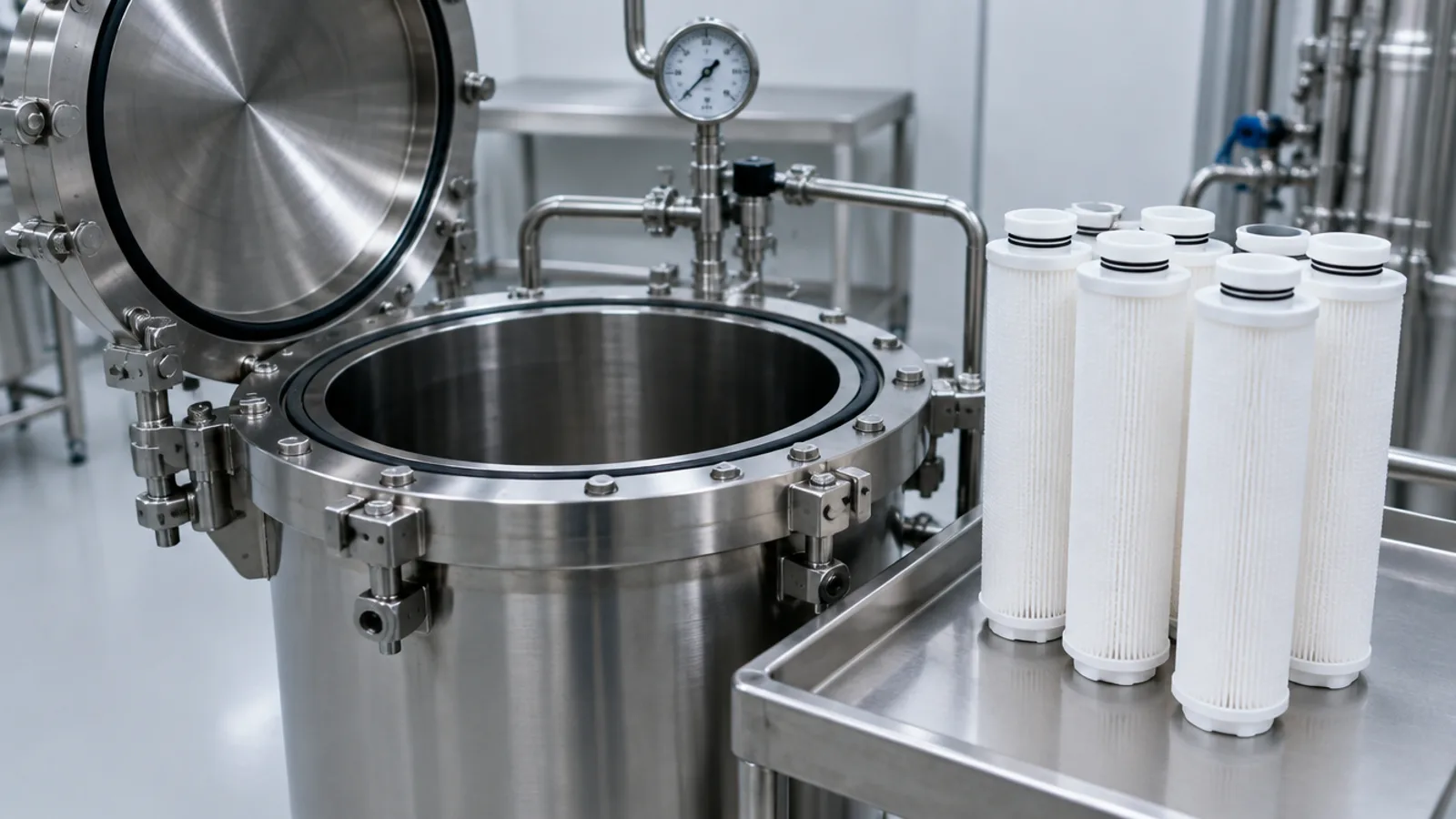
Chemical filter regeneration means cleaning used semiconductor chemical filters, testing them and putting them back on the tool once they pass instead of discarding them after a single use. A common cleaning method is supercritical CO₂. Above about 31 °C and 7.38 MPa, CO₂ becomes a supercritical fluid. It has no surface tension, so it can get into the membrane's micropores, and it can dissolve organics. When the pressure drops it turns straight back into gas, so no solvent is left behind and no drying is needed. After regeneration, a series of tests has to prove quality. First, differential pressure and flow are measured to confirm the membrane is neither torn nor clogged. Then come liquid particle countingWhat is liquid particle counting?DI water is run through the filter, and an instrument counts how many tiny particles are in the water.A low count means the filter itself isn't shedding particles that would contaminate the line downstream., ion chromatography (IC)What is ion chromatography (IC)?It separates the ions in water (such as chloride, sulfate and sodium) one by one and measures each concentration.It confirms the filter isn't leaching ions into the chemicals., ICP-MS metalsWhat is ICP-MS?A hot plasma turns the elements in a sample into ions, and a mass spectrometer sorts them by mass, so it can measure extremely small amounts of metals.It confirms the filter isn't releasing metals such as iron or sodium that can damage wafers. and total organic carbon (TOC)What is total organic carbon (TOC)?The total amount of carbon contained in all the organic matter in the water.The lower the number, the less organic material the filter is leaching.. Samples also go through material analysis: tensile testingWhat is tensile testing?A small strip of membrane is pulled until it breaks, to measure how much force it can take.Comparing it with a new membrane shows whether cleaning weakened it., FTIR infrared spectroscopyWhat is FTIR?Infrared light is shone on the material to see whether its chemical structure has changed, for example whether it has oxidized.Short for Fourier-transform infrared spectroscopy. and SEM electron microscopyWhat is SEM?A scanning electron microscope, which can magnify the membrane thousands to tens of thousands of times.It shows whether the micropores are deformed, torn or clogged., and finally the regenerated filters are run on the tool side by side with new ones. Before adopting regeneration, confirm whether the membrane is PTFE, what the OEM warranty and the fab's change-management rules say, and how many times a filter can be regenerated.
What is a chemical filter, and why is single use such a waste?
In short: a semiconductor chemical filter works like the cartridge in a water purifier, except it has to remove nanometer-scale particles from strong acids, strong bases and ultrapure water. Most use PTFEWhat is PTFE?Short for polytetrafluoroethylene, better known as Teflon.It is almost immune to strong acids, strong bases and high temperatures, which is why it is a common membrane material for semiconductor chemical filters. It is also a fluoropolymer, though, which puts it in the broad PFAS family. membranes, which are expensive and made from a regulated fluorinated material. Filter regeneration means cleaning used filters, validating them and putting them back on the tool instead of throwing them away after one use.
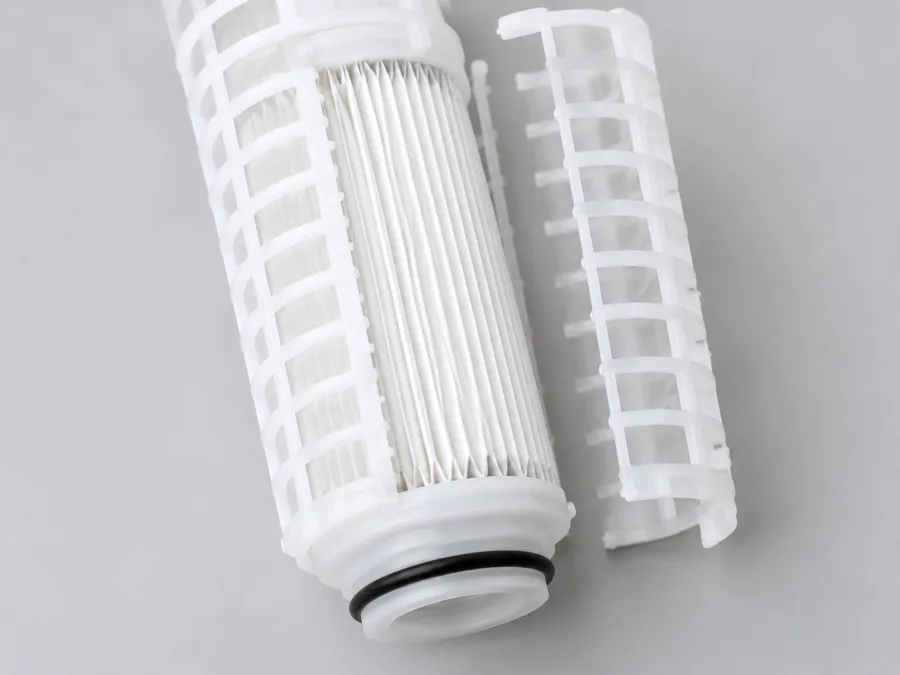
Any particle on a wafer can “bridge” the gap between circuit lines and cause a short, so ultrapure water usually passes through filters with pores of 200 nm or less before it reaches the tool. The particles to be stopped are roughly half the chip's minimum feature size (Wikipedia: Ultrapure water). Chemical lines work the same way: filters stand guard all the way from the facility supply system to the inside of the tool.
The problem is that most of these filters use PTFE membranes, and PTFE, along with the chemicals used to make it, is one of the best-known PFAS (Wikipedia: Polytetrafluoroethylene). In January 2023, Denmark, Germany, the Netherlands, Norway and Sweden proposed restricting about 10,000 PFAS in the EU (ECHA, 2023-02-07). In March 2026, two scientific committees of the European Chemicals Agency backed a “broad restriction with targeted derogations” and asked users granted derogations to manage their emissions (ECHA, 2026-03-26). Each extra use of a filter means one less fluorinated filter made and thrown away. That is a second reason to regenerate, beyond cost savings.
Why clean with supercritical CO₂?
Membrane pores are extremely fine. Liquid cleaning chemicals may not flow into them, and strong acids or bases can damage the membrane or bring in new metal contaminants. SupercriticalWhat does supercritical mean?Once temperature and pressure are both above a certain “critical point,” a substance is no longer clearly a liquid or a gas and has properties of both.CO₂'s critical point is about 31 °C and 7.38 MPa (about 73 atmospheres). The temperature is close to room temperature, so the process is relatively gentle on plastic filters. CO₂ falls between a gas and a liquid, so it can both get in and dissolve the contamination.
Property ①
Penetrates micropores
Supercritical CO₂ has no surface tension and low viscosity. Like a gas, it can get into the membrane's finest channels and reach places that ordinary liquid chemicals can't.
Targets: contamination deep in membrane pores
Property ②
Dissolves organics
Its density is close to a liquid's, so it can dissolve oils and organic residues. You can tune its dissolving power by adjusting temperature and pressure, with no change of solvent.
Targets: organics and additive residues
Property ③
Turns back into gas when depressurized
When cleaning is finished and the pressure drops, the CO₂ turns straight back into gas and carries the dissolved contamination away with it. The filter needs no water rinse and no drying.
Targets: no solvent residue
Property ④
CO₂ can be recovered
After depressurization, the CO₂ can be condensed, recovered and reused. No acid or alkaline liquid waste is produced, which helps fabs that want to cut chemical use and liquid waste.
Targets: less liquid waste and chemical use
CO₂ has a critical temperature of about 30.98 °C and a critical pressure of about 7.38 MPa. Above that point it has no surface tension and can get inside materials. It is widely used for extraction and industrial cleaning, and it can be condensed and reused afterward (Wikipedia: Supercritical carbon dioxide). For what supercritical means and how it compares with other CO₂ cleaning methods, see What is supercritical CO₂ and Three CO₂ cleaning methods compared.
How does regeneration work? The general process
Receiving and initial inspection
Confirm the filter model, membrane material and the chemicals it was used with. Measure differential pressure and flow once as a baseline, and reject any filter with visible damage or deformation.
Supercritical CO₂ cleaning
The filter goes into a sealed high-pressure vessel, which is heated and pressurized to supercritical conditions so the CO₂ can get into the pores and dissolve contamination. At the end, pressure is released slowly so a fast pressure change doesn't damage the membrane.
Outgoing inspection
Run the differential pressure, particle, ion, metal and organic carbon tests in order. A filter is released only if it passes all of them. If any test fails, it is cleaned again or returned.
Reports and traceability
Each filter ships with a test report and is marked with a serial number and regeneration count, so its later performance on the tool and its regeneration limit can be traced.
| Supercritical CO₂ regeneration | Chemical cleaning | Discard and replace | |
|---|---|---|---|
| How it works | Supercritical CO₂ penetrates the pores, dissolves contamination and leaves when depressurized | Soak and rinse in acid, base or solvent | Scrap and incinerate |
| Residue risk | CO₂ turns back into gas with no solvent left behind | May leave chemical residue or bring in new metal contaminants | — |
| Effect on the membrane | Near room temperature, relatively gentle; depressurization rate must be controlled | Strong acids and bases can damage the membrane | — |
| Waste | CO₂ is recoverable; no acid or alkaline liquid waste | Produces acid and alkaline liquid waste | Adds one more fluorinated waste item every time |
| Watch for | Requires high-pressure equipment and full testing | Still requires full testing after cleaning | High cost and exposure to PFAS regulation |
How do you prove a filter is “clean and undamaged”?
Whether a regenerated filter can go back on the tool doesn't depend on whether it looks clean. It depends on a series of tests compared against new filters. The rule for ordering them is: run the non-destructive tests that quickly show whether the membrane is damaged first, and send any failure straight back for re-cleaning. Leave the expensive chemical and destructive analyses for later.
First: non-destructive check for membrane damage
Differential pressure and flow
Run pure water through the filter and measure the pressure difference across it. A clearly lower differential pressure may mean a torn membrane, and a clearly higher one may mean pores are still clogged. Failed filters go straight back for re-cleaning, so no chemical analysis is wasted on them.
Instrument: digital differential pressure gauge
Next: does it shed anything?
Liquid particle counting
Pure water is run through the regenerated filter and the particles in the outflow are counted, to confirm the filter itself doesn't shed particles that would contaminate downstream.
Instrument: liquid particle counter (LPC)
Chemistry: are contaminants leaching out?
Ions, metals and organic carbon
Ion chromatography (IC) measures ions such as fluoride, chloride and nitrate, inductively coupled plasma mass spectrometry (ICP-MS) measures trace metals, and total organic carbon (TOC) measures the total organics released.
Instruments: IC, ICP-MS, TOC analyzer
Sampling: has the material itself changed?
Tensile testing, infrared spectroscopy, electron microscopy
Samples from each batch go through destructive analysis: tensile testing for strength, FTIR infrared spectroscopy for the membrane's chemical structure and SEM electron microscopy for the membrane surface and pores. Finally, the filters go on the tool and wafer surface particle counts are compared.
Key point: compare against new filters
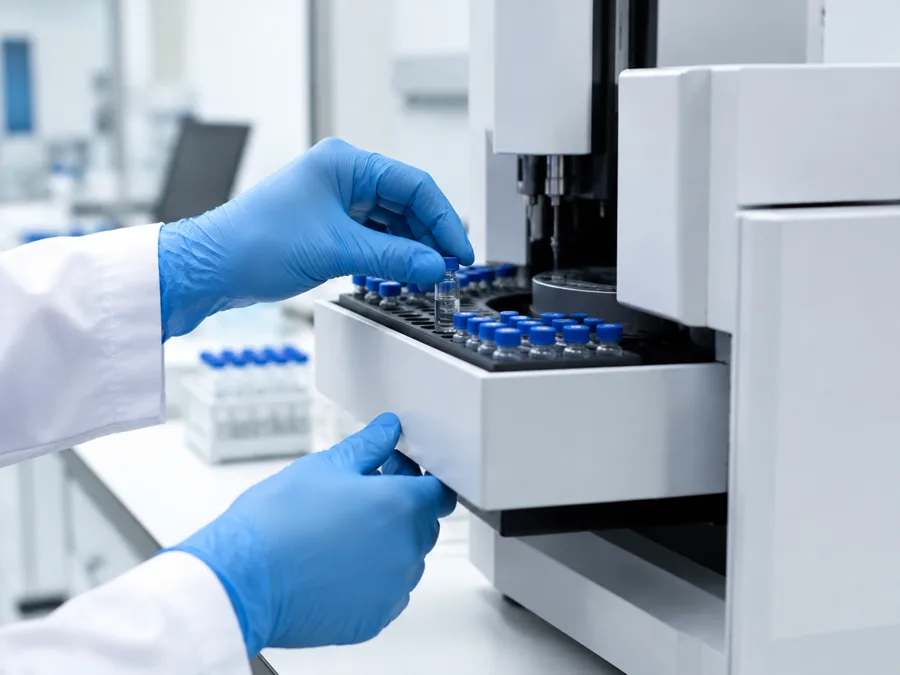
These are all standard analysis methods for semiconductor materials. The key is to measure new and regenerated filters with the same method on the same instrument at the same time, so the numbers can actually be compared. The most convincing test is to install regenerated and new filters on the same tool and compare particle counts on the wafer surface. Fabs usually won't accept lab data alone without an on-tool comparison.
5 things to confirm before adopting regeneration
Is the membrane PTFE?
Not every filter is a good fit. Filters for photoresist, slurry and some dilute acids may use UPE, nylon or polysulfone membranes, and whether those can withstand supercritical CO₂ has to be verified separately. Slurry filters trap inorganic abrasive particles, which CO₂ is not good at dissolving either.
OEM warranty
OEMs usually stop covering a filter once it has been regenerated. Decide up front how responsibility is split if something goes wrong, and who provides proof of quality.
The fab's change management
Switching to regenerated filters is a process change, and most fabs require a change review. Suppliers that deliver chemicals to fabs may also need to notify their customers before switching to regenerated filters.
How many times can it be regenerated?
Passing the first regeneration doesn't mean the second or third will pass too. Track each filter's regeneration count and on-tool performance, and set a maximum before it is retired.
Do the numbers work?
Regeneration pays off best for high-precision, high-cost filters that are replaced often. For cheap coarse filters, regeneration plus testing may cost more than it saves.
The safer approach is to start small. Pick one high-volume filter type whose membrane is confirmed to be PTFE, regenerate and fully test a few used units, and compare them with new ones. Once the data passes, run small quantities on the tool, track them over time and expand step by step.
FAQ
What is chemical filter regeneration?
Chemical filter regeneration means cleaning used semiconductor chemical filters and, once they pass differential pressure, particle, ion, metal and organic carbon tests, putting them back on the tool instead of discarding them after one use.
Why clean filters with supercritical CO₂?
Supercritical CO₂ has no surface tension and low viscosity, so it can get into membrane micropores. Its density is close to a liquid's, so it can dissolve organics. When depressurized it turns straight back into gas, leaving no solvent and requiring no drying, and the CO₂ can be recovered. CO₂'s critical point is about 31 °C and 7.38 MPa, close to room temperature, so it is relatively gentle on plastic membranes.
What tests should regenerated filters go through?
First come non-destructive differential pressure and flow checks to confirm the membrane is neither torn nor clogged. Next are liquid particle counting, ion chromatography (IC), ICP-MS metals analysis and total organic carbon (TOC). Samples also go through tensile testing, FTIR infrared spectroscopy and SEM electron microscopy to confirm the material hasn't degraded. Finally, regenerated and new filters are installed on the same tool and wafer surface particles are compared.
Can every filter be regenerated?
Not necessarily. PTFE membranes are the ones most often evaluated. Filters for photoresist, slurry and similar uses may have UPE, nylon or polysulfone membranes, which must be verified separately. Slurry filters trap inorganic particles, which CO₂ is not good at dissolving.
How does filter regeneration relate to PFAS?
PTFE belongs to the broad PFAS family of fluorinated substances. The EU is reviewing a proposal for a broad PFAS restriction, and in March 2026 the European Chemicals Agency's scientific committees backed a “restriction with targeted derogations.” Each extra use of a filter means one less fluorinated filter made and thrown away.
Source
- Wikipedia, “Ultrapure water,” 2026-10-23. Link
- Wikipedia, “Polytetrafluoroethylene,” 2026-10-23. Link
- Wikipedia, 'Supercritical carbon dioxide', 2026-10-23. Link
- ECHA, “ECHA publishes PFAS restriction proposal,” 2023-02-07. Link
- ECHA, “ECHA's Risk Assessment Committee adopts its opinion on PFAS restriction proposal,” 2026-03-03. Link
- ECHA, “ECHA supports PFAS restriction with targeted derogations,” 2026-03-26. Link