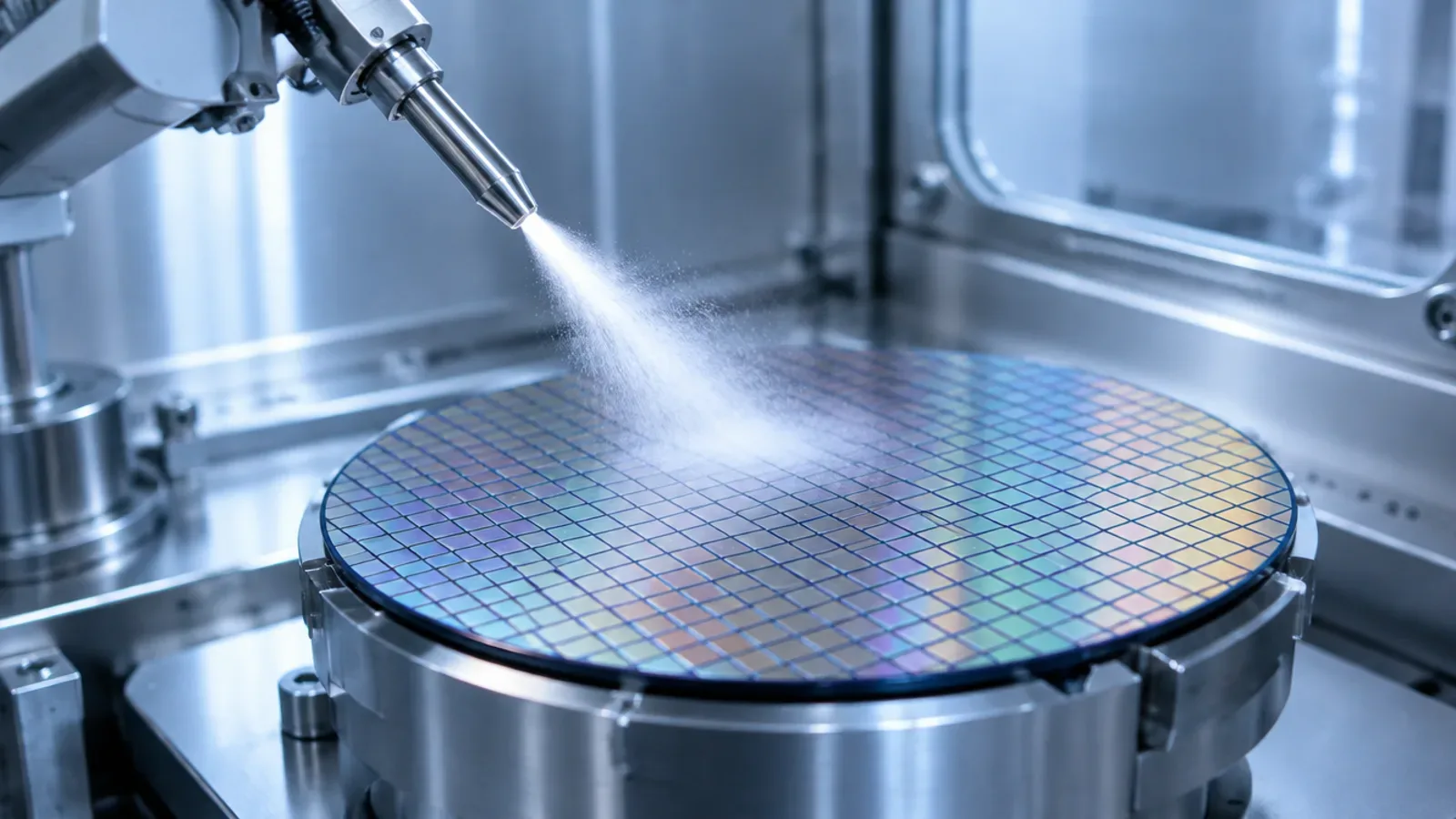
Key takeaways: What is CO₂ snow cleaning, and where does it fit?
CO₂ snow cleaning works by spraying liquid carbon dioxide through a nozzle. The sudden pressure drop turns it into extremely fine CO₂ snow (about −78 °C), which strikes the surface at high speed. It cleans through 4 mechanisms: impact knocks particles off, rapid cooling makes contaminants brittle and loosens them, sublimation expands in volume and lifts contaminants away, and momentary liquid CO₂ at the point of impact dissolves oil films. The snow turns straight into gas, so it needs no water, no chemicals, leaves no residue, and requires no drying. In semiconductors, it suits removing fine particles from wafer surfaces, metal residue on sidewalls after ion milling, and water-sensitive MEMS and precision parts. Before adopting it, consider CO₂ purity, surface condensation, static electricity, and the safety risk of CO₂ building up in enclosed spaces.
3:38 video: how particles become OLED dark spots, plus how CO₂ snow cleaning works and how it started in 1986. For the news roundup, see “iPhone Duo's foldable display and particle cleaning”.
What is CO₂ snow cleaning?
In a nutshell: CO₂ snow cleaning is like "sandblasting with fine sand that vanishes on its own": liquid carbon dioxide is sprayed from a nozzle and turns into ultra-fine CO₂ snow that strikes the surface, knocking off particles and thin oil films; once the snow hits, it sublimates directlyWhat is sublimation?A solid turns directly into a gas without passing through a liquid.That's what dry ice does: left on a table, it doesn't melt into a puddle but slowly "smokes" away. So when CO₂ snow hits a surface, it leaves no liquid behind.into gas, leaving no water, no chemicals, and nothing to dry.
CO₂ in a cylinder or tank is liquid at room temperature under high pressure, and is fed continuously to the nozzle.
As it leaves the nozzle, the pressure drops sharply and it expands adiabaticallyWhat is adiabatic expansion?When a gas or liquid expands suddenly without time to exchange heat with its surroundings, its temperature drops rapidly.It's the same reason a spray can gets cold after long use. Liquid CO₂ rushing from high pressure in the nozzle to atmospheric pressure cools so fast it turns into solid snow.makes the temperature plunge, turning the liquid into fine solid snow plus cold gas.
The snow knocks contaminants off the surface, then sublimates into gas and is exhausted, leaving the surface dry.
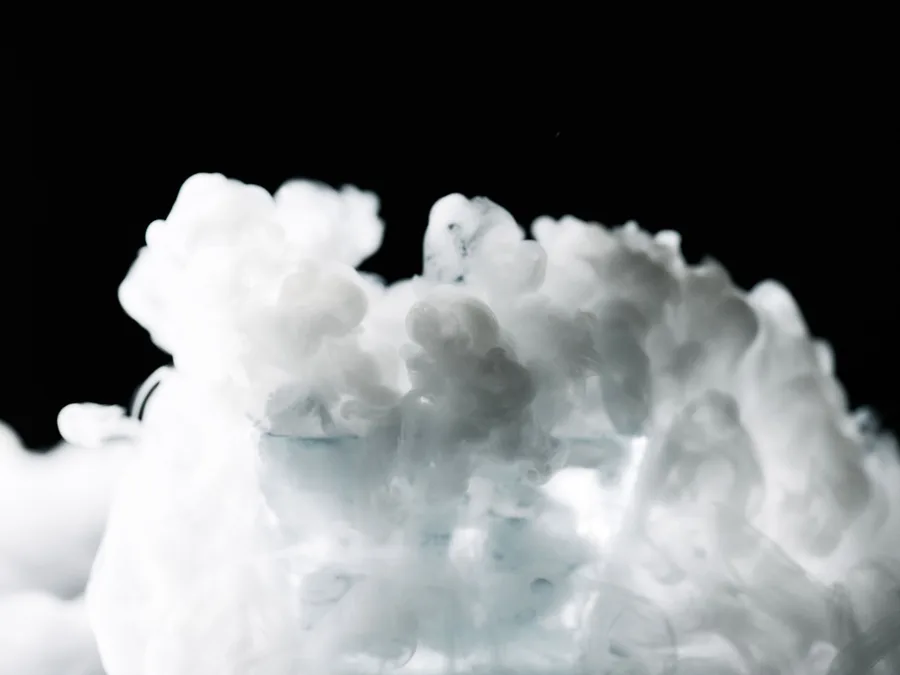
At one atmosphere, carbon dioxide has no liquid phase. Solid dry ice sits at about −78.5 °C and sublimates directly into gas (Wikipedia: Dry ice). CO₂ snow cleaning takes advantage of this: CO₂ in a cylinder is liquid at room temperature under high pressure. It is fed to a specially designed nozzle, and as it exits, the sudden pressure drop cools it rapidly into a jet of solid snow mixed with cold gas.
It's related to the more common industrial dry-ice blasting, but different. Dry-ice blasting fires ready-made dry-ice pellets with compressed air. The pellets are large and hit hard, which suits heavy grime on molds and machinery (Wikipedia: Dry-ice blasting). CO₂ snow, by contrast, forms on the spot inside the nozzle. The particles are extremely fine and much gentler, which suits precision surfaces such as wafers and optical components.
Why does it clean? 4 mechanisms, plus the all-important nozzle
CO₂ snow's cleaning power doesn't come from a single source; four mechanisms act at once. The main one is impact: the snow transfers its kinetic energy to particles on the surface and knocks them loose. The other three help deal with oil films and contamination lodged in crevices. For the principles and applications of CO₂ snow cleaning, see Sherman's academic review (Particulate Science and Technology, 2007).
Effect ①
Impact: knocking particles off
High-speed snow particles strike the surface and transfer kinetic energy to attached particles, which come loose and are carried away by the gas flow. This is the main cleaning force.
Best for: fine, submicron particles
Effect ②
Rapid cooling: making contaminants brittle and loose
At about −78 °C, the snow rapidly cools contaminants so they shrink and turn brittle. Their adhesion to the substrate weakens, and they come off more easily.
Best for: thin oil films and adhesive residue
Effect ③
Sublimation: lifting contaminants from underneath
Snow that works its way into crevices turns directly into gas on the surface. The sudden expansion acts like a push from below, lifting contaminants off the surface.
Best for: contamination stuck in fine gaps and corners
Mechanism ④
Dissolution: carrying off oils along the way
At the moment of impact, a very brief film of liquid CO₂ forms at the contact point. It dissolves oils and organic films and carries them away.
Best for: fingerprints, grease, and other organic residue
With gas blowing, smaller particles are harder to remove, because the gas flow's push on a particle falls off faster than the force holding it to the surface. CO₂ snow hits with "solid particles," so it stays effective on fine submicron particles. That's its biggest advantage in precision cleaning.
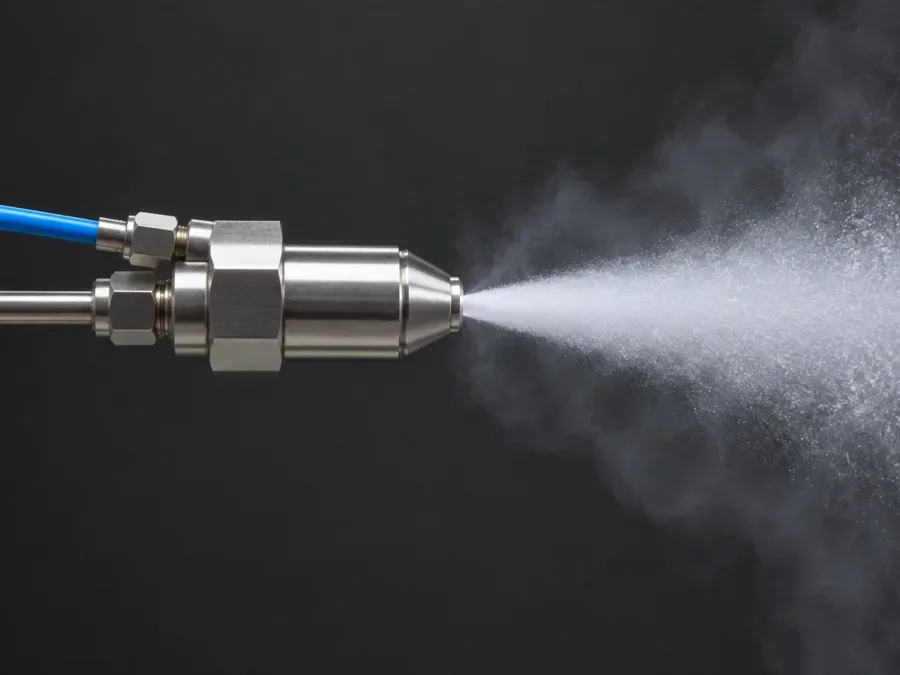
Even with the same CO₂, snow that is too coarse can damage the surface, while snow that is too fine can't dislodge particles, so nozzle design is the core of this technology. Precision cleaning typically uses two-fluid nozzlesWhat is a two-fluid nozzle?A single nozzle delivers two streams at once: liquid CO₂ in the center (which becomes snow) and compressed air or nitrogen in the outer ring.The outer gas acts like a "sheath," accelerating the snow into a tight, focused stream and keeping the snow particle size more consistent.: liquid CO₂ flows through the center to form snow, while an outer ring of compressed air or nitrogen accelerates the snow into a focused, narrow stream.
Nozzle design controls the gas-to-solid ratio in the jet and the size of the snow particles, so the "force" can be tuned to what's being cleaned. On a real production line, several more parameters are adjusted: scan speed (how fast the nozzle moves), nozzle angle (too perpendicular can damage the surface; a slight tilt "sweeps" particles away), workpiece orientation (so the jet follows the direction of the pattern), and workpiece rotation (to clean from every direction and avoid blind spots).
How does it compare with wet cleaning? One table
| CO₂ snow cleaning | Wet cleaning (DI water / chemicals) | |
|---|---|---|
| Dry / wet | Fully dry | Wet |
| Drying needed after cleaning? | No, the snow turns straight into gas | Yes, rinsing must be followed by blow-drying or baking |
| Chemicals and wastewater | No chemicals, no wastewater | Uses chemicals; wastewater and spent chemicals must be treated |
| Residue risk | The snow itself leaves no residue; impurities can stay on the surface if CO₂ purity is too low | Water marks, chemical residue |
| Good at | Fine particles, thin oil films, localized cleaning, water-sensitive components | Large areas, soluble contamination, contamination absorbed into the material |
| Watch for | CO₂ purity, condensation, static, CO₂ concentration monitoring | Water marks, drying, wastewater treatment, chemical compatibility of materials |
One doesn't replace the other. CO₂ snow excels at particles and thin films on the "surface," and can clean just one area. When large amounts of contamination need to be dissolved, or contamination has penetrated the material, wet cleaning is still needed. Many lines use both, for example switching to snow for water-sensitive steps, or using snow to remove particles before wet cleaning.
Where can it be used in semiconductors?
Application ①
Particles on wafer surfaces
A fully automated tool picks wafers from the cassette and moves them into an environment-controlled cleaning chamber, where the nozzle scans the whole wafer along a programmed path. It's dry-in, dry-out, with no rinsing or drying step afterward.
Key: tune scan speed, nozzle angle, and wafer rotation
Application ②
Metal "veils" after etching
Ion millingWhat is ion milling?A dry etching method that uses an accelerated ion beam to physically "blast" material away to form patterns. It's often used for materials that are hard to etch chemically, such as hard disk read/write heads and magnetic devices.Some of the blasted material sticks back onto the photoresist sidewalls, forming a thin ring of metal called a "veil." often leaves a ring of redeposited material on the photoresist sidewalls: a mix of nickel, cobalt, iron, silicon oxide, aluminum oxide, and more. The mix is too complex for chemicals to remove in one pass, and chemicals could damage the device, so CO₂ snow is used to remove it by impact instead.
Key: complex residue that chemicals can't handle well
Application ③
MEMS and other devices with moving structures
MEMSWhat is MEMS?Short for micro-electro-mechanical systems: using chipmaking methods to build tiny moving mechanical structures on silicon, such as swinging cantilevers and vibrating membranes.The accelerometer that detects screen rotation in your phone, the gyroscope used for navigation, MEMS microphones and car airbag sensors are all MEMS.See the full illustrated explanation → contain tiny cantilevers and membranes that can stick together (stiction) as soon as they come into contact with waterWhat is stiction?When tiny moving structures (such as cantilevers and membranes in MEMS) get wet, the water's surface tension during drying "pulls" them down so they stick to the substrate and can no longer move.It's the biggest risk in wet cleaning MEMS, and it can't happen with fully dry CO₂ snow cleaning. as soon as they touch water. CO₂ snow is dry from start to finish, so moving structures don't get stuck.
Key: precision structures that can't tolerate water or residue
Application ④
Optical and Precision Components
The technology has been used for precision cleaning of optical and electronic components for over 30 years. It's also common for parts that can't tolerate water, porous or moisture-absorbing parts, and surface cleaning before coating or bonding on production lines.
Key: parts that can't touch water or show water marks
What they have in common: they can't tolerate water, residue or wet chemicals, yet tiny particles still have to be removed. These needs are increasingly common in advanced packaging, MEMS, sensors and optical components, and this is where CO₂ snow cleaning shines. For other wafer cleaning methods, compare microbubble cleaning and three ways to strip photoresist; for where cleaning sits in the overall process, see the semiconductor process flowchart. CO₂ can also be used for dry ice blasting and supercritical cleaning — see three CO₂ cleaning methods compared for how to choose; for an overview of dry and wet cleaning methods, see dry cleaning vs wet cleaning.
What does the equipment look like? From handheld to fully automated
CO₂ supply
A cylinder or liquid tank supplies liquid CO₂ continuously. A filter removes impurities, and a cooling unit keeps the CO₂ stable in its liquid state so snow quality stays consistent.
Compressed air or nitrogen
Supplies the outer-ring gas flow of the two-fluid nozzle, which accelerates and focuses the snow. Precision applications typically use clean dry air or nitrogen.
Nozzle and motion system
Handheld units are held by an operator. Integrated units mount the nozzle on a robot arm or linear stage that scans the workpiece along a programmed path. Fully automated wafer tools pick wafers from the cassette, clean them, and return them.
CO₂ concentration monitoring
Monitors CO₂ concentration in the work area and triggers audible and visual alarms, or automatically shuts off the CO₂ supply, when it exceeds a set level.
According to publicly available equipment catalogs, integrated modules can be configured with 1 to 24 nozzles. Each nozzle uses about 0.07–0.14 kg of CO₂ per minute, the optimal nozzle-to-workpiece distance is about 80–200 mm, and travel speed can reach 1,000 mm per second. The actual number of nozzles and parameters should be designed around workpiece size, contaminants, and throughput needs.
5 things to check before adopting it
CO₂ purity
Impurities in ordinary industrial-grade CO₂ deposit on the surface along with the snow, so you contaminate as you clean. Precision applications need high-purity CO₂ with filtration at the supply.
Surface condensation
Once the snow cools the workpiece, moisture in the air can condense on the surface and leave water marks. Keep the cleaning environment dry, and heat the workpiece or use heated gas if needed.
Static electricity
High-speed snow impact can charge the surface, and the static then attracts particles back. Use grounding or ionizers; this matters especially for plastics and insulating materials.
CO₂ safety
CO₂ is heavier than air. High concentrations cause headaches, dizziness, and even loss of consciousness, and buildup in enclosed spaces can cause asphyxiation. The UK HSE sets workplace exposure limits of 5,000 ppm as an 8-hour average and 15,000 ppm as a 15-minute average (HSE). Work areas need exhaust ventilation and concentration monitoring.
Can the material handle low temperatures?
At about −78 °C, the snow makes the surface temperature drop sharply. For temperature-sensitive materials or structures, confirm they can tolerate it first, then adjust nozzle distance, angle, and dwell time.
The most practical approach is to run sample tests first: clean real workpieces with real contamination at different nozzle angles, distances, and speeds, and measure particle counts, surface condition, and temperature change before and after. Once results and safe conditions are confirmed, decide between handheld, integrated modules, or a fully automated tool.
FAQ
What is CO₂ snow cleaning?
CO₂ snow cleaning (CO₂ Snow Jet) sprays liquid carbon dioxide through a nozzle, where the sudden pressure drop turns it into extremely fine CO₂ snow. The snow strikes the surface at high speed and removes particles and oil films through impact, rapid cooling, sublimation, and dissolution. After impact, the snow turns straight into gas, so no water, chemicals, or drying are needed.
Is CO₂ snow cleaning the same as dry-ice blasting?
The principle is similar, but the uses differ. Dry-ice blasting fires ready-made dry-ice pellets with compressed air. The pellets are large and hit hard, which suits heavy grime on molds and machinery. CO₂ snow forms on the spot inside the nozzle, turning liquid CO₂ into extremely fine snow with a gentler force, which suits precision surfaces such as wafers and optical components.
Can CO₂ snow cleaning damage wafers or part surfaces?
The snow particles are very fine, and cleaning relies mainly on impact to carry particles away, making it a gentle dry cleaning method. Too much force or too perpendicular an angle can still damage fine structures, so tune the nozzle design, angle, distance, and scan speed, and confirm with sample tests on real workpieces first.
Does CO₂ snow cleaning leave residue?
The snow itself sublimates directly into gas and leaves no residue. What matters is CO₂ purity: impurities in ordinary industrial-grade CO₂ deposit on the surface along with the snow, so precision applications need high-purity CO₂ with filtration. Also, a cooled workpiece can collect condensation, so keep the cleaning environment dry.
Is cleaning with CO₂ safe?
CO₂ isn't flammable, but it's heavier than air. At high concentrations in enclosed spaces, it can cause headaches, dizziness, and even asphyxiation. The UK HSE sets workplace exposure limits of 5,000 ppm as an 8-hour average and 15,000 ppm as a 15-minute average. Work areas need exhaust ventilation and CO₂ concentration monitoring with alarms or automatic shutoff.