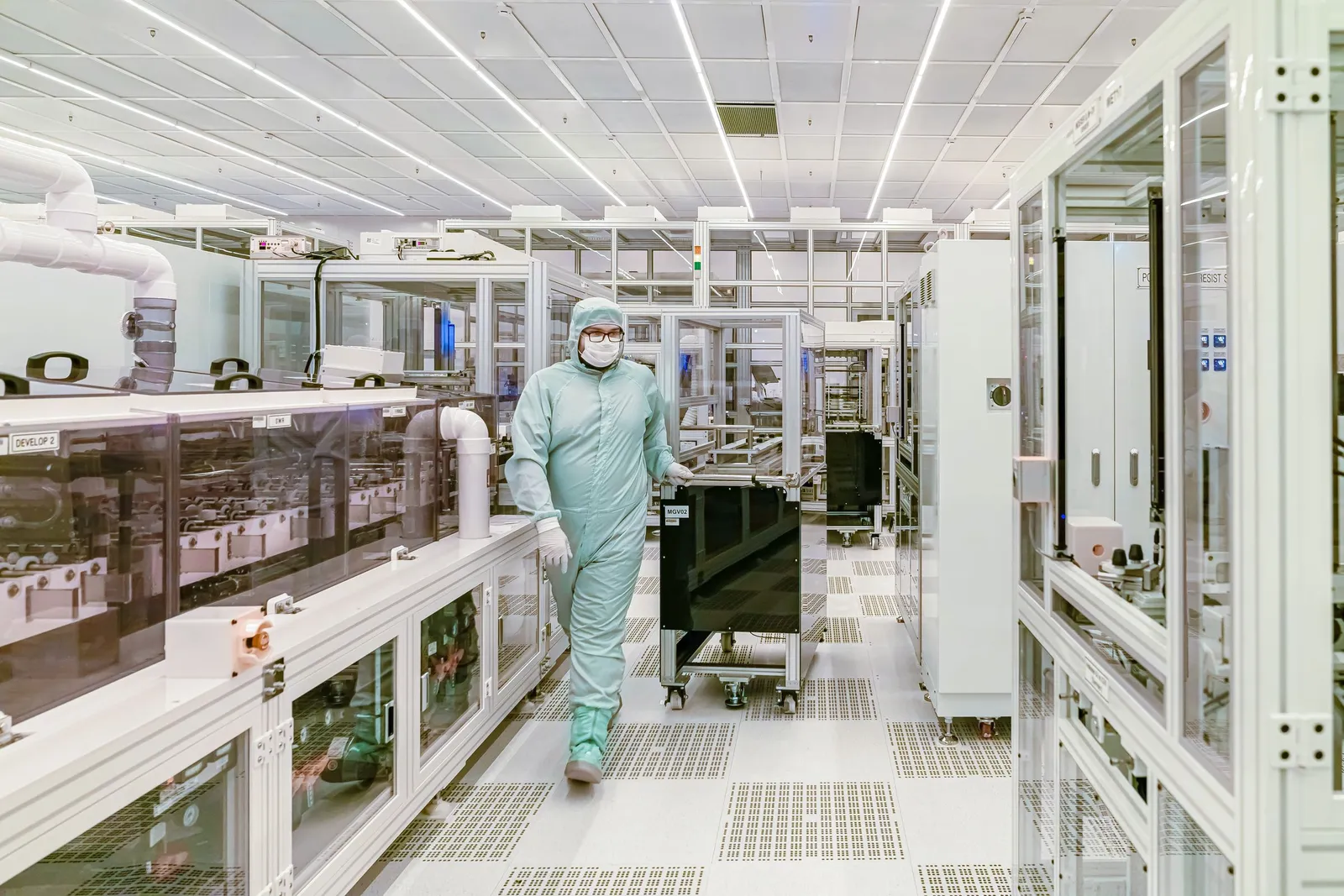
Key takeaways: What is microbubble cleaning, and does it work in semiconductor manufacturing?
Microbubbles are tiny bubbles 1–100 µm in diameter (under the ISO definition of fine bubbles, those smaller than 1 µm are called ultrafine bubbles). They rise very slowly through water and gradually shrink and dissolve. Their charged surfaces attract contaminants, and they release OH radicals when they collapse. Academic studies have shown that combining microbubbles with ozone speeds up photoresist stripping and can even remove resist that has hardened after high-dose ion implantation. Semiconductor applications include photoresist stripping, wafer cleaning, equipment parts cleaning, and cleaning of wafer carriers such as FOUPs. The goal is to use ultrapure water plus gas to reduce the use of aggressive chemicals. Microbubble equipment for semiconductor use must have metal-free wetted parts. Results depend on the contaminant type, the choice of gas, and whether the flow rate and pressure differential across the nozzle are properly matched, so confirm performance with side-by-side tests on your own process before adopting it.
What are microbubbles, and how do they differ from ordinary bubbles?
Bubbles smaller than 100 µm in diameter are collectively called fine bubbles. Those at least 1 µm but under 100 µm are microbubbles, and those under 1 µm are ultrafine bubbles (often called nanobubbles). These terms are standardized by ISO, and Japan's Fine Bubble Industries Association (FBIA) publishes an easy-to-follow explanation (FBIA).
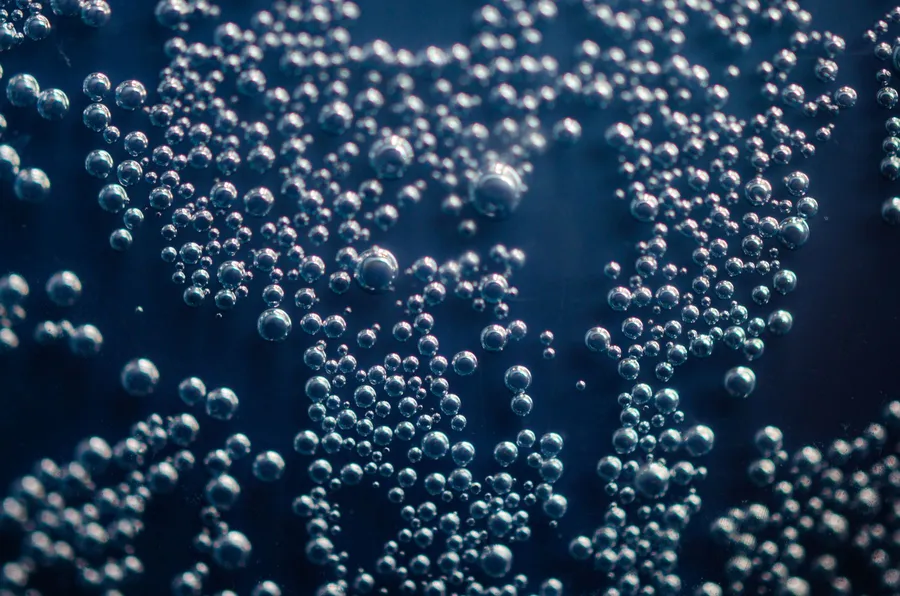
Visible bubbles (millimeter scale) have strong buoyancy and quickly float up and burst. Microbubbles are so small that their buoyancy is weak, so they rise very slowly. Meanwhile the gas inside dissolves into the water, shrinking the bubble until it disappears. Freshly generated microbubble water looks milky white, then turns clear again once the bubbles have dissolved.
| Ordinary bubbles | Microbubbles | Ultrafine bubbles (nanobubbles) | |
|---|---|---|---|
| Diameter | About 0.1 mm or larger | 1~100 µm | Under 1 µm |
| Behavior in water | Float up quickly and burst | Rise slowly, shrinking as they dissolve | Barely rise; can stay in water for a long time |
| To the naked eye | Individual bubbles visible | Water looks milky white | Clear; visible only with laser scattering |
| Role in cleaning | Agitation | Adsorb and lift off contaminants; generate radicals when collapsing | Penetrate tiny gaps; act over a long time |
Why do microbubbles clean? Three mechanisms
In one sentence: microbubbles attract contaminants, dissolve gas into the water, and when they finally collapse, they release free radicals that break down residue.
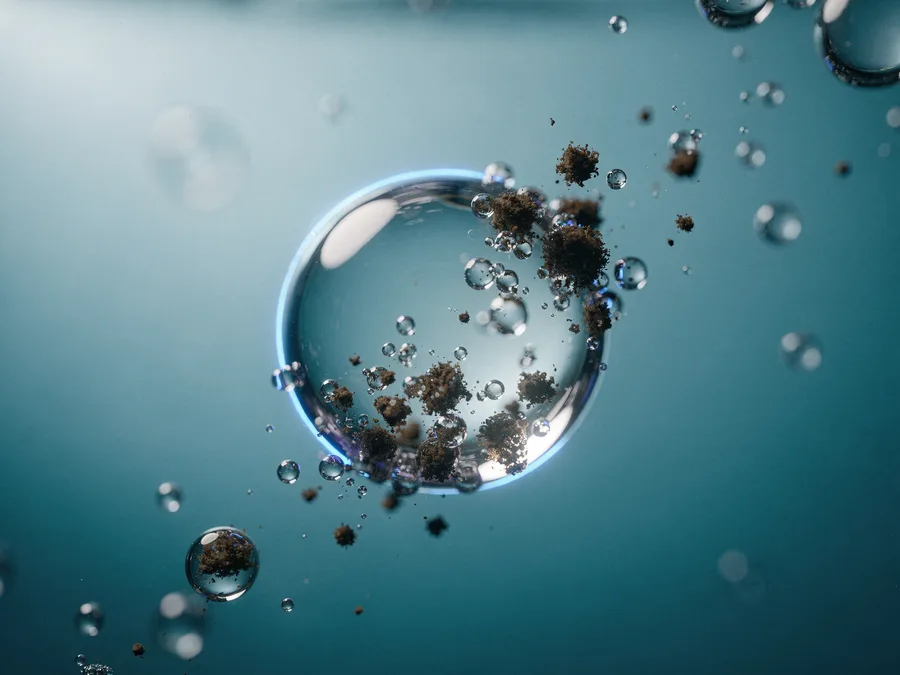
Effect ①
Pulling in contaminants like a magnet
The surface of each microbubble carries an electric chargeWhat is electric charge?It's the electrical property that makes things attract or push each other away. Rub a balloon on your hair, and it can lift your hair up.There are only two kinds of charge: positive (+) and negative (−). Opposite charges attract; like charges repel.An object becomes negatively charged when it gains electrons, and positively charged when it loses them.Microbubble surfaces are typically negatively charged, so dirt particles readily stick to them. And because every bubble carries a negative charge, they push each other apart instead of merging into large bubbles, so the water keeps a large number of tiny bubbles., so fine particles and oil in the water are drawn to the bubbles, stick to them, and are carried away with the flow. Because the bubbles repel one another instead of merging into larger ones, the water always has a large number of tiny bubbles at work.
Why it matters for cleaning: particles are less likely to redeposit on the surface
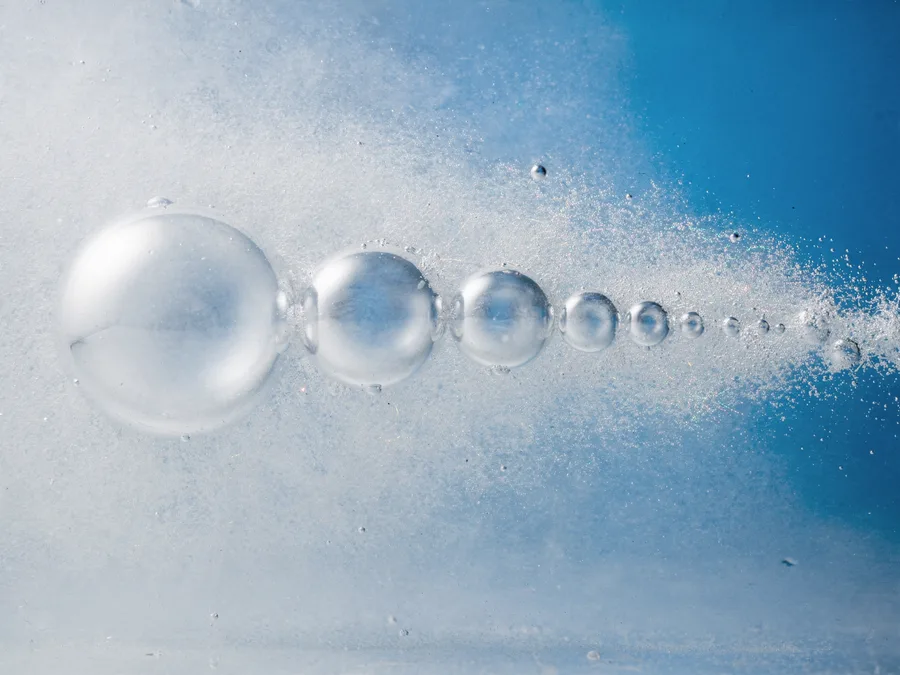
Effect ②
Shrinking smaller and smaller, "squeezing" gas into the water
Ordinary bubbles rise quickly to the surface and burst, so their gas escapes into the air and is wasted. Microbubbles rise very slowly and gradually shrink in the water, so nearly all the oxygen or ozone inside them dissolves into the water. Freshly made microbubble water looks milky and cloudy because of these tiny bubbles.
Why it matters for cleaning: more of the same gas ends up dissolved in the water
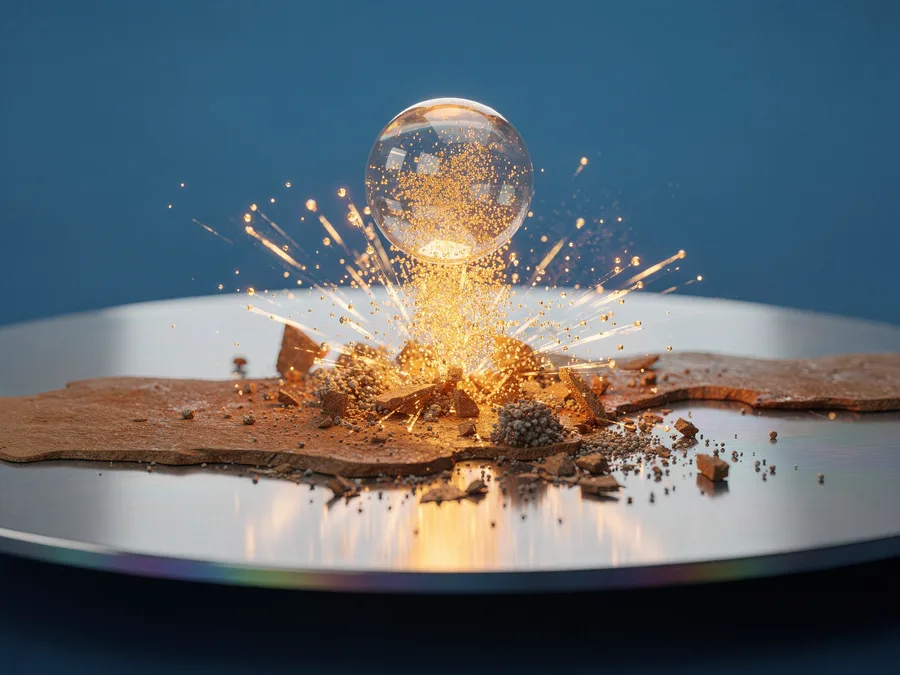
Effect ③
Releasing residue-breaking free radicals the moment they collapse
As a bubble shrinks and finally disappears, it releases OH radicals into the waterWhat is an OH radical?It is made of one oxygen atom and one hydrogen atom, but it is missing one electron, so it strongly "wants" to grab an electron from another molecule. When an organic molecule has an electron taken this way, its chemical bonds break and it gets broken down. That is oxidation.Its oxidation potential is about 2.8 V, higher than ozone (about 2.07 V) and hydrogen peroxide (about 1.78 V).It lasts only a very short time and reacts almost as soon as it forms. It only acts at the spot where the bubble collapses and leaves nothing behind in the water.It is not the same thing as the OH⁻ (hydroxide ion) found in alkaline water.See the full illustrated explainer →. These radicals are strong oxidizers that gradually break down organic contaminants stuck to surfaces, such as photoresist residue. Research has confirmed that no ultrasound is needed. It happens on its own when the bubbles collapse.
Why it matters for cleaning: organic residue is broken down chemically, not scrubbed off
All images are AI-generated illustrations
Effect ③ is the main reason microbubbles are getting so much attention in semiconductor cleaning (for what an OH radical is, see this plain-language illustrated explainer). A 2007 study by Takahashi et al. in J. Phys. Chem. B found that radical generation is linked to the rising ion concentration at the bubble interface as the bubble shrinks (Takahashi et al., 2007). In 2015 they went further and found that adding microbubbles to ozonated water greatly speeds up photoresist stripping. This comes from a higher dissolved ozone concentration plus radicals generated directly by the microbubbles. The method even removed high-dose ion-implanted photoresist, whose surface has hardened into a crust that ordinary ozonated water or chemicals can barely remove (Takahashi et al., 2015).
Note that the "gentleness" of microbubbles is different from ultrasonics. Ultrasonic and megasonic cleaning lift off particles through the impact of cavitation bubbles collapsing instantly; the force is strong but can damage fine patterns. Microbubbles shrink and collapse slowly over several minutes, relying on adsorption and radicals rather than impact. This also means that for firmly attached, hard contaminants, microbubbles are not necessarily more effective than methods with stronger physical force. It depends on the type of contaminant.
How Are Microbubbles Generated? What to Look for in Semiconductor-Grade Equipment
There are several ways to generate microbubbles. Common methods listed by Japan's Fine Bubble Industries Association (FBIA) include swirling flow, venturi/ejector, fine-pore, and pressurized dissolution (FBIA). Pressurized dissolution is the most widely used method in semiconductor cleaning:
- ① Pressurized dissolution→A pump pressurizes gas and ultrapure water together, dissolving a large amount of gas into the water to form a supersaturated solution
- ② Rapid depressurization at the nozzle→Pressure drops sharply at the nozzle, and gas that can no longer stay dissolved comes out as large numbers of micro- and nanobubbles
- ③ Applied to the target→The microbubble water is sprayed or flowed directly onto wafer, part, or carrier surfaces
| Method | Principle | Characteristics for semiconductor cleaning |
|---|---|---|
| Pressurized dissolution | Gas is dissolved under pressure, then released by rapid depressurization | High bubble density and small bubble size; can be built with metal-free wetted parts; the mainstream choice for semiconductor cleaning |
| Swirling flow | A high-speed swirling liquid flow shears gas into bubbles | Simple design and high flow; mostly used in water treatment, agriculture, and aquaculture |
| Venturi / ejector | A constriction in the flow path causes a sharp pressure change that breaks up bubbles | Can be installed inline; bubble density is usually lower |
| Fine-pore | Gas is dispersed through extremely fine pores | Compact, but pores clog easily and bubble size is harder to control |
Microbubble equipment for semiconductor use has several requirements that general industrial equipment does not:
No metal in wetted parts
Front-end processes are highly sensitive to metal impurities. Pumps, tanks, piping, and fittings must be made of fluoropolymers such as PFA and PTFE, and both the gas and ultrapure water lines need filters.
Pressure differential determines bubble volume
Pressurized dissolution relies on the pressure differential across the nozzle to release bubbles. The closer the outlet is to atmospheric pressure, the larger the differential and the more bubbles you get. When the cleaning tool's flow rate changes or back pressure rises, bubble volume drops.
The closer to the nozzle, the better
Microbubbles merge and dissolve as they travel through piping, so the gas-liquid mixing fitting should be installed as close to the nozzle as possible, with the shortest practical piping run.
Match the flow rate to the cleaning tool
The microbubble generator's design flow rate must match the actual flow used at each step of the cleaning tool. Excess flow needs a return path, or it will build up as back pressure.
Where is microbubble cleaning used in semiconductor manufacturing?
A 2018 review by Takahashi in the journal of the Japan Society of Vacuum and Surface Science identified microbubbles as a strong candidate for removing hardened (crusted) photoresist in single-wafer spin cleaning without substrate loss (Takahashi, 2018). Based on published research and industry data, the main application areas today are as follows:
| Applications | Gas used | Problem addressed | Maturity |
|---|---|---|---|
| Photoresist stripping (including hardened crust resist after ion implantation) | Ozone | Reduce use of harsh chemicals such as hot sulfuric acid–hydrogen peroxide mixture (SPM) | Academic papers and patents exist; a front-end process evaluation topic |
| Wafer cleaning (substrate, front-end, back-end) | Nitrogen, oxygen, ozone | Particles, metal impurities, organic residue | Under evaluation at various fabs; process-dependent |
| Equipment parts cleaning (resin, metal, ceramic) | Oxygen, nitrogen | Grease, particles, ionic residue | Already in practical use |
| Cleaning wafer carriers such as FOUPs/FOSBs | Oxygen, ozone | Particles and AMC (airborne molecular contamination, such as VOCs and NH₃) inside the carrier | Under industry evaluation; results depend on integration with the cleaning tool |
Photoresist stripping: using less SPM
In the front end, photoresist has to be removed after every lithography, etch, or ion implantation step. The conventional methods are hot sulfuric acid–hydrogen peroxide mixture (SPM) or plasma ashing. Ozone microbubbles speed up resist stripping with ozonated water. In studies they have even removed resist whose surface hardened into a crust after implantation, which makes them one way to cut strong acid use.
Wafer cleaning: gently removing particles and organics
In single-wafer spin cleaning, microbubbles work through adsorption and radical action rather than the instantaneous impact that ultrasonics rely on. Researchers believe they may be able to remove contamination without substrate loss, which suits advanced processes with ever finer linewidths and more fragile structures.
Equipment parts cleaning: chamber parts and fixtures
Parts from etch and deposition tools (resin, metal, ceramic, quartz) have to be removed and cleaned regularly. Microbubbles can remove oils, particles, and ionic residues and put less stress on materials than aggressive chemicals.
Wafer carrier cleaning: FOUPs and FOSBs
Particles, photoresist debris and AMC (airborne molecular contamination such as VOCs and NH₃) left inside a FOUP can contaminate wafers during transport. Microbubbles can be added to the spray or rinse steps of an existing FOUP cleaner: oxygen microbubbles handle general contamination, while ozone microbubbles target organic residue. How well this works depends on whether the generator's flow rate and pressure differential match the cleaner's. Before adopting it, run a with/without-microbubble comparison test on the same tool.
Across the full process flow: photoresist stripping and wafer cleaning recur throughout the front end, and you can see where each step sits in the front-end process flow chart; the whole process from crystal growth to back end is in the semiconductor process flow chart. For flux residue in back-end packaging, chemical spray cleaning is still mainstream (see Deflux flux cleaning); there is no published volume-production data for microbubbles at this stage yet.
Microbubbles are also often discussed in an ESG context: they mainly use DI water plus gas, so if they can replace or reduce some strong acid and alkali chemicals, they cut chemical use, wastewater treatment, and water consumption at the same time. But "how much can be saved" must be calculated from controlled tests on your own process. Don't simply borrow someone else's numbers.
Before adopting microbubble cleaning, confirm these 5 things
Define what you need to remove
Particles, organics (VOCs), alkaline gases (NH₃), photoresist, and ionic residue each call for different gases and methods. For firmly attached hard contaminants, microbubbles are not necessarily more effective than methods with stronger physical force.
Get the cleaning tool's flow and pressure profile
How many L/min each step uses, the nozzles' pressure-flow characteristics, and how the valves switch. The microbubble generator must be designed around these numbers, not chosen on a "bigger is better" basis.
Choose the gas: oxygen, nitrogen, or ozone
Ozone is the strongest for removing organics, but 100 ppm ozonated water releases about 2 mg/m³ of ozone gas, requiring a sealed chamber, local exhaust, an ozone destruct unit, and gas detectors, plus wastewater treatment. Many fabs simply prohibit ozone, so ask first.
Plan the installation location and utilities
The fitting should be as close to the nozzle as possible. A 20 L/min-class system, for example, needs about 25 L/min of ultrapure water at 0.2 MPa, 3–5 L/min of gas at 0.25 MPa, compressed drive air at 0.6 MPa, and a 220 V power supply. If space inside the tool is limited, fittings and piping need to be custom designed.
Always run a controlled test
Same tool, same procedure, with the only difference being microbubbles on or off, measuring the same set of metrics (particle count, TVOC, NH₃, surface damage). Removal rates without a control group should not be used as the basis for adoption.
Further reading: Three photoresist stripping methods compared, Ozone water uses and safety regulations, How to choose a micro-nano bubble generator.
FAQ
What is the difference between microbubbles and nanobubbles?
Under the ISO definition, bubbles at least 1 µm but under 100 µm are microbubbles, and those under 1 µm are ultrafine bubbles (often called nanobubbles). Microbubbles slowly shrink and dissolve, turning water milky white; nanobubbles are invisible to the naked eye, barely rise, and can stay in water much longer.
What Are OH Radicals (Hydroxyl Radicals) and Why Do They Clean?
An OH radical (·OH, hydroxyl radical) is made of one oxygen atom and one hydrogen atom but is missing one electron. It takes electrons from other molecules, which breaks the chemical bonds of organic compounds and decomposes them. Its oxidation potential is about 2.8 V, stronger than both ozone and hydrogen peroxide. It is extremely short-lived and reacts as soon as it forms, so it leaves no residue in the water. It is different from the OH⁻ (hydroxide ion) in alkaline water.
Can microbubble cleaning replace chemicals?
It depends on the contaminant and the process. Academic research has shown that ozone microbubbles speed up photoresist removal and can even remove crusted resist after ion implantation, so there is a chance to cut some harsh chemical use; in one major chipmaker's evaluation, stripping was about 50% faster at the same ozone concentration (see the case study). But how much chemical you can cut must be determined by controlled tests on your own process, not by applying someone else's numbers.
Will microbubble cleaning damage wafers or FOUPs?
Microbubbles shrink and collapse slowly over several minutes and clean through adsorption and radical action. Ultrasonics rely on the impact of cavitation bubbles collapsing instantly, so microbubbles are generally considered gentler on surfaces. When using ozone microbubbles, separately confirm that the wafer films and carrier materials can withstand oxidation.
How do you install microbubble cleaning equipment on an existing cleaning tool?
The usual approach is to install the gas-liquid mixing fitting on the cleaning tool's nozzle supply line, as close to the nozzle as possible. The generator's flow rate must match the actual flow at each step of the cleaning tool, and a return path is needed to avoid back pressure. Without enough pressure differential, bubbles will not form.
Source
- Fine Bubble Industries Association (FBIA), "ファインバブルとは? (What Are Fine Bubbles?)", 2026-10-23. Link
- The Journal of Physical Chemistry B, 111, 1343–1347, "Free-Radical Generation from Collapsing Microbubbles in the Absence of a Dynamic Stimulus (Takahashi, Chiba, Li)", 2007-01-25. Link
- Journal of Photopolymer Science and Technology, 28(2), 293–298, "Effect of Microbubbles on Ozonized Water for Photoresist Removal (Takahashi, Horibe, Matsuura, Tatera)", 2015-05-11. Link
- 表面と真空 (Vacuum and Surface Science), 61(2), 64–69, "Fundamental Properties of Microbubble in Semiconductor Cleaning Technology (Takahashi)", 2018-02-10. Link
- Fine Bubble Industries Association (FBIA), "ファインバブルの作り方 (How Fine Bubbles Are Generated)", 2026-10-23. Link