Key takeaways: how much faster do ozone microbubbles strip photoresist than ozone water?
In a major semiconductor maker's evaluation, at the same 80 ppm ozone concentration with single-wafer spin spraying, ozone microbubbles stripped photoresist at approx. 3,370 Å/min versus approx. 2,150 Å/min for ordinary ozone water — about 50% faster. Lab tests also showed that adding microbubbles at the same temperature made stripping roughly 2–3 times faster than ozone water; raising the ozone concentration doubled the rate again; and resist hardened by phosphorus ion implantation was completely removed in 3 minutes without ashing. The chipmaker figures are test data from our customer, and the lab tests are the manufacturer's data; actual results must be confirmed with a controlled trial on your own resist and process.
Why look for photoresist stripping methods other than SPM?
Conventional photoresist stripping takes 4 process steps and 2 tools: a plasma asher burns off most of the resist, then a wet tool soaks the wafer in hot sulfuric acid–hydrogen peroxide, followed by a hot-water rinse and an ultrapure-water rinse. This carries three burdens: large volumes of sulfuric acid waste must be recovered and treated, 120℃ chemicals are a safety risk, and the plasma used in ashing can damage devices. For a full comparison of the three stripping methods, see “How photoresist stripping works”.
The new process we propose strips the resist directly with 60℃ ozone microbubble water (ozone gas + CO₂ gas + ultrapure water), followed by a room-temperature ultrapure-water rinse. The CO₂ adjusts the water's resistivity to prevent static build-up while the wafer spins.
| Item | Conventional | Ozone microbubbles |
|---|---|---|
| Process | Plasma ashing → SPM 120℃ → hot-water rinse 80℃ → ultrapure-water rinse | Ozone microbubbles 60℃ → ultrapure-water rinse |
| Process steps | 4 | 2 |
| Tools | 2 (asher + stripper) | 1 |
| Chemical | Sulfuric acid, hydrogen peroxide | No acid or alkali chemicals |
| Process temperature | SPM approx. 120℃ | 60℃ |
| Ashing damage | At risk | No ashing |
The process comparison is our proposed alternative; whether it can replace the entire sequence depends on resist type, thickness and underlying materials.
A major chipmaker's Si wafer evaluation: same concentration, 50% faster
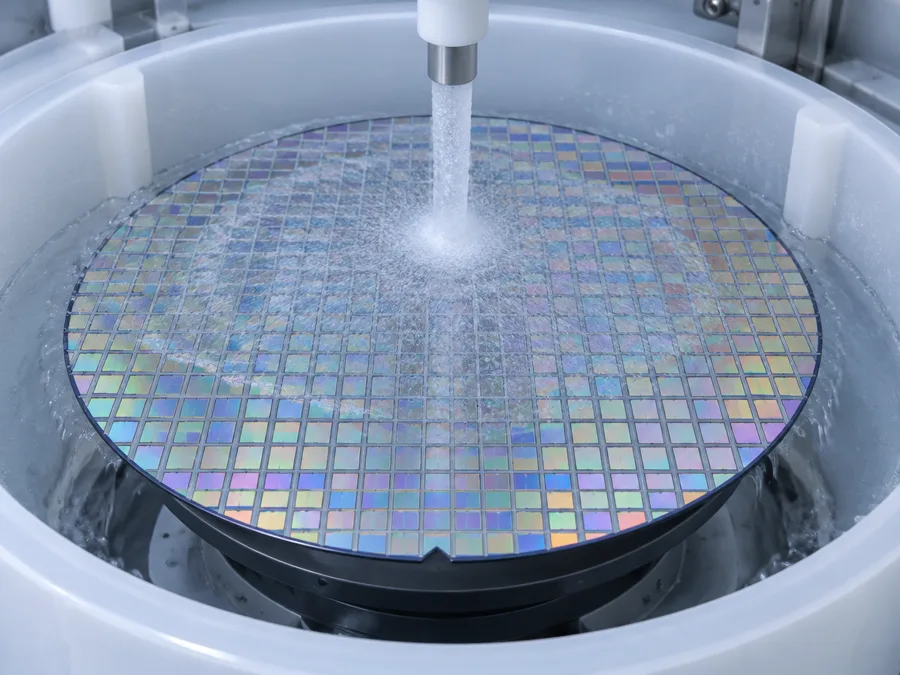
This test changed only one variable: both used 80 ppm ozone, one as ordinary ozone water and one as ozone microbubbles, with all other conditions identical, comparing how thick a layer of resist each removed per minute.
Unit: Å/min (ångströms per minute; 1 µm = 10,000 Å). Approx. 3,370 Å/min equals removing about 0.34 µm of resist per minute.
| Item | Condition |
|---|---|
| Wafer | Si wafer (resist-coated) |
| Spin speed | 300 rpm |
| Flow rate | 1 L/min |
| Nozzle | Center dispense |
| Ozone concentration | 80 ppm (same for both) |
| Temperature | 24℃ |
| Result | Strip rate up about 50%; judged able to replace the conventional process |
Lab tests: how much do temperature, concentration and microbubbles each contribute?
A separate test on novolac resist compared three variables separately — heating, adding microbubbles, and raising the ozone concentration:
Unit: nm/min. Sample: novolac resist. This test used different resist and equipment from the chipmaker evaluation above, so the two sets of figures cannot be compared directly.
It reads simply: heating doubles the speed of ozone water, but adding microbubbles has an even bigger effect (from approx. 40 to approx. 110 nm/min even at room temperature); temperature and microbubbles stack, and raising the ozone concentration doubles the rate again. Temperature and concentration are two independent levers, so a trial can find the optimum for each separately.
Hardened resist after ion implantation: removed in 3 minutes without ashing
During ion implantation, high-energy ions turn the resist surface into a hard, dense crust that ordinary wet stripping struggles to penetrate, which is why the conventional process always ashes first. The test used wafers with patterned resist implanted with phosphorus ions:
| Item | Details |
|---|---|
| Sample | Wafer with patterned resist, phosphorus ion implantation (dose 1E15, energy 60 keV) |
| Pretreatment | No ashing |
| Cleaning method | Ozone microbubbles |
| Cleaning time | 3 minutes |
| Result | Resist completely removed under the microscope |
The higher the implant dose and energy, the thicker the crust; resist from different conditions needs its own trial.
3 lessons from this data
- Compare at the same concentration: the chipmaker's evaluation fixed ozone at 80 ppm, so the difference can be attributed to the microbubbles rather than to stronger ozone.
- Tune temperature, concentration and microbubbles separately: all three speed up stripping; testing them separately in a trial shows which is most cost-effective.
- Implanted resist shows the difference best: many methods can remove ordinary resist; whether hardened resist can be removed without ashing is what decides whether the asher can be eliminated.
For why ozone microbubbles can break down organic matter, see “What is the hydroxyl radical”.
Data sources and limitations
The chipmaker data on this page is test data from our customer's evaluation period (c. 2019), and the lab test data was provided by the manufacturer; the evaluation was still in progress at the time, and customer names are withheld under confidentiality.
Figures were read from the original charts and are approximate. DEYly has not independently retested them, and actual results will vary with contaminants, materials, equipment and process conditions; before adopting, please confirm with a controlled trial on your own samples.
FAQ
How much faster do ozone microbubbles strip photoresist than ordinary ozone water?
In a major semiconductor maker's Si wafer evaluation at the same 80 ppm ozone concentration, ozone microbubbles stripped at approx. 3,370 Å/min versus approx. 2,150 Å/min for ordinary ozone water — about 50% faster. In lab tests on novolac resist, adding microbubbles at the same temperature made stripping roughly 2–3 times faster than ozone water.
Can resist be removed after ion implantation without ashing?
In lab tests, patterned resist implanted with phosphorus ions (dose 1E15, energy 60 keV) was completely removed in 3 minutes with ozone microbubbles, without ashing. Different doses and energies form crusts of different thickness, so trial your own samples.
Can ozone microbubbles fully replace SPM and ashing?
The process we propose uses 60℃ ozone microbubbles plus an ultrapure-water rinse to replace ashing, SPM and the hot-water rinse, cutting the steps from 4 to 2. Whether it can fully replace them depends on resist type, thickness, underlying materials and throughput requirements; we recommend a controlled trial first.
Which semiconductor maker's data is this?
Customer names are withheld under confidentiality. This is our customer's data from the c. 2019 evaluation period, when the chipmaker was conducting a final evaluation aimed at adoption.