Key takeaways: What is ozone water, and how is it used in semiconductor cleaning?
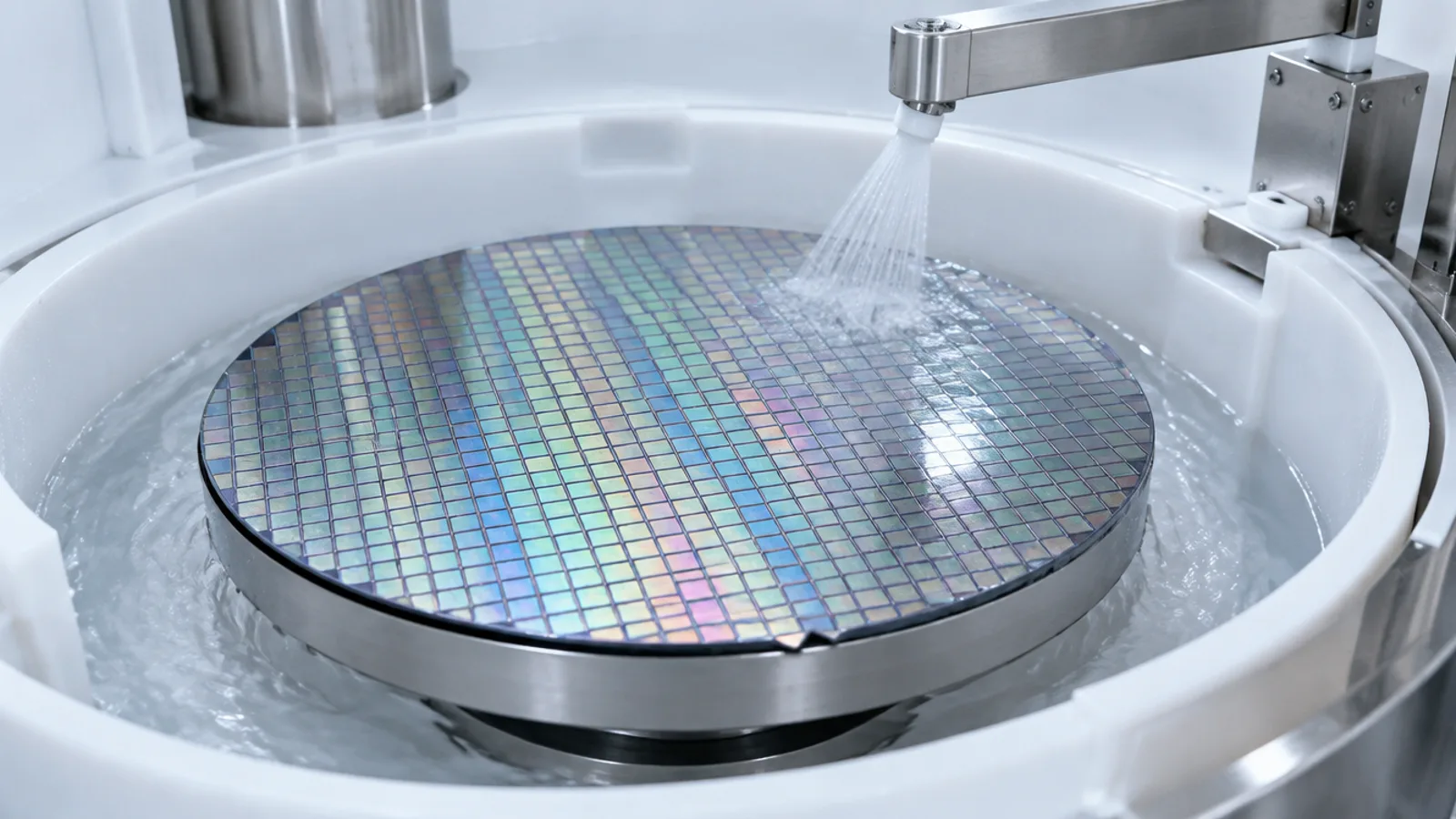
Ozone water is a functional water made by dissolving ozone (O₃) in ultrapure water, with concentration usually expressed in ppm. Ozone is a strong oxidizer, and as it decomposes in water it also produces even more powerful OH radicals, which oxidize and break down organic contaminants such as photoresist and grease; the ozone ultimately reverts to oxygen, leaving no chemical residue. Semiconductor fabs use it for photoresist stripping, organic contamination removal and sterilization, with the aim of reducing use of hot sulfuric acid-hydrogen peroxide mixture (SPM). Its limitations are that ozone decomposes quickly in warm water (half-life about 15 minutes at pH 7, 25℃) and escapes into the air: Taiwan's Ministry of Labor sets the 8-hour permissible concentration at 0.1 ppm (0.2 mg/m³), so equipment must have a sealed chamber with local exhaust, ozone destruction for exhaust and drain, ozone detection with interlocked shutdown, and oxidation-resistant materials.
What is ozone water?
In one sentence: ozone water is ozone dissolved in ultrapure water, with concentration usually expressed in ppmWhat is ppm?It means “parts per million” and is used to express very dilute concentrations.Ozone water labeled 10 ppm has about 10 mg of ozone dissolved in 1 liter of water; 0.1 ppm in air means 0.1 part ozone per million parts of air.Ozone in air is also often expressed in mg/m³ (milligrams per cubic meter); 1 ppm is about 2 mg/m³. . It oxidizes and breaks down organic contaminants, then reverts to oxygen, leaving no chemical residue.
The oxygen we breathe is two oxygen atoms (O₂), while ozone is three oxygen atoms (O₃). That extra oxygen atom is restless and always ready to oxidize something else, so ozone is a far stronger oxidizer than oxygen and is often used for disinfection, deodorizing and breaking down organics.
Ozone gas is colorless to pale blue with a pungent odor (NIOSH). Dissolve it in ultrapure water and you get ozone water. Semiconductor ozone water is always made with ultrapure water to avoid introducing metals and particles.
| Oxygen (O₂) | Ozone (O₃) | Ozone water | |
|---|---|---|---|
| Composition | 2 oxygen atoms | 3 oxygen atoms | Ozone dissolved in ultrapure water |
| Oxidizing power | Weak | Strong (~2.07 V) | Ozone + OH radicals from decomposition |
| Stability | Stable | Slowly reverts to oxygen | Decomposes faster at higher temperatures |
| What's left after use | — | Oxygen | Oxygen and water |
How is ozone water made?
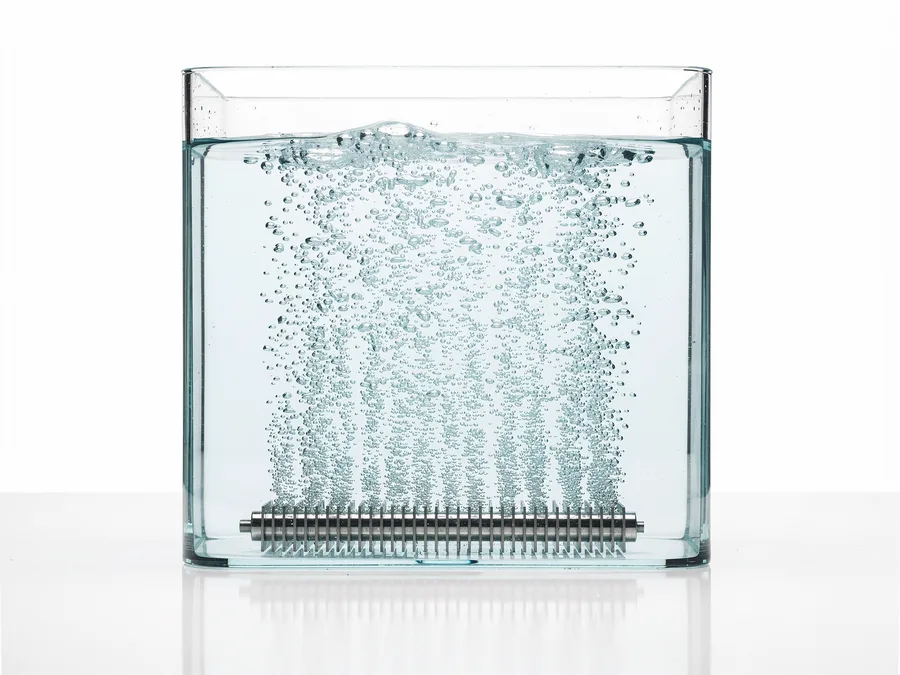
Ozone can't be bottled and stored because it slowly reverts to oxygen on its own, so it is always produced on site and used immediately. The process has two steps:
① Produce ozone gas with an ozone generator
The most common method is “corona discharge”: oxygen or dry air passes through a high-voltage discharge zone, where oxygen molecules are split apart and recombine into ozone. Using pure oxygen as feed gas yields about 1.7–2.5 times as much as using air (Lenntech).
② Dissolve the ozone into ultrapure water
Bubbles, dissolution membranes or pressurization bring ozone into full contact with water. The finer the bubbles and the longer the contact, the more ozone dissolves; this is also why ozone microbubbles raise concentration.
③ Deliver it to the point of use quickly
Ozone water keeps decomposing in the piping, so the generator and dissolution unit should sit as close to the cleaner as possible, with the shortest possible piping.
Temperature is ozone water's biggest enemy. The higher the water temperature, the faster ozone decomposes:
Lenntech also notes that above 40℃ ozone decomposes too quickly to be practical (Lenntech). This is the opposite of SPM, which must be heated above 100℃: ozone water works best “cold,” so some designs heat the wafer rather than the ozone water.
Why does ozone water clean?
Ozone water's cleaning power comes from two “electron grabbers”:
- Ozone itself→Directly oxidizes organics, with an oxidation potential of about 2.07 V, stronger than hydrogen peroxide or chlorine
- OH radicals from decomposition→Ozone produces OH radicals as it decomposes in water; they are even stronger oxidizers (about 2.8 V), and more form the more alkaline the water
- What's left→Ozone reverts to oxygen, OH radicals revert to water, and the broken-down organics become small molecules rinsed away by water
For what OH radicals are and why they're so powerful, see this plain-language guide. Simply put, they take dirt apart at the molecular level, which makes them especially good at thin, stubborn organic residue hiding in tight gaps, without leaving chemical residue the way strong acids and bases do.
Where is ozone water used in semiconductors?
| Purpose | Problem addressed | Why ozone water |
|---|---|---|
| Photoresist stripping | Removing photoresist after lithography, etching and ion implantation | Conventional SPM must be heated above 100℃ and uses large volumes of chemicals and waste liquid; ozone water is a strong oxidizer and its wastewater decomposes naturally in a short time |
| Organic contamination removal | Grease and organic residue on wafers, photomasks and parts | Leaves only oxygen and water after decomposition, with no chemical residue |
| Forming a thin oxide layer | Growing a very thin, clean protective oxide film on the silicon surface after cleaning | Ozone's oxidizing power does this at room temperature |
| Sterilization | Bacteria and biofilm in pure-water piping and tanks | Ozone is a common water-treatment disinfectant that leaves no residue after decomposing |
Taking photoresist stripping as an example, a patent filed by NEC in 1999 notes that SPM must be heated above 100℃ in a quartz tank, consumes large amounts of chemicals, generates large volumes of waste liquid and puts a heavy load on the tool; ozone water, by contrast, is a strong oxidizer whose wastewater decomposes naturally in a short time and needs no special waste treatment, which is why it has drawn attention (US6559064). Photoresist stripping recurs throughout front-end processing, after every lithography, etching and ion implantation step; you can locate it in the front-end process flow chart, and see the full picture in the semiconductor process flow chart.
Ozone water has limitations too: it may be too slow for very thick resist or resist hardened by ion implantation; it oxidizes metals, so wafers with metal layers need careful evaluation; and its concentration drops with temperature and time. These are exactly the limitations ozone microbubbles aim to address.
How does ozone water differ from ozone microbubbles?
| Standard ozone water | Ozone microbubble water | |
|---|---|---|
| Approach | Ozone gas dissolved in ultrapure water | Ozone formed into microbubbles 1–100 µm in diameter and injected into water |
| Dissolution | Limited by contact area | Microbubbles rise slowly and dissolve as they shrink, so more ozone dissolves |
| OH radical | Generated by ozone decomposition in water | Generated by ozone decomposition and also when microbubbles collapse |
| Photoresist stripping | Removes standard photoresist | Studies show markedly faster stripping, even removing resist hardened by ion implantation |
Masayoshi Takahashi and colleagues at Japan's National Institute of Advanced Industrial Science and Technology (AIST) found that adding microbubbles to ozone water raises the dissolved ozone concentration and directly contributes to radical generation, markedly increasing photoresist stripping speed (Takahashi et al., 2015). Microbubble principles and semiconductor applications are covered in microbubble cleaning.
What safety requirements apply to ozone water equipment?
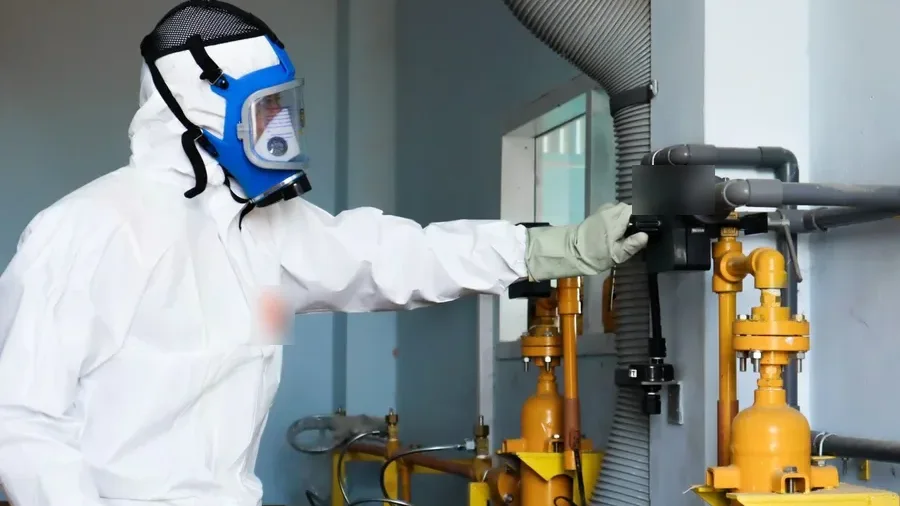
Ozone is harmful to people: it irritates the eyes and respiratory tract, and high concentrations can cause pulmonary edema (NIOSH). Ozone in ozone water constantly escapes into the air, so for tools using ozone water, safety design matters as much as cleaning performance.
Taiwan's Permissible Exposure Standards for Workplace Hazards set the 8-hour time-weighted average permissible concentration for ozone at 0.1 ppm (0.2 mg/m³); under the same standard's excursion factor, no 15-minute average may exceed 0.3 ppm (Laws & Regulations Database of the ROC). US standards are on the same order: OSHA's 8-hour average is 0.1 ppm, NIOSH's recommended ceiling is 0.1 ppm, and 5 ppm or above is considered immediately dangerous to life or health (NIOSH).
| Standard | Value | Meaning |
|---|---|---|
| Taiwan Ministry of Labor 8-hour average | 0.1 ppm(0.2 mg/m³) | Average over an 8-hour workday must not exceed |
| Taiwan Ministry of Labor 15-minute average | 0.3 ppm | No continuous 15-minute average may exceed |
| US NIOSH recommended ceiling | 0.1 ppm | Not recommended to exceed at any time |
| US NIOSH IDLH | 5 ppm | Immediately dangerous to life or health |
Why so strict
Ozone in water escapes into the air
About 10×
Based on equipment design reference values, using 100 ppm ozone water can release about 2 mg/m³ of ozone gas inside the chamber, roughly 10 times Taiwan's Ministry of Labor 8-hour permissible concentration (0.2 mg/m³). That is why ozone water equipment must contain the gas inside the tool and destroy it there.
Actual levels vary with concentration, temperature and chamber design
Measure ①
Sealed chamber + local exhaustWhat is local exhaust?It pulls ozone away right where it is released, so it never spreads through the fab, like a range hood mounted directly above the stove.The cleaning chamber is kept at slight negative pressure so ozone gas is drawn into the exhaust duct instead of leaking out through door gaps.
Cleaning takes place in a sealed chamber connected to exhaust and held at slight negative pressure, so ozone only goes into the exhaust duct. Before opening the door or changing loads, confirm the ozone in the chamber has been fully purged.
Key point: no gas escapes
Measure ②
Ozone destruction units on both exhaust and drainWhat is an ozone destruction unit?A device on the exhaust line that uses a catalyst or heat to turn ozone back into ordinary oxygen before it is released to the atmosphere.For example, catalysts such as magnesium oxide decompose ozone (Lenntech); emission levels must meet site rules.Residual ozone in the drain water must also be decomposed first (e.g., by UV or catalyst) before it goes to the facility drain.
Extracted ozone cannot be vented straight to the roof; it must first pass through a destruction unit and turn back into oxygen. Residual ozone in drain water must also be treated before it enters the facility drain, with discharge limits set by each site.
Key point: turn it back into oxygen before it leaves
Measure ③
Install ozone detectorsWhat is an ozone detector?A sensor that continuously measures ozone in the air, installed around the cleaning tool and at operator positions.When the set point is exceeded it sounds an alarm and triggers a shutdown, just like a gas detector.People can smell ozone, but the sense dulls with exposure, so you cannot rely on your nose to judge safety.with interlocked shutdown
Install ozone detectors around the tool and at operator positions to alarm and shut down when levels exceed limits. The chamber and exhaust duct also need monitoring to confirm the destruction unit is working properly.
Key point: see the concentration, stop when it is too high
Measure ④
Oxidation-resistant materials wherever ozone touches
Ozone oxidizes ordinary rubber and some plastics and metals, which become brittle and leach over time. Piping, valves, tanks and seals should use oxidation-resistant fluoropolymers such as PFA and PTFE.
Key point: don't let the equipment become a contamination source
Further reading: for how to choose among the three photoresist stripping methods, see how photoresist stripping works; to turn ozone into microbubbles, see how to choose a micro-nano bubble generator for equipment selection.
FAQ
What is ozone water?
Ozone water is a functional water made by dissolving ozone (O₃) in water, with concentration usually expressed in ppm. Both ozone and the OH radicals formed as it decomposes in water oxidize organics, then revert to oxygen, leaving no chemical residue. Semiconductor-grade ozone water is made with ultrapure water.
Can ozone water replace sulfuric acid–peroxide (SPM) for photoresist stripping?
Partly. Ozone water is a strong oxidizer and its waste water breaks down quickly on its own, so it can cut the use of hot SPM and the resulting waste; but it may be too slow for very thick or implant-hardened photoresist, which calls for ozone microbubbles, wafer heating or other methods, and should be tested on your own process.
Why can't ozone water be heated?
Ozone decomposes quickly in warm water: at pH 7 its half-life is about 30 minutes at 15℃, about 15 minutes at 25℃ and only about 8 minutes at 35℃; above 40℃ it is hard to use. So ozone water is usually used at room temperature or below, and when heat is needed the wafer is heated instead.
What is the permissible exposure limit for ozone?
Taiwan's Ministry of Labor Permissible Exposure Standards set an 8-hour time-weighted average of 0.1 ppm (0.2 mg/m³) for ozone, and the 15-minute average may not exceed 0.3 ppm. US OSHA's 8-hour average is also 0.1 ppm, and NIOSH lists 5 ppm as immediately dangerous to life or health.
What safety features does ozone water equipment need?
At least four: a sealed chamber with local exhaust, ozone destruction units on exhaust and drain, ozone detectors with interlocked shutdown, and oxidation-resistant materials such as PFA and PTFE for piping, tanks and seals. Emission levels must meet each site's rules.
Source
- Laws & Regulations Database of the R.O.C. (Ministry of Labor), “Standards of Permissible Exposure Limits of Airborne Hazardous Substances in Workplace (Schedule 1, No. 348 Ozone)”, 2025-04-11. Link
- CDC/NIOSH, “NIOSH Pocket Guide to Chemical Hazards: Ozone”, 2026-10-23. Link
- Lenntech, “Ozone generation”, 2026-10-23. Link
- Lenntech, “Ozone reaction mechanisms (including oxidation-reduction potential table for oxidants)”, 2026-10-23. Link
- Lenntech, “Ozone decomposition (decomposition and half-life of ozone in water)”, 2026-10-23. Link
- Google Patents, “US6559064B1 Method and apparatus for removing photoresist on semiconductor wafer (NEC)”, 2003-05-06. Link
- Journal of Photopolymer Science and Technology, 28(2), 293–298, "Effect of Microbubbles on Ozonized Water for Photoresist Removal (Takahashi, Horibe, Matsuura, Tatera)", 2015-05-11. Link