Key takeaways: What is AMC?
AMC (Airborne Molecular Contamination, gas-phase molecular contamination) refers to chemical contaminants present in cleanroom air as gas molecules. Unlike particles such as dust, which high-efficiency filters can capture, AMC molecules are too small and pass straight through ordinary filters before settling on the wafer surface. The industry commonly classifies AMC under the SEMI F21 standard into categories such as acids, bases, condensable organics, dopants and metals, for example hydrofluoric acid, ammonia and siloxanes. It can deform photoresist patterns, corrode metals, cause poor film adhesion or shift electrical properties. Modern fabs typically keep AMC below 10 ppb, using multiple layers of chemical filters, FOUP purging and cleaning, and management of low-outgassing materials.
What is AMC? The difference between dust and “odors”
In one sentence: AMC is “odor molecules” that can't be seen or filtered out, floating in cleanroom air and quietly sticking to wafers, ruining circuits.

Traditional contamination: particles
Like dust: visible and filterable
Particles are tiny individual grains, like the dust you see in sunlight. The high-efficiency filters in the cleanroom ceiling act like very fine sieves that catch them.
Countermeasure: filters catch the particles

AMC: airborne molecular contamination
Like odors: invisible and passes through
AMC consists of individual gas molecules, like the smell of coffee or smoke. They are far smaller than the holes in the sieve, pass straight through ordinary filters, and then cling to the wafer surface the way smoke clings to clothing.
Countermeasure: methods designed specifically to “capture gases”
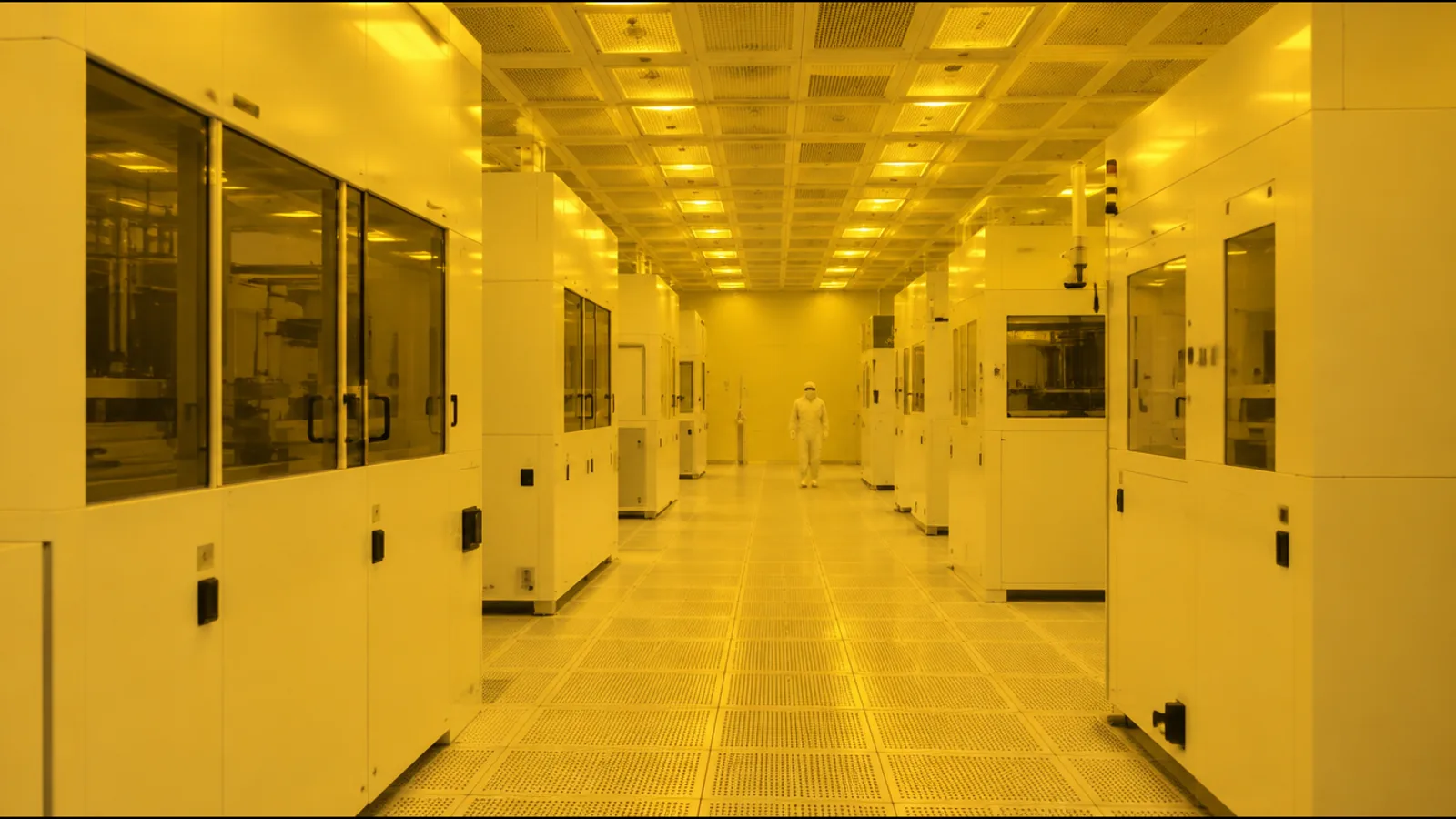
Image: Pexels free stock photo
AMC stands for Airborne Molecular Contamination, also called “gas-phase molecular contamination” or “airborne molecular contaminants.” The key word is “molecular”What is a molecule?A molecule is one of the smallest units of matter, made of a few atoms bonded together. A water molecule, for example, is 1 oxygen plus 2 hydrogens.Molecules are extremely small, thousands of times smaller than dust, invisible to the naked eye and ordinary microscopes. When we smell coffee, it's because coffee molecules have drifted into our nose.: it isn't individual specks of dust, but chemicals mixed into the air in gaseous form.
| Particles | AMC (airborne molecular contamination) | |
|---|---|---|
| What it looks like | Individual tiny solid grains | Gas molecules mixed into the air |
| Everyday analogy | Dust floating in sunlight | The smell of coffee, smoke or perfume |
| Can ordinary filters stop it? | Yes (HEPA/ULPA filters) | No, it passes straight through |
| How it's measured | Particle count (particles per cubic meter) | Concentration (ppb, ppt) |
| How it's controlled | Filters, personnel and traffic-flow management | Chemical filters, purging, cleaning, low-outgassing materials |
What are the types of AMC?
The semiconductor industry most commonly classifies AMC using the F21 standard from SEMI (the global semiconductor industry association), grouping it by “what harm it does to the wafer” into acids, basesWhat are acids and bases?Acids are substances like vinegar, lemon juice and hydrochloric acid that “bite” metals and cause corrosion; bases are substances like soapy water and ammonia that feel slippery.When acids and bases meet, they cancel each other out (neutralize) and may form a layer of tiny salt crystals.On a wafer, this “corrosion” and “neutralization” happen at a scale invisible to the eye, yet they are enough to ruin circuits., condensable organics, dopants and metals (Entegris AMC technical guide).
| Category | Plain-English explanation | Common examples | Potential problems |
|---|---|---|---|
| Acids | Gases that corrode metals | Hydrofluoric acid (HF), hydrochloric acid, sulfuric acid, nitric acid, sulfur dioxide, acetic acid | Metal line corrosion, salt crystal formation |
| Bases | Gases that neutralize acids | Ammonia (NH₃), amines, NMP (resist stripping solvent) | Deformed photoresist patterns (e.g. T-top, where the top widens) |
| Condensables | High-boiling organics that readily condense on surfaces | Siloxanes (sealants, silicone), plastic additives | Leaves a film on surfaces, causing poor adhesion and film delamination |
| Dopants | Substances that alter semiconductor electrical properties | Boron, phosphorus and arsenic compounds (e.g. BF₃, AsH₃) | Chip electrical properties drift |
| Metals | Metal compounds present in gaseous form | — | Metal contamination |
Beyond these main categories, ozone, sulfur-containing gases and some volatile organics, though not formally classified, are increasingly controlled as well. As linewidths keep shrinking, almost any “molecule that shouldn't be there” can become a problem.
Where does AMC come from?
people
The human body emits ammonia and organic acids, and cosmetics and skincare products also release volatile substances.
Building materials and supplies
Walls, floors, sealants, furniture, clothing, gloves and other materials continuously and slowly “outgas,” mostly organics.
Tools and process chemicals
Etching, cleaning and other tools use large amounts of chemicals, which become contamination sources if they leak; even without leaks, chemicals left on wafers are carried to the next station.
Outside air
Roads, parking lots, nearby factories, farmland and even lakes emit gases; the fab's own exhaust can also be drawn back in if ventilation is poorly designed.
Wafer pods (FOUPs)
Plastic wafer pods outgas, and they also absorb gases from the previous process into the material, later releasing them onto the next batch of wafers.
An easily overlooked source
Wafer pods outgas too
FOUPs are made of plastic. Research shows the plastic not only releases gases on its own but also absorbs chemical gases brought in from the previous process, then slowly releases them onto the next batch of wafers, causing “cross-contamination.”
That's why FOUPs need regular purging and cleaning
Where it ends up
Molecules stack up layer by layer on the wafer
Wherever it comes from, AMC can end up on the wafer surface. The amount is tiny, as thin as a single molecular layer, but with chip linewidths now just a few nanometers, that layer is enough to make later process steps go wrong.
The more advanced the process, the more vulnerable it is
Cross-contamination from wafer pods has drawn growing attention in recent years. A 2018 study published in Microelectronic Engineering compared continuous purging with clean gas and wet cleaning; both significantly reduced hydrofluoric acid transfer from FOUPs to wafers, and the sooner cleaning happened after contamination, the better the result (González-Aguirre et al., 2018). For what a FOUP is and how it differs from the FOSB used for shipping, see this article.
How does AMC damage wafers?
AMC is present at mere parts per billion, so why does it cause problems? Because chip linewidths are now only a few nanometers, and a single molecular layer is enough to affect later process steps. Common types of damage include:
Deformed photoresist patterns (bases)
The “chemically amplified resists” used in advanced lithography rely on trace acid generated by exposure. Even ppb-level basic gases in the air neutralize the acid at the surface, forming a “skin” on the resist, so after development the top of the pattern widens, known in the industry as T-top. An IBM research team found as early as 1993 that resist-coated wafers left for just a few minutes in air containing trace bases performed noticeably worse.
Metal corrosion (acids)
Acid gases such as hydrofluoric and hydrochloric acid corrode copper, aluminum and other metal lines, or react with other substances to form salt crystals that become defects on the wafer.
Poor adhesion and film delamination (organics)
Even organic molecules only temporarily adsorbed on the surface can interfere with later coating and deposition, causing films to adhere poorly or even peel off.
Electrical drift (dopants)
Boron- or phosphorus-containing gases on the wafer amount to adding dopant where none should be, which can push the chip's electrical properties away from the design.
Hazing of optical lenses
Lithography lenses fog up when molecules deposit on them; extreme ultraviolet (EUV) tools are even more sensitive, as any organic molecule can burn into carbon residue on the mirrors.
These problems all occur at critical front-end steps such as lithography, etching and deposition, which you can locate in the front-end process flow chart, with the full process in the semiconductor process flow chart. For back-end packaging and shipping, moisture is another common enemy; see MSL moisture sensitivity levels.
How clean is clean enough for AMC? How much is a ppb?
AMC concentrations are so low they are measured in ppbWhat is ppb?ppb stands for parts per billion. 1 ppb means 1 contaminant molecule mixed in among a billion air molecules.Another analogy: drip about 2.5 mL of ink (less than half a teaspoon) into a standard Olympic swimming pool of about 2.5 million liters, and the concentration is roughly 1 ppb.An even smaller unit is ppt (parts per trillion), 1,000 times smaller than ppb., or even ppt. According to filter makers' technical guides, most modern fabs keep AMC below 10 ppb, many areas at 1–2 ppb or lower, and control down to ppt levels is increasingly required (Entegris).
| Approximate era | Process node | Concentration requiring control |
|---|---|---|
| Around 1990 | ~800 nm | ppm level (parts per million) |
| Around 2000 | ~130 nm | ~10 ppb |
| Around 2010 | 32 / 22 nm | ~10 ppt |
| After 2015 | 14/10 nm and below | Single-digit ppt; nearly any foreign molecule must be controlled |
In other words, requirements have tightened roughly a million-fold over 30 years. That's why the more advanced the fab, the more it needs dedicated AMC monitoring instruments and control measures.
How do fabs control AMC?
Because AMC passes through ordinary filters, fabs defend in “layers”: from the outside-air intake, return air and cleanroom ceiling all the way down to tools and wafer pods, each layer may be fitted with chemical filtersWhat is a chemical filter?Standard cleanroom HEPA/ULPA filters are like very fine sieves that catch dust particles, but gas molecules are too small and pass straight through.Chemical filters contain activated carbon or chemically treated adsorbent media that capture specific gas molecules through “adsorption” and “chemical reaction.”Different contaminants (acids, bases, organics) require different media formulations, and the media must be replaced once saturated. or use purging.
Outside-air intake
Chemical filters in the air handlers that bring outside air into the fab block outdoor contamination first.
Return air and ceiling fan filter units
Air recirculating inside the fab passes through another layer, which can also be installed above the fan filter units (FFUs) in the cleanroom ceiling.
The tools themselves
Lithography tools have had built-in chemical filters since the deep ultraviolet (DUV) era; at 28 nm and below, other tools increasingly need protection too.
Wafer pod purging and cleaning
FOUPs are continuously purged with nitrogen or clean air while waiting for the next station and cleaned regularly, reducing contamination the pod absorbs and re-releases onto wafers.
Materials and personnel management
Choose low-outgassing building materials, sealants, gloves and consumables; manage chemical storage and tool leaks; plan exhaust locations so waste gas isn't drawn back into the fab.
Wafer pod cleaning commonly uses pure-water spraying plus blow-drying; recently, adding microbubbles or ozone to the cleaning water has also been studied, using OH radicals to break down organic residue. For the principles, see microbubble cleaning.
Further reading: ozone itself is a gas that must be controlled—see ozone water safety regulations for usage guidelines; for photoresist problems caused by basic AMC, see how photoresist stripping works.
FAQ
What is AMC?
AMC stands for Airborne Molecular Contamination: chemical contaminants present in cleanroom air as gas molecules, such as hydrofluoric acid, ammonia and siloxanes. It passes through ordinary filters and settles on the wafer surface, causing defects.
How is AMC different from particles?
Particles are tiny solid grains that HEPA/ULPA filters can capture, measured by “count.” AMC consists of gas molecules that pass through ordinary filters; it is controlled with chemical filters, purging and cleaning, and measured in concentration units such as ppb and ppt.
What types of AMC are there?
The industry commonly follows the SEMI F21 standard, dividing AMC into acids (e.g. hydrofluoric acid), bases (e.g. ammonia, amines), condensable organics (e.g. siloxanes), dopants (boron, phosphorus and arsenic compounds) and metals. Ozone, sulfur-containing gases and some volatile organics are not formally classified but are often controlled as well.
What concentration should AMC be kept below?
There is no single industry-wide standard; each fab sets its own by process. According to filter suppliers' technical data, most modern fabs keep AMC below 10 ppb, many areas at 1–2 ppb or lower, and advanced processes increasingly require control at the ppt level.
Why do FOUPs cause AMC contamination?
FOUPs are made of plastic, which outgasses on its own and also absorbs chemical gases brought in by the previous process, later releasing them onto stored wafers and causing cross-contamination. That's why fabs purge FOUPs with nitrogen or clean air and clean them regularly.
Source
- Entegris, “Airborne Molecular Contamination (AMC) Solutions for the Microelectronics Industry (AMC classification, sources, concentration trends and filter placement)”, 2026-10-23. Link
- Chemistry of Materials (IBM Research), “Airborne Contamination of a Chemically Amplified Resist. 1. Identification of Problem (MacDonald et al.)”, 1993-01-01. Link
- Microelectronic Engineering, “FOUP decontamination solutions to control AMCs in semiconductor fabs: Gas purge or wet cleaning? (González-Aguirre et al.)”, 2018-07-01. Link
- R&D World, “Chemicals in Cleanrooms”, 2013-04-01. Link