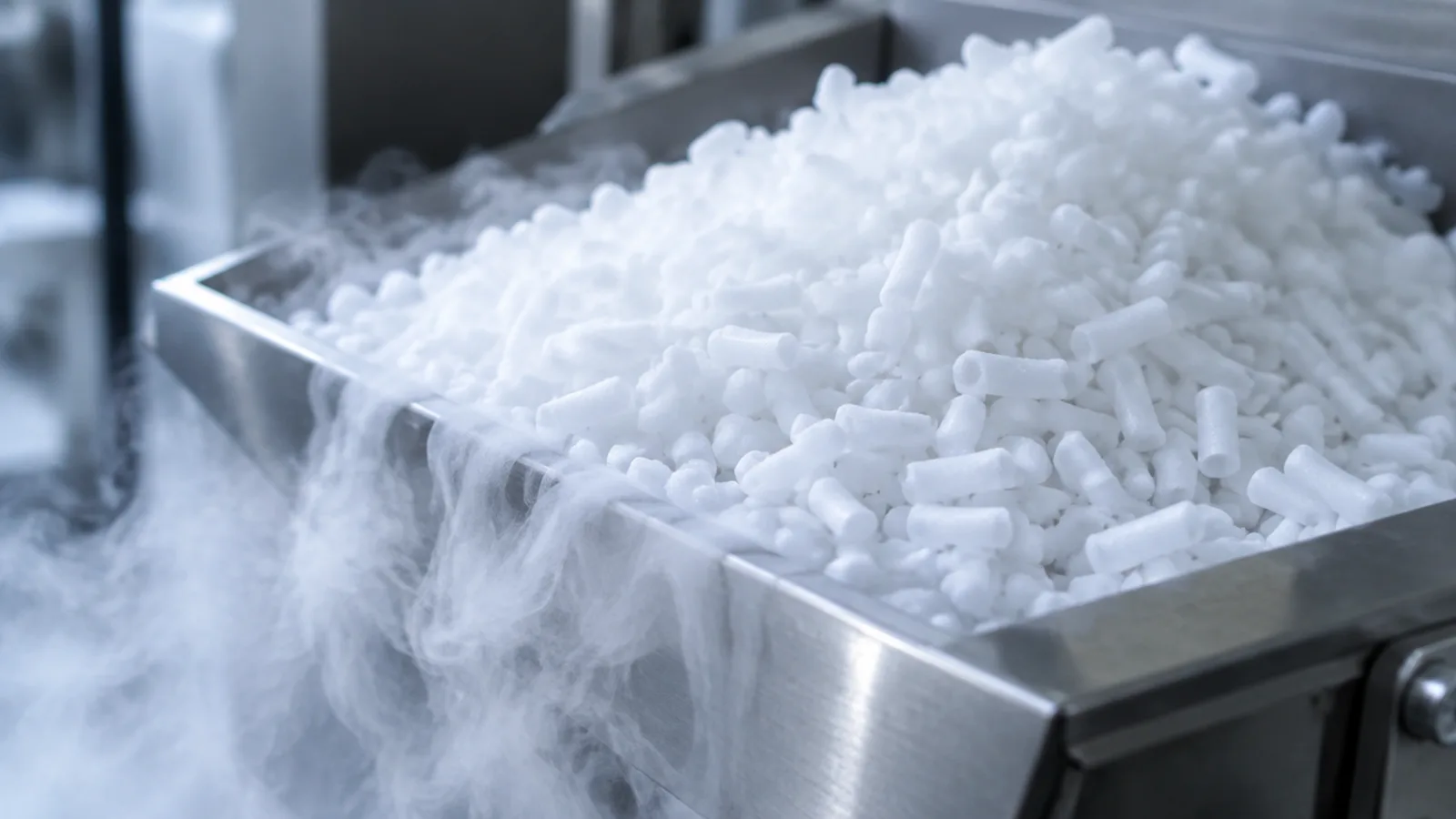
Key takeaways: how do dry ice blasting, CO₂ snow and supercritical CO₂ cleaning differ?
All three use carbon dioxide; the difference is the state of the CO₂. Dry ice blasting uses dry ice pellets of about 3 mm accelerated by compressed air; it has the strongest force and suits heavy deposits on molds and machinery. CO₂ snow cleaning turns liquid CO₂ into ultra-fine snow in the nozzle; it is gentle and suits fine particles and thin oil films on precision surfaces such as wafers and optical components. Supercritical CO₂ cleaning takes place in a sealed high-pressure vessel above about 31 °C and 7.4 MPa, where CO₂ becomes a fluid with a gas's penetrating power and a liquid's solvent power, reaching into fine gaps and porous materials; it is also used for drying MEMS. The first two are open spraying that cleans surfaces; the third is sealed immersion that cleans interiors.
Three CO₂ cleaning methods, differing in the 'state' of CO₂
In one sentence: all three use carbon dioxide, and the difference is the 'state' of the CO₂: dry ice blasting strikes with hard dry ice pellets, CO₂ snow strikes with fine snow generated on the spot, and supercritical CO₂ becomes a fluid that slips into gaps and dissolves grease, 'soaking' the part. The first two clean surfaces; the third reaches inside the material.
Method ①
Dry ice blasting
Ready-made dry ice pellets are accelerated by compressed air — like sandblasting, except the 'sand' disappears by sublimationWhat is sublimation?A solid turning directly into gas without passing through a liquid. Dry ice on a table doesn't melt into a puddle; it slowly 'smokes' away.after impact. Large pellets, strong force.
Like: sandblasting with ice pellets
Method ②
CO₂ snow cleaning
Liquid CO₂ is sprayed from a nozzle; the sudden pressure drop turns it into ultra-fine CO₂ snow on the spot, which strikes the surface. Fine particles, gentle force.
Like: sweeping gently with fine snow
Method ③
Supercritical CO₂ cleaning
In a sealed high-pressure vessel, CO₂ is turned into a supercritical fluidWhat is a supercritical fluid?Heat CO₂ above about 31 °C and pressurize it above about 7.4 MPa (roughly 73 atmospheres), and you can no longer tell whether it is a liquid or a gas.At this point it can like a gas slip into extremely fine gaps, and like a liquid dissolve contaminants such as grease., and the part 'soaks' in it as it slips into gaps and dissolves grease; once depressurized, the CO₂ turns back into gas.
Like: soaking in a solvent that gets into every gap
At one atmosphere carbon dioxide has no liquid state; solid dry ice sublimates directly into gas at about −78.5 °C (Wikipedia: Dry ice). Heated and pressurized past the critical point (about 31 °C, 7.38 MPa), it becomes a supercritical fluid (Wikipedia: Supercritical carbon dioxide). The three cleaning methods each exploit one of these states of CO₂.
They share one benefit: the cleaning medium always ends up as CO₂ gas, leaving no water, no solvent and no cleaning wastewater — only the removed contaminants themselves. The difference is how the contaminants are removed: the first two by impact, the third by penetration and dissolution.
How does each method clean?
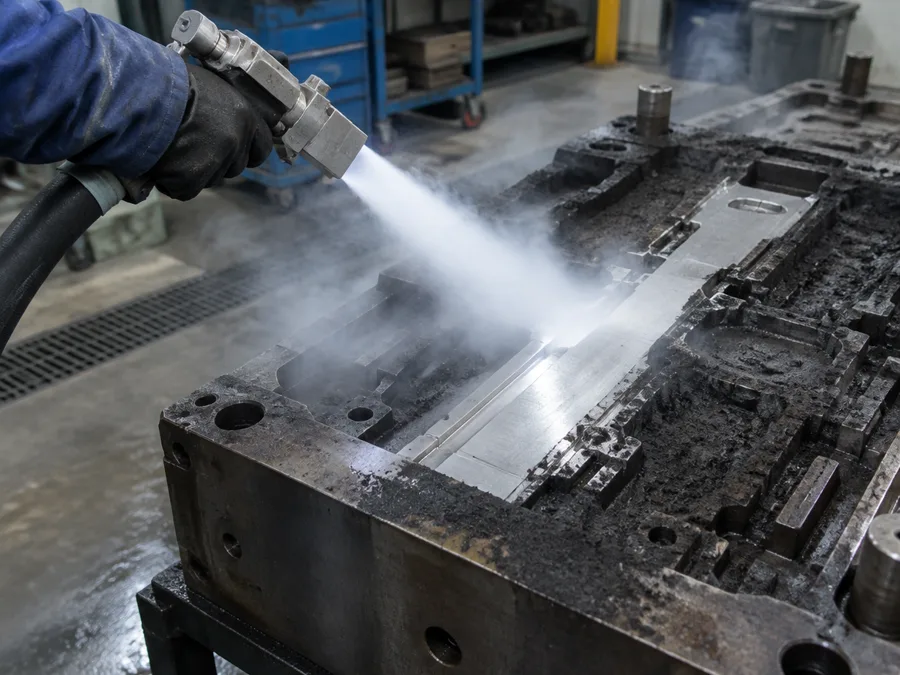
① Dry ice blasting: dry ice pellets or shaved dry ice are accelerated by compressed air toward the surface. The principle is much like sandblasting, but dry ice is softer and far less dense than sand and sublimates almost immediately on impact, causing very little surface abrasion. Sublimating dry ice draws a large amount of heat from the surface, creating thermal shock that makes the surface deposit shrink faster than the substrate and flake off; the instant solid-to-gas transition also produces tiny shock waves that help lift contaminants (Wikipedia: Dry-ice blasting). The industry-standard pellet is 3 mm; according to equipment makers' public catalogs, some models can adjust pellet size between 0.3 and 3 mm for more delicate surfaces.
The most common use of dry ice blasting is cleaning plastic and rubber molds: molds can be cleaned in place at production temperature without shutting down to remove them. It is also used on food processing equipment, welding lines, casting molds, surface prep before coating and deburring (same source).
② CO₂ snow cleaning: instead of ready-made dry ice, liquid CO₂ is fed into a special nozzle and, on exit, the sudden pressure drop turns it into ultra-fine snow that removes small particles and thin oil films through impact, rapid cooling, sublimation and dissolution. Snow is far finer than dry ice pellets and gentle, suited to wafers, optical components and precision parts. For details on how it works, see What is CO₂ snow cleaning.
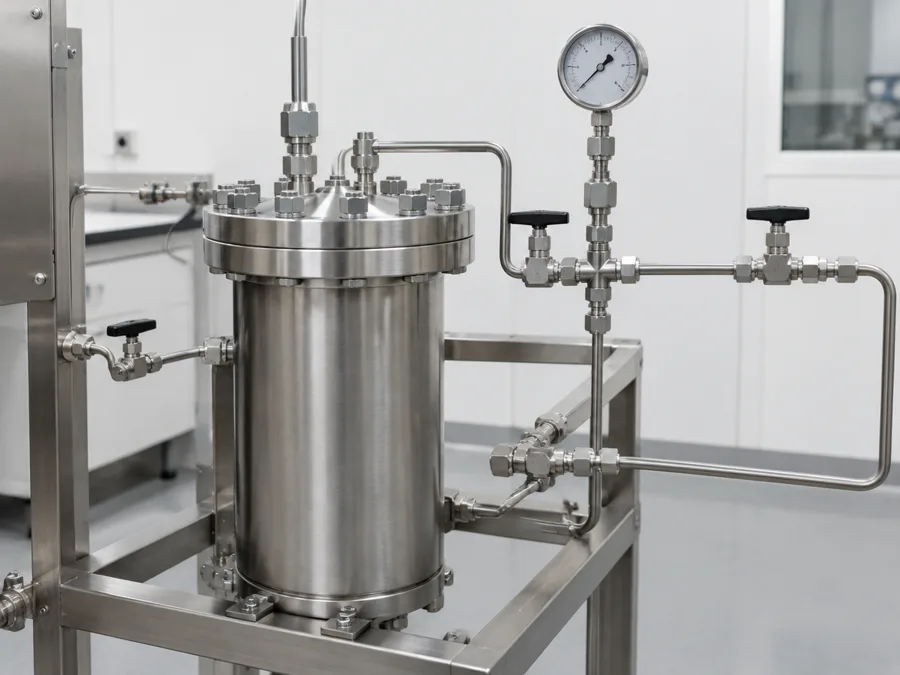
③ Supercritical CO₂ cleaning: the part is placed in a sealed high-pressure vessel and the CO₂ is taken past its critical point to become a supercritical fluid. Its density is then close to a liquid's, so it dissolves grease and organics, yet like a gas it fills the vessel and diffuses into fine gaps, and it has no surface tension, so it reaches micro-pores that ordinary liquids cannot. When cleaning is complete, the pressure is released, the CO₂ turns back into gas, and the dissolved contaminants separate out. Supercritical CO₂ is already used in garment dry cleaning, coffee decaffeination and some industrial cleaning (Wikipedia: Supercritical carbon dioxide).
The absence of surface tension is especially useful in semiconductors: if the tiny moving structures in MEMS are cleaned with an ordinary liquid and then dried, surface tension as the liquid recedes can damage them or make them stick. Supercritical drying avoids this problem, which is why it is commonly used in MEMS manufacturing (Wikipedia: Supercritical drying).
The three CO₂ cleaning methods in one table
| Dry ice blasting | CO₂ snow cleaning | Supercritical CO₂ cleaning | |
|---|---|---|---|
| State of CO₂ | Solid pellets (ready-made dry ice) | Solid fine snow (generated at the nozzle) | Supercritical fluid |
| How it cleans | Pellet impact + thermal shock | Snow impact, rapid cooling, sublimation, dissolution | Penetration + dissolution, carried out on depressurization |
| Force | Strong | Gentle | No impact |
| Reach | Surfaces the spray can reach | Surfaces the spray can reach | Fine gaps, inside porous materials |
| Best for | Heavy deposits, carbon buildup, release agent residue | Fine particles, thin oil films, fingerprints | Grease, organics, solvent residue |
| Typical parts | Molds, machinery, production fixtures | Wafers, optical components, precision parts | Precision parts, porous materials, MEMS drying |
| Equipment type | Open spraying (handheld or robot arm) | Open spraying (handheld, module or fully automated) | Sealed pressure vessel, batch processing |
| Watch for | Noise, whether the surface can withstand impact, dust collection | CO₂ purity, condensation, static | High-pressure equipment safety, whether parts can withstand pressurization and depressurization |
All three methods release CO₂ gas, so the work area needs exhaust and CO₂ concentration monitoring; CO₂ is heavier than air and can pose an asphyxiation risk if it accumulates in enclosed or low-lying areas. Contaminants knocked loose by dry ice blasting and snow cleaning scatter, so dust collection or exhaust is needed to carry them away and keep them from settling back on the part.
Where is each used in the semiconductor industry?
Dry ice blasting: maintenance of equipment, molds and fixtures
Removes heavy residue from packaging molds, production line components and fixtures, often inline or without full disassembly. Because it leaves no residue, dry ice blasting is also used in semiconductor, aerospace and medical device manufacturing (Wikipedia: Dry-ice blasting). It is too forceful for precision surfaces such as wafers, which call for a finer method.
CO₂ snow: particles on wafers and precision surfaces
Fully dry and gentle, suited to fine particles on wafer surfaces, sidewall residue after etching, and water-sensitive MEMS and optical components; it can also clean just a local area.
Supercritical CO₂: getting into gaps and pores
Suited to parts with complex structures, fine gaps or porosity, and to drying MEMS that are sensitive to surface tension. It can dissolve grease and organics trapped inside, which the two surface-spraying methods cannot do.
In practice the three often complement rather than replace each other: surface particles go to snow, heavy deposits to dry ice blasting, and interiors and pores to supercritical CO₂. To compare them with wet cleaning using ultrapure water and chemicals, see how to choose between dry and wet cleaning; for a plain-English explanation of the supercritical state itself, see What is supercritical CO₂.
How to choose? Start with these 5 questions
Is the contamination on the surface or inside?
If it is only on surfaces the spray can reach, choose dry ice blasting or snow; if it is trapped in fine gaps, blind holes or inside porous materials where spraying can't reach, consider supercritical CO₂.
How thick and stubborn is the deposit?
Heavy carbon buildup and release agent residue are removed more efficiently by dry ice blasting; fine particles, thin oil films and fingerprints are handled well by snow, which is also safer in terms of force.
How precise and fragile is the part?
Wafers, optical coatings and tiny moving structures can't take the impact of dry ice pellets, so choose snow or supercritical CO₂; also confirm whether the part can withstand low temperatures, or the pressurization and depressurization of supercritical cleaning.
Continuous inline processing or batch processing?
Dry ice blasting and snow can be mounted on robot arms or production lines for continuous cleaning; supercritical CO₂ requires loading a pressure vessel, pressurizing, soaking and depressurizing — batch processing — so cycle time and throughput per batch need to be worked out.
What are your plant's space, CO₂ supply and safety conditions?
All three need a stable CO₂ source, exhaust and concentration monitoring; dry ice blasting also involves noise and dust collection, while supercritical systems must meet high-pressure equipment safety rules. The safest approach is to run sample tests on actual parts before deciding.
FAQ
What types of CO₂ cleaning are there?
There are three common types: dry ice blasting (dry ice pellets propelled by compressed air), CO₂ snow cleaning (liquid CO₂ turned into fine snow in the nozzle) and supercritical CO₂ cleaning (CO₂ turned into a supercritical fluid in a pressure vessel to penetrate and dissolve contaminants). None uses water or chemical solvents, and in all three the CO₂ turns back into gas afterward.
What is the difference between dry ice blasting and CO₂ snow cleaning?
Dry ice blasting uses ready-made dry ice pellets (industry standard about 3 mm) with strong force, suited to heavy deposits on molds and machinery; CO₂ snow is ultra-fine snow generated from liquid CO₂ at the nozzle, with gentle force, suited to fine particles and thin oil films on precision surfaces such as wafers and optical components.
What is supercritical CO₂ cleaning good for?
It suits parts with fine gaps, blind holes or porous structures, and cases where internal grease and organics must be removed. Supercritical CO₂ has no surface tension, so it reaches pores ordinary liquids can't; it is also used for supercritical drying of MEMS, preventing surface tension from damaging tiny structures.
Can dry ice blasting be used to clean wafers?
Generally it is not used directly on precision surfaces like wafers because dry ice pellets hit hard; particles on wafer surfaces are usually removed with gentler, ultra-fine CO₂ snow. In the semiconductor industry, dry ice blasting is more commonly used for maintenance cleaning of equipment, molds and fixtures.
Is CO₂ cleaning safe?
CO₂ is non-flammable and non-toxic, but it is heavier than air, and high concentrations building up in enclosed or low-lying areas can cause headaches, dizziness and even asphyxiation, so the work area needs exhaust and CO₂ concentration monitoring. Supercritical CO₂ cleaning also involves high-pressure equipment and must meet pressure vessel safety rules.