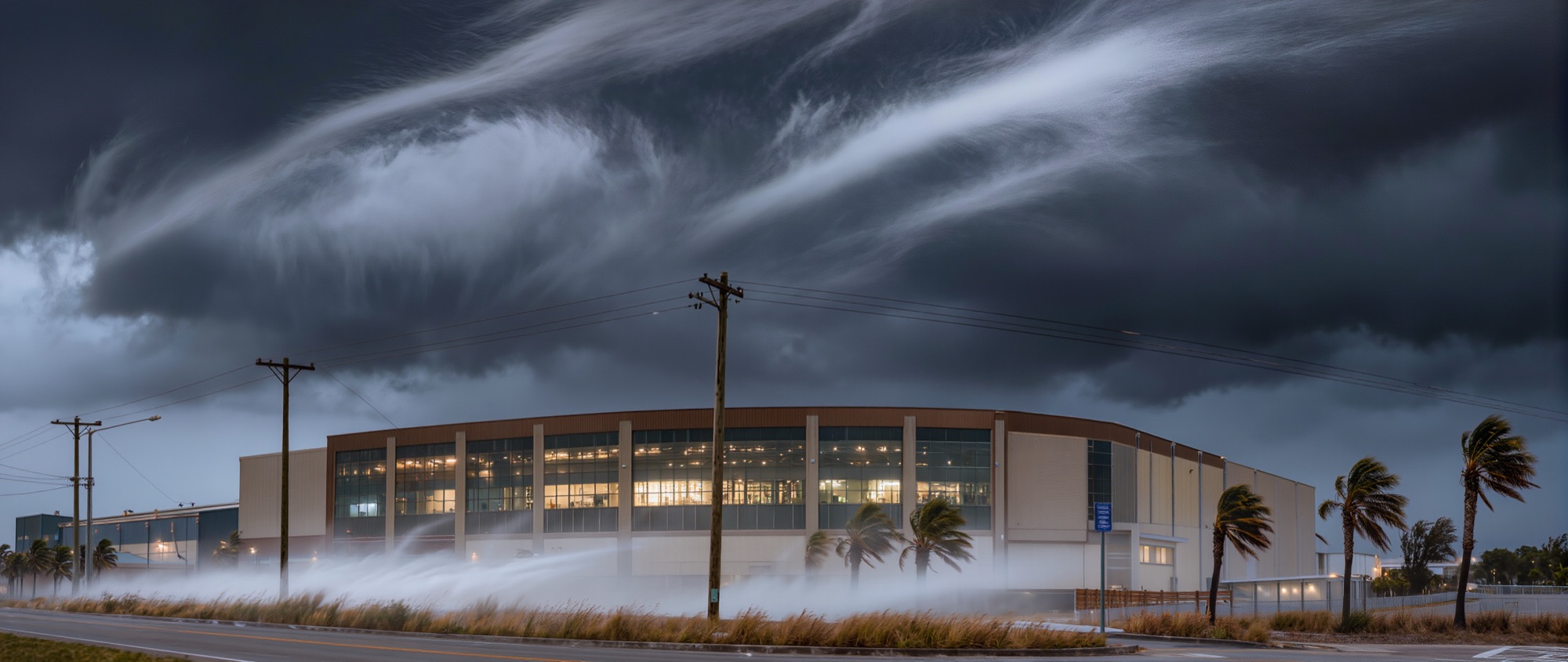
Summary: beyond the outages, what should factories guard against?
Hurricane Isaias made landfall near Destin, Florida, around 8 p.m. ET on October 9. On the morning of October 10, more than 884,000 customers in Florida, Alabama and Georgia were without power. Outage counts only include customers who lost power completely. But when high winds push trees into lines and cause short circuits, plants on the same grid that never lose power still go through voltage sags: voltage drops to 10–90% of nominal for a fraction of a second, tool controllers reset, and work in process is scrapped all the same. Long outages call for generators or UPS; for sags lasting from a fraction of a second to a few seconds, protecting only the control circuits that reset with a sag compensator is the lowest-cost approach. They are different problems and should be assessed separately.
How widespread were the Hurricane Isaias outages?
According to the Associated Press, Isaias was the first hurricane of the 2026 Atlantic season. It made landfall near Destin, Florida, as a Category 2 hurricane on Friday, October 9; flights at several Panhandle airports were grounded that day, and trees and power lines came down in Mobile, Alabama (AP / ABC News). CBS News live coverage recorded maximum sustained winds of about 105 mph at landfall, after the storm briefly strengthened to Category 3 beforehand (CBS News).
The hurricane also caused deaths and injuries; this article covers only how the power situation affects factories.
What outage counts miss: voltage sags
The "hundreds of thousands without power" in the news counts customers who lost power completely. During a storm, factories also run into something else: the power never goes out, but the voltage drops and recovers within a fraction of a second. That is a voltage sag.
- Wind pushes trees into lines; a short circuit→Before protection clears the fault, voltage across the nearby grid is pulled down
- Customers near the fault→Outage: shows up in outage counts
- Plants on the same grid that keep power→Voltage sag: controllers reset, WIP is scrapped, and none of it appears in outage counts
Lightning strikes and wind-blown trees touching lines are already the most common causes of voltage sags (see What Is a Voltage Sag?). During hurricanes and typhoons these faults cluster together, so even if your factory is outside the outage area, trips usually increase in the days the storm passes through. For a full typhoon-season preparation checklist, see Preventing Factory Trips in Typhoon Season.
Three power problems factories face during storms
| Problem | Duration | Typical result | What to do |
|---|---|---|---|
| Outage | Minutes to days | Entire plant down | Generators; online UPS (to bridge until the generator takes over) |
| Voltage sag | A fraction of a second to a few seconds | Tool trips, controller resets, scrapped WIP | Sag compensator on control circuits; adjust undervoltage relay settings |
| Surges | Microseconds | Fried boards | Arresters, SPDs |
To be clear: a sag compensator is not meant to ride through an outage. DEYly's Voltage Sag Protector (VSP) compensates for up to 3 seconds at full load; it covers sags lasting a fraction of a second to a few seconds. Long outages caused by a hurricane need generators and UPS. Conversely, putting the whole plant on UPS just to handle sags brings high standing losses and battery replacement costs. Protecting only the PLCs, IPCs, robots, control power supplies and EMO circuits that reset keeps capacity small and cost low, which is why the two should be assessed separately (comparison: How to Choose Voltage Sag Protection).
Why it matters more for overseas plants
When Taiwanese manufacturers build plants in the US, Japan or Southeast Asia, carrying over the equipment specs and power protection from Taiwan as-is overlooks real differences in local grid structure, weather risk and outage frequency. The US Gulf Coast and Southeast have hurricane season, Taiwan has typhoon season, and Japan has typhoons and earthquakes. Checking power protection before storm season should be standard practice at any new plant.
When buying equipment for a new plant, write SEMI F47 ride-through requirements into the spec; for tools already in production, find the components most likely to trip and reinforce them (see Legacy Tools That Fail SEMI F47: How to Improve Them).
4 things facilities teams can do before storm season
Log outages and voltage sags separately
For every trip in the past year: did the whole plant lose power, or did power stay on while only some tools stopped? The two problems need different fixes, so separate them first.
Confirm how long generators and UPS can hold
Which loads must stay up during an outage and for how long, and whether generator fuel and UPS batteries are in good condition.
Find the tools that trip most often on sags
Use alarm logs to find the tool models and components that trip most, and protect their control circuits first with a compensator or setting changes.
Set up power monitoring
Event logs from a power quality analyzer or compensator record the time, depth and waveform of every sag, so you can review after storm season whether the fixes worked. Full steps: Reducing Sag Downtime Losses: Where Facilities Teams Should Start.
FAQ
Why do tools still trip during a hurricane or typhoon when the plant never lost power?
Because storms bring a cluster of faults such as trees touching lines and short circuits. Until each fault is cleared, voltage across the nearby grid is pulled down for a fraction of a second. Power never goes out, but a tool controller that can't ride through the sag resets. These events don't appear in outage counts.
Can a sag compensator ride through a hurricane outage?
No. A sag compensator covers sags from a fraction of a second to a few seconds; DEYly's VSP, for example, compensates for up to 3 seconds at full load. Long outages need generators or UPS.
We already have UPS. Do we still need a sag compensator?
Not necessarily, if your UPS already covers every control circuit that resets. Commonly, though, UPS covers only a few critical loads and the control circuits of other tools are unprotected; or many loads were put on UPS to handle sags, driving up standing losses and battery replacement costs. In those cases, adding compensators only on control circuits is usually cheaper than expanding UPS.
How can I tell whether a trip was caused by an outage or a voltage sag?
If the whole plant lost power and the lights went out, it was an outage. If the lights only flickered, some tools stopped, and they ran normally after a restart, it was most likely a voltage sag. Matching trip times against power monitoring or UPS input-fault logs confirms it.