Hsinchu Science Park
A transformer failed inside a 161 kV customer's plant, causing a ~0.1 s sag nearby. Supply wasn't cut, but some customers' equipment tripped.
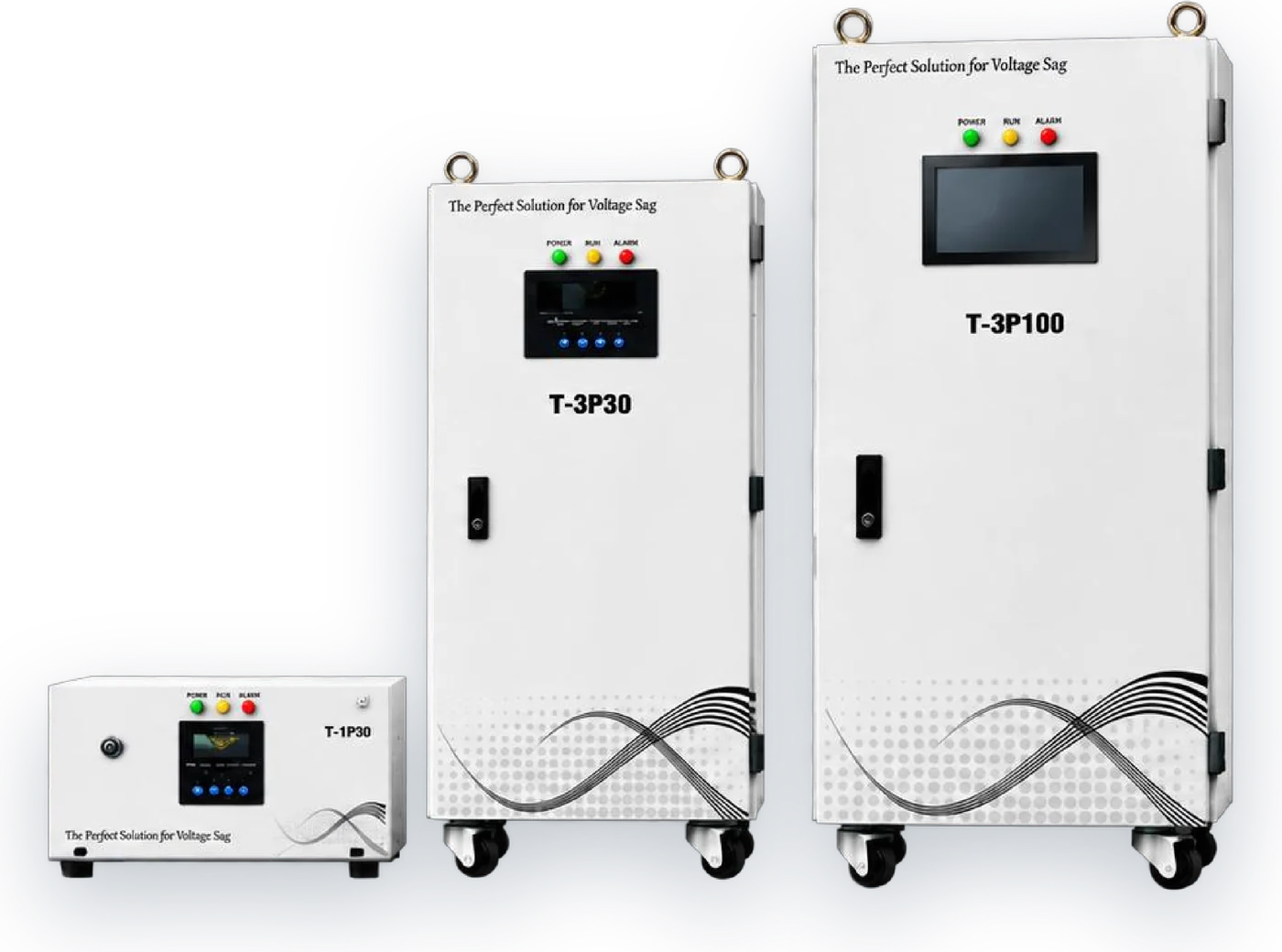
Source: Taipower press release, 2022/3/2A voltage sag protector (VSP), also called a voltage sag compensator, is a power protection device that stores energy in supercapacitors. In normal operation, current flows through a bypass and the unit draws almost no power; when it detects a sag, it switches to supplying power from the capacitors through an inverter within 1 millisecond, riding through for up to 3 seconds at full load — so PLCs, industrial PCs, robots and other controls don't reset and stop every time the power "blinks."
ESG: E (Environmental)SDG 9Industry & InnovationSDG 12Responsible ProductionOur ESG approach →
Per IEEE 1159, a voltage sag is a drop to 10–90% of rated voltage lasting half a cycle to 1 minute before recovering; below 10% counts as an interruption. Sags in Taiwan's science parks usually last only about 0.1 seconds — people just see the lights flicker, but PLCs, control power supplies and contactors inside the tools have already lost power and reset.
Taipower (Taiwan's state utility) uses the same definition: a sudden drop in RMS supply voltage to below 90% of rated, lasting 0.5 cycles to 1 minute (Taipower FAQ: "What is a voltage sag?").
| Item | Voltage sag | Interruption |
|---|---|---|
| Is power lost? | No, supply continues | Supply is cut |
| Voltage | 10–90% of rated remains | Below 10% |
| Duration | ½ cycle to 1 min; ~0.1 s typical in Taiwan | Usually seconds or more, possibly hours |
| What you see | Lights flicker | Lights out, all stops |
| Affected equipment | Only voltage-sensitive equipment trips or resets | All equipment stops |
| Protection | Sag protector, UPS | UPS, generator |
Common causes include lightning and weather, bird contact, excavation damage, faults at neighboring customers, utility equipment failures and large motor starts inside the plant. Except for the last, all originate outside the plant — a factory can't prevent them, only help its equipment ride through. That's the point of sag protection. For the six causes and how to identify them, see What is a voltage sag? Causes and events in Taiwan; for prevention, see How factories can prevent voltage sag problems.
A transformer failed inside a 161 kV customer's plant, causing a ~0.1 s sag nearby. Supply wasn't cut, but some customers' equipment tripped.
Source: Taipower press release, 2022/3/2A 161 kV switch failed at Fenghua substation, causing sags in the Tainan and Kaohsiung parks. UMC confirmed scrapped wafers and tool restarts.
Source: CNA, 2023/6/1Taipower reports 13 sags at STSP in 2020 and 3 more by April 2021 — from birds, customer faults and digging. Mostly outside the plants' control.
Source: Commercial Times, 2021/4/16That's Taipower's own count for 2020. One park company counted "18 in one quarter" (Liberty Times, 2021/4/15). Either way, sags happen every year — the question is what's still unprotected.
For the 2025 Lunar New Year's Eve sag at Hsinchu Science Park and the Kaohsiung park events, see Timeline of voltage sag events in Taiwan's science parks.
Usually it isn't the big equipment that fails. Pumps, heaters and motors ride through 0.1 s on inertia; what actually stops a tool is the control system — one small control power supply resets, the whole tool stops, and then comes rebooting, checking and requalification.
SEMI F47 is the voltage sag immunity standard for semiconductor equipment: the main equipment must not stop when voltage falls to 50% for 0.2 s, 70% for 0.5 s or 80% for 1 s. But real sags in Taiwan are often deeper and messier — below 50%, unbalanced across phases, and repeated — and peripherals like robots, communications and control power supplies aren't necessarily validated. The VSP fills the gap that F47 doesn't cover.
The VSP sits between facility power and the process tool. In normal operation current passes straight through an SCR bypass with almost no loss while recharging the supercapacitors; when a sag occurs, the supercapacitors output a sine wave through the inverter to make up the voltage; when the grid recovers, it switches back to bypass automatically and recharges.
This is the first principle in DEYly's sizing assessment: a 100 kVA tool does not need a 100 kVA VSP. Connect only the control circuits that reset during a sag to the VSP, and leave pumps, heaters and motors on their original supply to ride through on inertia — the smallest capacity stops the most common cause of downtime.
Green = sag-sensitive loads recommended for the VSP; gray = usually left on original supply. Actual protection scope requires an engineering review of the tool's wiring.
An 850 VA wall-mount VSP on the cabinet, wired only to the controls, keeps the whole compressor running through sags.
In the same sag, every tool sees the same voltage drop; if only one model trips, a control component inside it (such as a control power supply or contactor) can't hold. That's exactly why we protect only the parts that reset: find that model's control circuit and add a VSP there only.
They divide the work; neither replaces the other. A UPS keeps power on for minutes to tens of minutes during an outage; a VSP handles sags within 3 seconds. An online UPS handles sags fine — the issue is the cost: double conversion runs 24 hours and consumes power continuously, and batteries need periodic replacement. If all critical loads are already on adequately sized online UPS units, you don't need a VSP. To compare other technologies such as active voltage conditioners and flywheels, see How to choose voltage sag protection.
| Item | VSP voltage sag protector | UPS | Why it matters |
|---|---|---|---|
| Main purpose | Voltage sags | Outage backup | They complement each other |
| Protection scope | Control circuits only, from 0.85 kVA | Whole tool or circuit | A 100 kVA tool may need only a few kVA |
| Standby losses | SCR bypass, very low losses | ~3–6% loss, constantly | Lower bills, less carbon |
| Ride-through time | Up to 3 s, full load | Minutes or more (battery) | No paying for backup you don't need |
| Switchover time | 0.7–1 ms on average | Online double conversion 0 ms; line-interactive about 2–4 ms; offline about 4–10 ms | Makes up voltage before controls reset |
| Energy storage | Supercaps, ~10-year life; check at 8 years | Batteries every 3–5 years; lithium fire risk | No batteries, less fire risk |
| Size (100 kVA) | 640 × 1000 × 1800 mm | About 1740 × 1900 × 1400 mm | Saves floor space |
| Outages over 3 s | Not protected | Protected | Still need a UPS or generator |
Excludes AC power to remove the heat, so the real cost is higher. Default values — enter your own.
A VSP solves one thing: voltage sags within 3 seconds. In the following cases a VSP isn't worth it or doesn't apply, and DEYly will tell you so directly during the assessment.
A VSP holds up to 3 s at full load. For longer outages you still need a UPS or generator — both can coexist.
If every control circuit that resets is already on a big enough online UPS, you don't need a VSP.
Pumps, heaters and motors ride through on inertia; adding them just inflates size and cost. Protect only the controls; RF generators need separate review.
Indoor only: 0–40°C, 20–90% RH. Fix outdoor or hot rooms first.
Standard: single-phase 110/220 V to 10 kVA; three-phase 220/380/440 V to 200 kVA. Larger needs custom design.
Wiring inside the tool may affect warranty — confirm with the equipment maker first.
The cost of a sag goes beyond what shows on the power bill: downtime, rework or scrap of interrupted WIP, requalification, engineering labor, plus delivery dates and customer trust. If a VSP costs less than one incident, it pays for itself at the first sag.
Defaults are assumptions — enter your own numbers. We can turn last year's trip records into a formal ROI report.
Single-phase models 850 VA–10 kVA (110 V / 220 V) for a single tool's control circuits; three-phase models 5–200 kVA (220 V / 380 V / 440 V) for multiple tools or a whole line. Size and enclosure can be customized.
For reference only. Final sizing needs an on-site check of wiring and inrush current.
| Switchover time | 0.7–1 ms on average |
|---|---|
| Ride-through time | Up to 3 s at rated load (2 s for 850 VA and 1 kVA); adjustable to environment and load |
| Repeated ride-through | Repeats within capacity; recharges automatically |
| Energy storage | Supercaps, no batteries; ~10-year life, check at 8 years |
| Input voltage range | Rated voltage ±10% |
| Output accuracy | ±5% of input |
| Output waveform | Sine wave, THD < 3% |
| Frequency | 50 / 60 Hz(±2 Hz) |
| Overload | Cuts output above 150% rated current |
| Fire protection | On overheat, capacitor fault, overcurrent or overvoltage, it returns to bypass; the tool stays on mains |
| Temperature | Three sensors (capacitor bank, control board, power stage), shown live on screen |
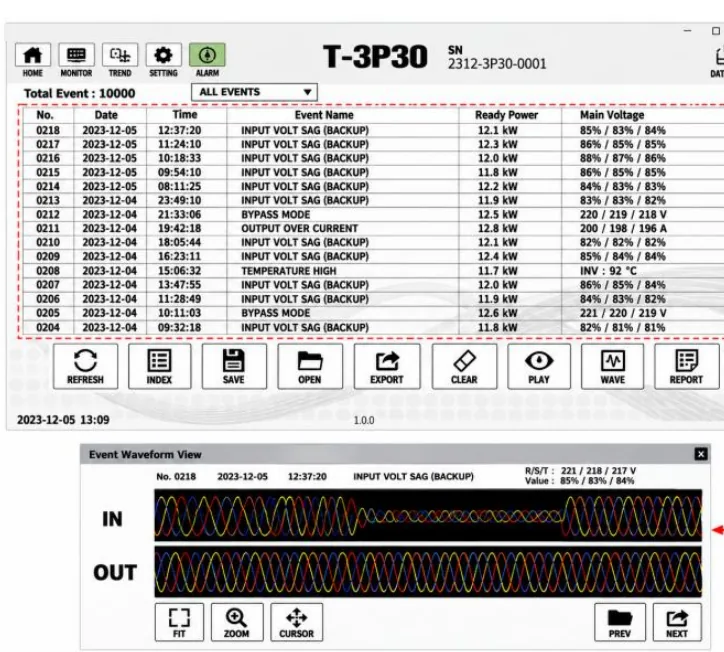
| Event log | Stores 10,000 events and 30 sag waveforms |
| Communications | RS485, Ethernet (RJ45), USB; connects to facility monitoring systems |
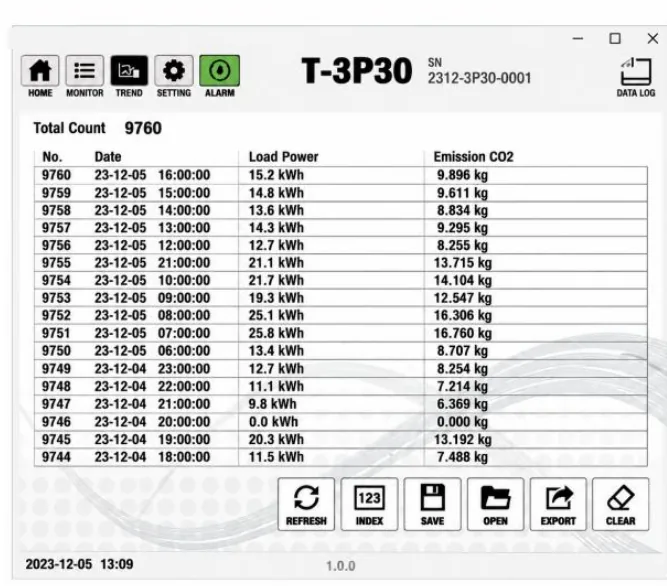
| Extras | Capacitor health, energy and carbon logs, TPM software |
| Environment | 0–40°C, 20–90% humidity, indoor use only |
| Cooling | Large fans exhaust heat outward |
| Capacity | 850 VA | 1 kVA | 2 kVA | 3 kVA | 5 kVA | 10 kVA |
|---|---|---|---|---|---|---|
| Rated current 110 V (A) | 8.2 | 9.1 | 18.2 | 27.3 | 45.5 | 90.9 |
| Rated current 220 V (A) | 4.1 | 4.5 | 9.1 | 13.6 | 22.7 | 45.5 |
| Input/output breaker 110 V | 15A | 20A | 20A | 50A | 100A | 150A |
| Input/output breaker 220 V | 15A | 20A | 20A | 40A | 50A | 75A |
| Full-load ride-through | 2 s | 2 s | 3 s | 3 s | 3 s | 3 s |
| Size W×D×H (mm) | 170×140×460 wall-mount | 480×430×190 | 480×430×210 | 510×420×245 | 540×490×245 | 570×580×290 |
| Weight (kg) | 12 | 21 | 29 | 40 | 54 | 73 |
| Capacity (kVA) | 5 | 10 | 15 | 20 | 30 | 40 | 50 | 60 | 70 | 80 | 100 | 150 | 200 |
|---|---|---|---|---|---|---|---|---|---|---|---|---|---|
| Rated current 220 V (A) | 13.1 | 26.2 | 39.4 | 52.5 | 78.7 | 105 | 131.2 | 157.5 | 183.7 | 210 | 262.4 | 393.6 | 525 |
| Rated current 380 V (A) | 7.6 | 15.2 | 22.8 | 30.4 | 45.6 | 60.8 | 76 | 91.2 | 106.4 | 121.6 | 151.9 | 228 | 304 |
| Rated current 440 V (A) | 6.6 | 13.1 | 19.7 | 26.2 | 39.4 | 52.5 | 65.6 | 78.7 | 91.9 | 105 | 131.2 | 197 | 262.4 |
| Breaker 220 V | 30A | 40A | 75A | 75A | 100A | 150A | 200A | 250A | 300A | 300A | 400A | 600A | 800A |
| Breaker 380/440 V | 20A | 30A | 40A | 50A | 75A | 100A | 125A | 150A | 200A | 200A | 250A | 350A | 450A |
| Size W×D×H (mm) | 420×710 ×1000 | 440×760 ×1080 | 440×760 ×1120 | 460×810 ×1150 | 460×810 ×1200 | 490×850 ×1380 | 490×850 ×1380 | 540×950 ×1450 | 540×950 ×1450 | 540×950 ×1570 | 640×1000 ×1800 | 790×1450 ×1810 | Contact us |
| Weight (kg) | 130 | 175 | 211 | 251 | 288 | 365 | 415 | 440 | 490 | 505 | 520 | 843 | 1,300 |
Three-phase models ride through for 3 s at full load. Size and enclosure can be customized for the site. Scroll the table sideways.
The VSP sits on a bypass. Any critical fault — overheat, capacitor, overcurrent, overvoltage — switches it back to bypass, and the tool stays on mains.
Capacitor boards are insulated to prevent leakage and terminal shorts; temperature monitoring, cooling fans and fire compartment management can be added.
When, which phase, how deep, how long? Facility teams can show the waveforms to the utility and management, and put energy and carbon data straight into ESG reports.
Yes. Standard models from 0.85 kVA single-phase to 150 kVA three-phase — 15 capacities in all — each have two CE documents, EMC (electromagnetic compatibility, 2014/30/EU) and LVD (low-voltage safety, 2014/35/EU), based on the EU UPS standard series EN 62040. For 9 of the capacities, the technical files were reviewed by the Czech state testing institute SZÚ (Strojírenský zkušební ústav), which issued attestations of conformity; the other 6 are covered by EC declarations of conformity signed by the manufacturer under the same standards.
Click a certificate to enlarge. To protect supply-chain information, the manufacturer's name, address and signature have been redacted; if you need the complete documents (for example, for approvals or import customs), please contact us.
The rule is simple: which tools stopped over the past year because the power "blinked"? Start with those.
Stepper / Scanner, Etcher, CVD, PVD, Sputter, Ion Implant
No interruptions, scrap or recalibrationGrinder, Dicing Saw, CMP
Avoid mid-process stops and wafer damageTester, Handler, Die Bonder, Wire Bonder
No lot interruptions or restartsRobot, EFEM, Sorter, OHT / AMHS
Avoid servo, PLC and robot resetsVacuum / Cryo Pump, Chiller, Blower
No cascading tool shutdownsReflow, oven and furnace control systems
No temperature, fan or conveyor faultsCoaters, exposure, deposition, lasers, CNC
No interrupted runs or scrapIPCs, PLCs, controllers, comms
No data loss or control dropsMost used in: lithography (coat, expose, develop), wafer probe, final test, reflow, CMP, backgrinding
Click a flowchart to open it with relevant stations outlined in orange; click a box for details. Based on our process flowcharts.
The most convincing moment of a POC: at the next sag, tools without a VSP alarm, stop and take hours to recover; the tool with a VSP keeps producing and leaves only an event record.
It depends on what kind of "unstable" it is. If tools trip when the lights flicker and run normally after restart, that's a voltage sag — exactly what a sag protector is for. For long outages you need a UPS or generator; for sustained high or low voltage you need an AVR; if equipment is burned out by surges, you need surge protection. Check the trip records to see which it is, then decide. Lightning trips: surge or sag? →
A voltage sag is a brief drop to 10–90% of rated voltage that then recovers — the power isn't cut. An outage is a drop below 10%. Per IEEE 1159, a sag lasts half a cycle to 1 minute; those in Taiwan's science parks usually last about 0.1 s, and people only see the lights flicker.
Because the tool's control system can't ride through a 0.1-second power dip. Pumps, heaters and motors survive on inertia, but PLCs, control power supplies and contactors reset within milliseconds; the tool alarms and stops, and it takes hours to reboot, check and requalify.
Most sags originate outside the plant — lightning, line faults, neighboring customer faults, excavation damage — so a factory can't stop them, only help its equipment ride through. There are three layers: choose SEMI F47-compliant equipment; add sag protectors or UPS to the control circuits that reset; and use power quality monitoring to log every sag and protect the tools that trip most first. See all 5 prevention methods →
A UPS provides backup during outages; a sag protector handles sags within 3 seconds. An online UPS also handles sags, but double conversion running 24 hours loses about 3–6% of power continuously, and lead-acid batteries need replacing every 3–5 years. A sag protector runs on bypass with almost no loss and uses supercapacitors that need no battery replacement. If every control circuit that resets is already on an adequately sized online UPS, you don't need one.
Because SEMI F47 only requires the main equipment to keep running at 50% voltage for 0.2 s, 70% for 0.5 s and 80% for 1 s. Real sags in Taiwan often go below 50%, are unbalanced across phases or repeat, and peripherals like robots, communications and control power supplies aren't necessarily validated — so F47-compliant tools can still stop.
Size it for the control circuits you're protecting, not the whole tool. A 100 kVA tool usually needs only a few kVA if you protect just the PLC, IPC, robot, control power and EMO circuits; an air compressor with only its control unit connected needs just 850 VA. Standard models are single-phase 850 VA–10 kVA and three-phase 5–200 kVA; actual capacity depends on an on-site review of the tool's wiring. See 5 calculation steps with worked examples →
Up to 3 seconds at rated load (2 seconds for the 850 VA and 1 kVA models), with an average switchover time of 0.7–1 ms. It's designed for sags, not outage backup; outages longer than 3 seconds still need a UPS or generator, and the two can coexist.
Yes, as long as the cumulative ride-through stays within its capacity. Three-phase models can compensate continuously within their 3-second capacity; single-phase 850 VA and 1 kVA models can compensate repeatedly within 2 seconds. They recharge automatically after discharge.
No. The sag protector is built on a bypass architecture; if it detects over-temperature, a capacitor fault, overcurrent or overvoltage, it switches back to bypass automatically and the tool stays on utility power.
No batteries to replace. It stores energy in supercapacitors with a design life of about 10 years; inspection is recommended in year 8, and built-in capacitor performance measurement lets you track their condition in advance. By comparison, UPS lead-acid batteries usually need replacing every 3–5 years.
Price depends mainly on four things: the load capacity to protect (from single-phase 850 VA to three-phase 200 kVA, a wide range), phase and voltage, installation location and wiring work, and whether customization is needed. Because only the control circuits that reset are protected, the capacity needed is usually far smaller than the whole tool — so measuring first gives the most accurate quote. Send us the tool models and trip records and we'll provide a formal quote after an on-site assessment. Book an assessment and quote →
It depends on where it's wired. If internal tool wiring is involved, the warranty may be affected, so confirm the wiring method with the equipment maker before deployment; DEYly can evaluate it together with the equipment maker.
Book a sag risk assessment and let the data show which tools need protection most.


