
Key takeaways: What is an RFID tag, and how do you choose one?
An RFID tag contains a chip and antenna. The reader sends out radio waves and the tag replies with the ID stored on its chip—no line of sight or alignment needed. When choosing a tag, start with the frequency band: LF and HF (including smartphone NFC) have short read ranges and suit access control and card tapping, while asset tracking and inventory typically use UHF, which can read several meters away and many tags at once. Next, consider what the tag will be attached to: standard tags on metal won't read or have greatly reduced range, so you need on-metal tags. Tag price depends mainly on frequency band, form factor (label or hard case), on-metal capability, and order volume. Disposable items need new tags for every batch, while reusable assets only need to be tagged once.
How does an RFID tag work?
An RFID (radio frequency identification) tag contains a chip and an antenna coil, and the chip stores an ID number. Common passive tags have no battery: the reader emits radio waves, the tag's antenna harvests that energy to wake the chip, and the chip sends its ID back to the reader. Taiwan's freeway ETC eTag works on the same principle.
- Reader emits radio waves→Tags within range receive energy
- Tag returns its chip ID→The reader can receive multiple tags at once
- ID is sent to the system→Mapped to which item it is, where it is, and when it passed
There are also active tags with built-in batteries that transmit signals on their own. They have longer read ranges but are bulkier and more expensive, and are mostly used to locate and track large objects such as shipping containers and vehicles. For fixtures, tools, and totes in a factory, passive tags are almost always sufficient.
LF vs. HF vs. UHF: start with the frequency band
| Frequency band | Read range | Reads multiple tags at once | Common uses |
|---|---|---|---|
| LF (low frequency) | Very short, nearly contact | Not suitable | Access cards, animal microchips |
| HF (high frequency, incl. NFC) | Short; NFC is typically within 2 cm | Limited | Transit cards (e.g., EasyCard), libraries, phone tapping |
| UHF (ultra-high frequency) | Up to several meters | Suitable; reads an entire batch at once | Asset tracking, warehouse inventory, logistics, ETC |
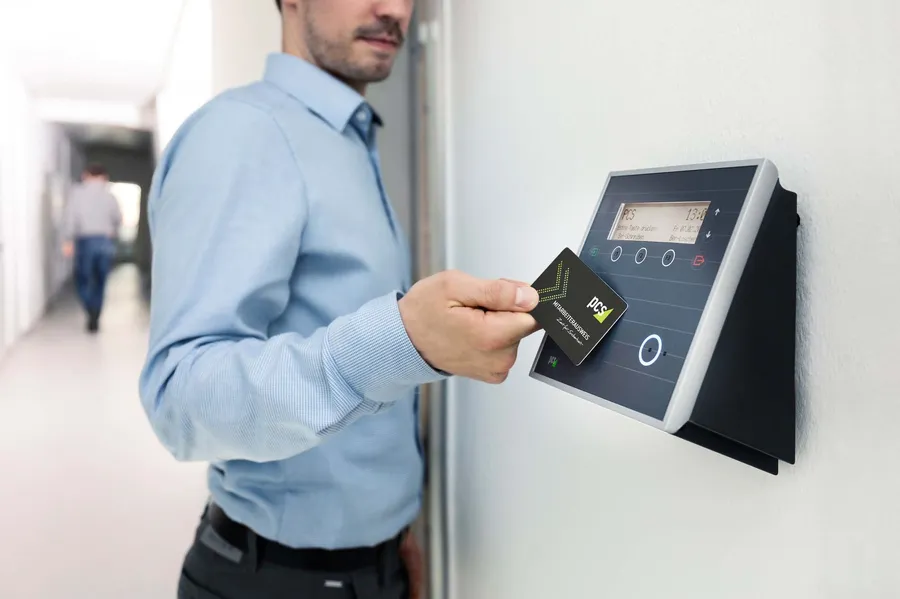
NFC operates at 13.56 MHz with a typical range within 2 cm (NFC Forum), so a smartphone can't read UHF tags. The common international standard for passive UHF tags is ISO/IEC 18000-63, covering the 860–960 MHz band (ISO). The bands actually allocated vary by country, so choose a reader model that complies with local regulations.
If your goal is to read an entire row at once during inventory or automatically log items passing through doorways, you need UHF. See "RFID Asset Tracking Solution" for how it's done.
How to choose tag form factor and material
| Form | Features | Best for |
|---|---|---|
| Paper / PET label tags | Thin and inexpensive; can be printed with barcodes and text | Cardboard boxes, plastic boxes, file folders |
| On-metal tags | Has an isolation layer or special antenna so it reads even on metal | Fixtures, tools, metal racks, equipment |
| Hard-case tags | Plastic or resin housing; impact-resistant and can be mounted with screws or cable ties | Totes, pallets, outdoor assets |
| High-temperature and chemical-resistant tags | Special materials that withstand washing, baking, or chemicals | Carriers that go through washing or high-temperature processes |
When choosing a tag, also confirm whether it can go through washing, baking, or chemicals along with the item, and whether you need a printed barcode as well. Many sites use dual "RFID + barcode" labeling: if the reader can't pick up a tag, you can still scan it with a barcode scanner or handheld terminal.
Why won't tags read on metal or near liquids?
UHF tags rely on their antenna to receive radio waves. Metal reflects radio waves and interferes with the antenna, so a standard tag stuck directly on metal will have a greatly reduced read range or won't read at all. Water and water-containing items absorb radio waves, so liquid-filled containers also lower read rates. Common solutions:
Switch to on-metal tags
These tags have an isolation layer or dedicated antenna on the back, so they can be mounted directly on metal surfaces.
Adjust placement and orientation
Avoid recesses, corners, and spots blocked by other metal, and orient the tag toward where the reader will pass.
Test on site before deciding
Attach tags on actual racks, next to machines, and at doorways, record the read rates, then decide on tag models and reader positions.
Read ranges from labs or catalogs are all measured under ideal conditions. Always test on site before rollout—it's the cheapest way to avoid discovering after purchase that tags won't read.
How to estimate RFID tag prices
There's no single price for RFID tags. Price depends mainly on these factors:
| Factor | Effect on price |
|---|---|
| Form | Paper labels are cheapest; hard-case, high-temperature, and chemical-resistant tags cost more |
| On-metal capability | Because of their special construction, on-metal tags often cost several times more than standard tags |
| Order volume | Higher volume means lower unit price; small orders carry noticeably higher unit prices |
| Printing and encoding | Whether barcodes or text are printed, and whether IDs are pre-encoded before shipment |
More important is calculating the total system cost: beyond tags, there are readers and system integration, and only the tags keep growing with the number of items. That's why RFID pays off best for reusable assets (fixtures, tools, totes), where one tag can be read for years. Disposable consumables need new tags every batch, so barcodes usually make more sense there.
FAQ
Do RFID tags need batteries?
Common passive RFID tags don't need batteries; they draw energy from the reader's radio waves and send back their ID. Tags with built-in batteries that transmit on their own are active tags, which have longer read ranges but are larger and more costly.
Can a smartphone read RFID tags?
A smartphone's NFC can only read 13.56 MHz HF tags, usually within a few centimeters. It can't read the UHF tags commonly used for asset tracking; for those you need a UHF reader or a handheld terminal with a UHF sled.
What if RFID tags won't read on metal?
Switch to on-metal tags and adjust placement and orientation, avoiding recesses and blocked spots. Before rollout, attach tags on actual racks and next to machines to test read rates, then decide on the tag model.
How much does an RFID tag cost?
It depends on frequency band, form factor, on-metal capability, printing needs, and order volume, and prices can vary several-fold. When evaluating, include readers and system integration as well as tag unit price, and prioritize reusable assets.
What's the difference between RFID tags and barcodes?
Barcodes must be aimed at and scanned one at a time, but cost very little. RFID needs no alignment or line of sight, reads many tags at once, and can be installed at doorways for automatic logging, but tags and equipment cost more. The two are often used together: RFID for batch reading, barcodes as backup.