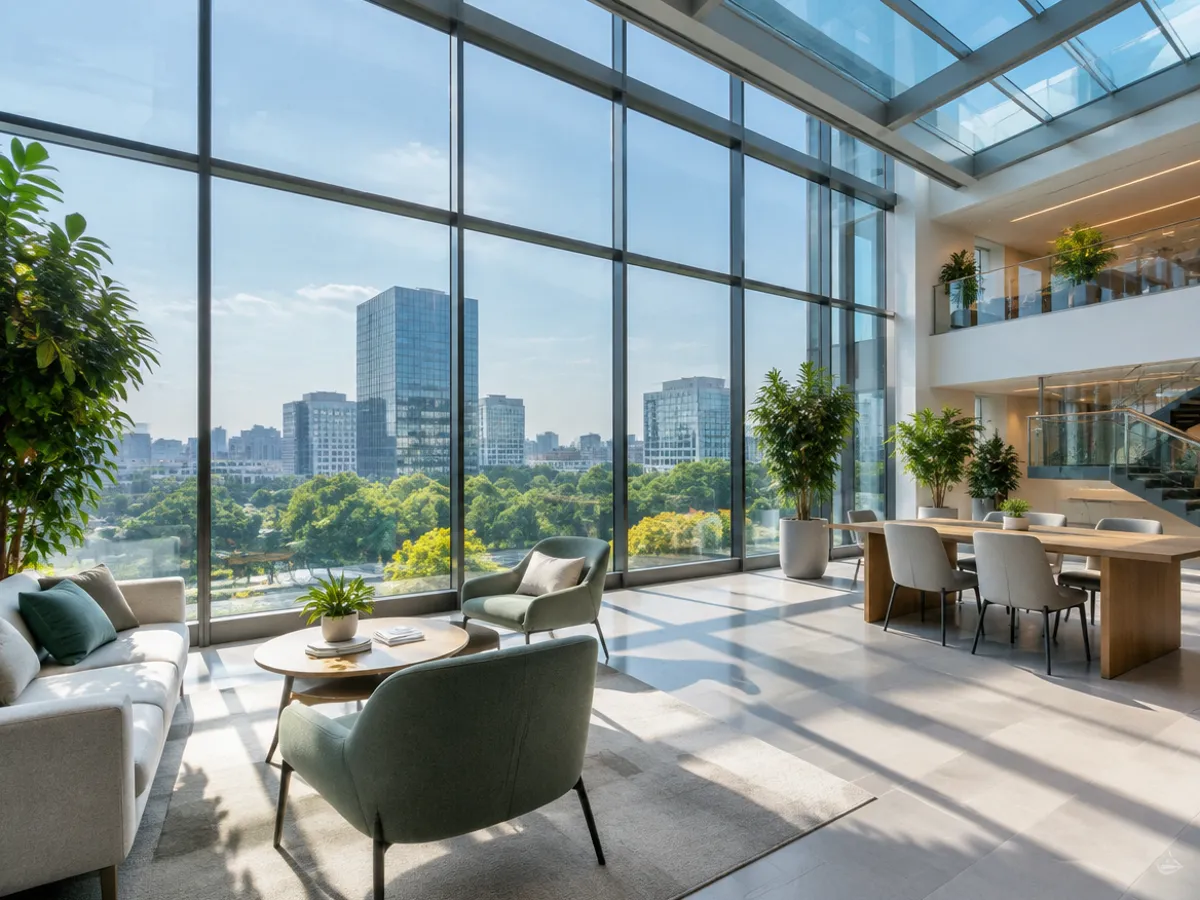
Summary: how much comfier by the window?
At an office building with 38℃ outdoors and AC set to 26℃, the office with transparent window film saw thermal dissatisfaction (PPD) fall from 40% to 5%, with thermal sensation moving from "slightly warm" to "comfortable." A glass dome's mean radiant temperature dropped from 33.7℃ to 26.4℃; in a lobby with no AC, globe temperature was up to 11.5℃ lower. The film transmits about 70% of visible light, so rooms don't get dark.
Why window seats stay hot
Whether people feel hot depends not just on air temperature but on radiant heat from surrounding surfaces. Sunlight through the glass falls directly on people, and the sun-heated glass keeps radiating heat, so people by the window still feel warm even at 26℃. Turning the AC down just makes people away from the windows feel cold.
Just colder AC
- Windows still hot, interior gets cold
- Higher AC load and power bills
- Solar heat keeps coming through the glass
Cooling window film
- Keeps about 70% of visible light
- Blocks solar heat, lowers glass surface temperature
- Smaller difference between window and interior
What are PMV and PPD?
They're two international indices for indoor thermal comfort (ISO 7730): PMV is the predicted thermal sensation from −3 (cold) to +3 (hot), with 0 meaning neutral; PPD is the predicted percentage of people who will be dissatisfied. The closer PMV is to 0 and the lower the PPD, the more people feel comfortable — much closer to "how people actually feel" than air temperature alone.
Office: discomfort 40% → 5%
Two offices with similar conditions — one with transparent window film on its glass, one left as is — were measured at the same time on a sunny day in August 2022 with 38℃ outdoors and AC set to 26℃ in both.
| Item | No film | Office with film |
|---|---|---|
| Sensation (PMV) | 1.30 (warm) | 0.14 (comfy) |
| Discomfort (PPD) | 40% | 5% |
| Air temperature | — | Up to 2.8℃ lower |
| Globe temperature | — | Up to 4.3℃ lower |
Glass dome: radiant temp −7.3℃, comfort up to Category I
Transparent window film was applied to the glass of a large glass-domed hall in a religious building. Comparing before and after on a sunny day in June 2022 with 35℃ outdoors and AC set to 26℃:
| Item | Before | After |
|---|---|---|
| Radiant temp | 33.7℃ | 26.4℃ |
| SET* | 29.5℃ | 25.8℃ |
| Sensation (PMV) | 1.05 | 0.14 |
| Discomfort (PPD) | 28% | 5% |
Thermal sensation dropped from "slightly warm" to "neutral," and the hall's thermal comfort rating rose from non-compliant to Category I.
Lobby, no AC: globe temp up to 11.5℃ lower
Another lobby in the same building, at noon on a sunny day in March 2022 with 20℃ outdoors and no AC, comparing areas with and without film:
| Item | Without film | With film |
|---|---|---|
| Sensation (PMV) | 3.51 (hot) | 0.74 (warm) |
| Discomfort (PPD) | 100% | 16% |
| Globe temperature | — | Up to 11.5℃ lower |
| Air temperature | — | Up to 3.4℃ lower |
With only 20℃ outdoors in spring, the area under the glass was still hot enough for 100% dissatisfaction — showing the stuffiness comes mainly from solar radiation, not air temperature.
More sites and film specs
Transparent window film is also used on airport boarding bridge glass: at a regional airport in Japan, the fixed bridge glass (46 ㎡) was 10.9–11.3℃ cooler indoors in summer than an untreated corridor, with about 23% annual energy saving (see the airport boarding bridge case). It has also been applied at exhibition centers, shopping mall skylights, a corporate headquarters and homes in Thailand, and office buildings in Dubai.
| Item | Value |
|---|---|
| Visible light transmittance | About 70% |
| Shading coeff. | 0.66 |
| Emissivity (8–13 μm) | >90% |
| Thickness | 58 μm |
| Applied to | Façades, skylights, domes; inside or out |
FAQ
Will transparent radiative cooling film make the room darker?
Visible light transmission is about 70%, keeping most daylight; typical office lighting isn't affected.
How is it different from ordinary solar film?
Ordinary solar film mainly blocks sunlight; transparent radiative cooling film also releases heat as infrared in the 8–13 μm atmospheric window, lowering the glass's own temperature and reducing radiant heat from the glass into the room.
Inside or outside the glass?
Either, depending on glass type, floor height and installation conditions. Outside application performs better but requires work at height; inside application is easier and suits retrofits of existing buildings.
Where is the difference most noticeable?
Window seats along large glass façades, atriums and lobbies under skylights, meeting rooms and reception areas, corridors under glass canopies, and glass-walled control rooms in factories.