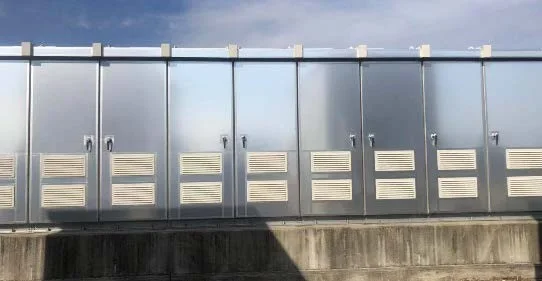
Summary: how much cooler do cabinets get?
With reflective radiative cooling film on the shells of 10 kV–750 kV transformer cabinets, distribution cabinets and control cabinets, results across sites show surface temperatures up to 15–30℃ lower and interior temperatures up to 7–16℃ lower. An HV substation cabinet at a solar plant in Japan went from 53.6℃ to 22.0℃ at the surface; at another plant, a treated converter cabinet with its fan removed was still 4.5℃ cooler inside than an untreated cabinet with a fan.
Why cabinet heat matters
Enclosures have metal shells whose surfaces often exceed 50℃ in summer sun; that heat passes inside and, combined with the equipment's own heat, keeps interior temperatures high. Heat makes breakers trip early, ages capacitors and electronics faster, and is a common cause of telecom equipment failures. The usual fix is adding fans or enclosure AC, but those need power and maintenance and add points of failure.
Fans, enclosure AC
- Need power, consume energy continuously
- Filters and fans need maintenance
- One more point of failure
- Heat keeps coming in through the shell
Film on the shell
- No power, no energy use
- No moving parts
- Blocks solar heat at the source
- Surface can be below outdoor air
Japan solar plant: HV cabinet −31.6℃
At a solar plant in Japan, 7 HV substation cabinets (each about 8.2 m × 2.1 m × 2.2 m) had about 50 ㎡ of reflective film applied to each shell, and surface temperatures of treated and untreated cabinets were compared with a thermal camera. Another solar plant ran a stricter comparison on HV converter cabinets: the treated cabinet had its fan removed, while the control cabinet kept its fan.
| Measurement | Untreated | Treated | Difference |
|---|---|---|---|
| HV cabinet surface | 53.6℃ | 22.0℃ | −31.6℃ |
| HV converter interior | 40.4℃ (with fan) | 35.9℃ (fan removed) | −4.5℃ |
In the second comparison, the treated cabinet had no fan yet was still 4.5℃ cooler than the control cabinet with a fan — saving the fan's energy and maintenance at the same time.
Substations and cabinets in 27 provinces
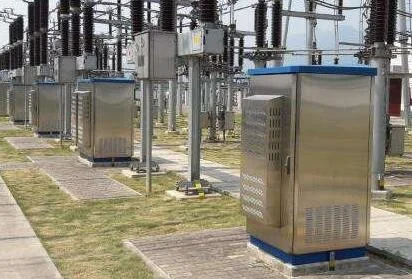
Reflective film has been used at outdoor and mobile substations covering 10 kV–750 kV equipment, including control cabinets, switchgear, junction boxes, combined distribution cabinets, transformers and control room buildings across 27 provinces. Results across sites:
| Item | Result |
|---|---|
| Enclosure surface temperature | Up to 15–30℃ lower |
| Interior temperature | Up to 7–16℃ lower |
| Benefits | More stable, reliable equipment operation and less AC run time |
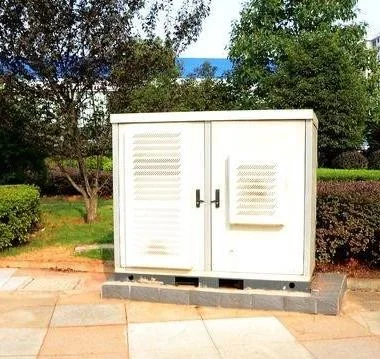
Telecom room: temperatures even AC couldn't hold, now stable below 28℃
Two telecom rooms with similar conditions — one with reflective film on the roof and exterior walls, one left as is — were compared over 4 consecutive sunny days with AC on.
| Item | Untreated room | Treated room |
|---|---|---|
| Room roof temp | Max difference 37.9℃ | |
| Daytime room temp | Up to 31.4℃, 3.4℃ above the AC setpoint | Always below 28℃ |
Equipment rooms are temperature-sensitive, and problems start when the room exceeds the setpoint. With the film, the AC no longer fights solar heat and room temperature swings disappear.
Container: 8.6℃ cooler, no AC
A container building in Malaysia with no AC or ventilation fan (6.1 m × 2.4 m × 2.6 m) had about 60 ㎡ of reflective film applied to its shell:
| Measurement | Untreated | Treated | Difference |
|---|---|---|---|
| Shell surface | 43.3℃ | 31.0℃ | −12.3℃ |
| Interior air | 37.9℃ | 29.3℃ | −8.6℃ |
Site offices, storage containers and outdoor guard booths share these conditions.
FAQ
How much cooler does an outdoor distribution cabinet get inside with radiative cooling film?
Across transformer and distribution cabinet sites, interior temperatures fell by up to 7–16℃ and surfaces by up to 15–30℃. An HV cabinet at a solar plant in Japan went from 53.6℃ to 22.0℃ at the surface. Actual reductions depend on sun exposure, enclosure size and internal heat load.
With the film applied, can the cabinet's fan be removed?
It depends on internal heat load. In a comparison at a solar plant in Japan, a treated cabinet with its fan removed was still 4.5℃ cooler than an untreated cabinet with a fan; but equipment with high heat output still needs cooling, so we recommend treating one cabinet first and measuring its interior temperature before deciding.
Will the film affect vents or cabinet maintenance?
The film goes only on flat shell surfaces, avoiding vents, door gaps and nameplates, so doors can still be opened for maintenance.
Which locations in Taiwanese factories are suitable?
Outdoor substation enclosures, site distribution cabinets, rooftop control cabinets, monitoring cabinets, container site offices, and electrical room roofs exposed to the sun all day.