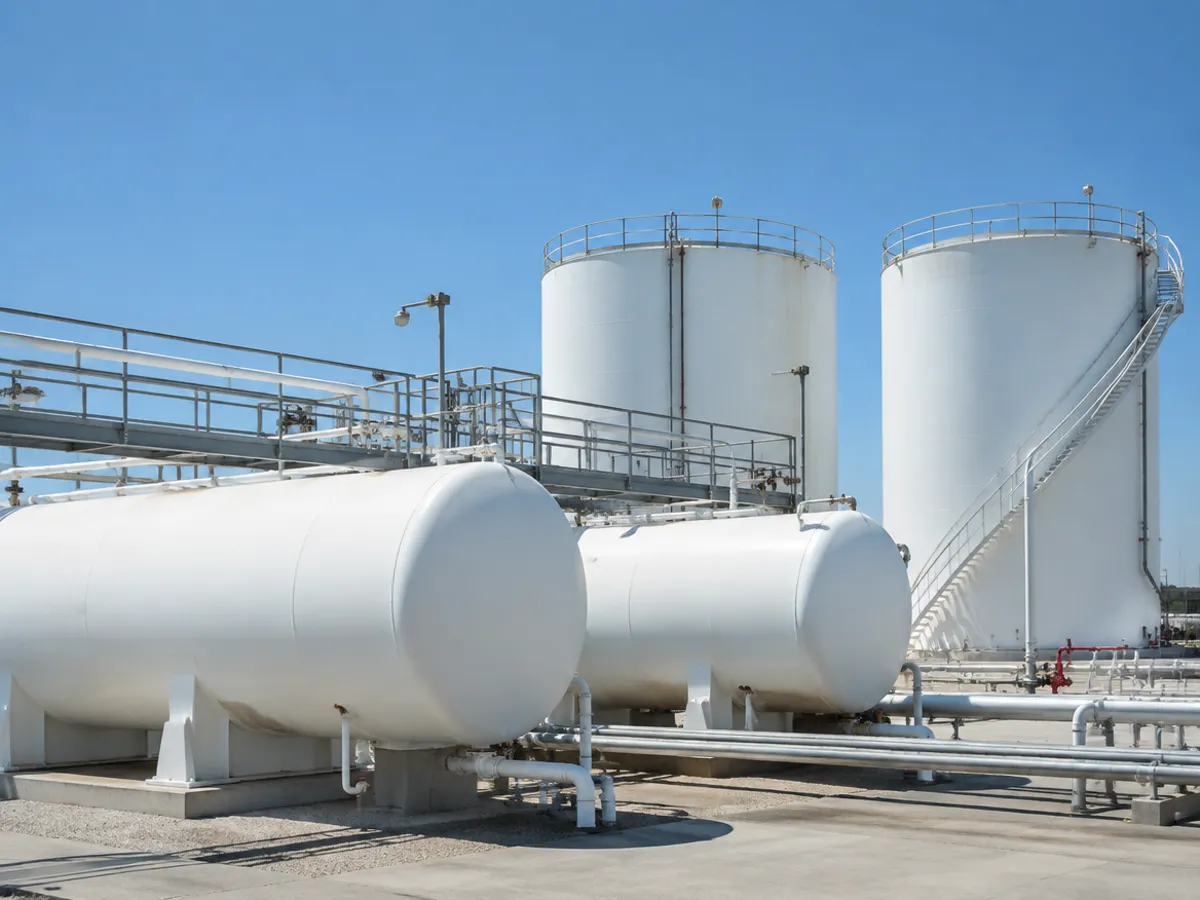
Summary: how much cooler with cooling paint?
After cooling coating was applied to light-oil absorption tanks at a petrochemical plant, compared with untreated tanks of the same type on sunny days, the tank top was up to 15.6℃ cooler in the daytime, the middle 12.8℃ cooler and the bottom 11.1℃ cooler, with outlet temperature down from 40℃ to 35℃. At another depot, a vertical tank's surface dropped more than 25℃ and the oil 2℃. Coating suits complex surfaces that are hard to cover with film; flat roofs and enclosures are better served by reflective film.
Why cool oil storage tanks?
Tanks in the petrochemical and oil industry are mostly steel, sitting in the sun for long periods in summer, keeping surface and internal temperatures high. Higher temperatures mean higher tank pressure and faster evaporation, bringing safety risks, product losses and volatile organic compound (VOC) emissions. The common fix is water spraying, which needs constant water and power and accelerates tank corrosion.
Water spray
- Constant water and power
- Heats up again once spraying stops
- Moisture accelerates tank corrosion
Cooling paint
- No power, no water
- Passive cooling all day
- Doubles as a protective coating for the tank
Plant tanks: 7 days, top up to 15.6℃ cooler
Light-oil absorption tanks at a petrochemical plant (horizontal tank 1.6 m in diameter, vertical tank 1.2 m) had about 70 ㎡ of cooling coating applied in September 2019, and their maximum daytime temperature difference was compared with untreated tanks in the same area over 7 consecutive days:
| Date · weather | Tank top | Tank middle | Tank bottom |
|---|---|---|---|
| 10/01 rain | −0.8℃ | −1.7℃ | −4.5℃ |
| 10/02 overcast | −13.7℃ | −12.4℃ | −9.1℃ |
| 10/03 sunny | −15.6℃ | −12.8℃ | −11.1℃ |
| 10/04 overcast | −10.3℃ | −7.8℃ | −8.7℃ |
| 10/05 rain | −7.4℃ | −5.5℃ | −7.4℃ |
| 10/06 overcast | −5.5℃ | −5.3℃ | −7.0℃ |
| 10/07 sunny | −11.1℃ | −9.1℃ | −8.4℃ |
The effect is greatest on sunny days; on cloudy and rainy days there's less sun and the difference shrinks, but at night the treated tank stays 0.6–9.4℃ cooler than the untreated one. Outlet temperature dropped from 40℃ to 35℃.
Depot tank: surface −25℃, oil −2℃
At an oil depot, one vertical steel storage tank was coated and another left as is: the treated tank's surface temperature dropped by more than 25℃ and the oil inside by 2℃. Lower oil temperature means lower evaporation and pressure risk.
Containers, substations, warehouses
| Site | Treated | Result |
|---|---|---|
| Container, Dubai | Paint on the shell | Ceiling gap up to 18℃ |
| A substation in Malaysia | Paint on the exterior | Surface up to 19.6℃ lower |
| Small warehouse (2.5 × 2.3 × 2.5 m) | Paint on roof and walls | Energy 32.87 → 22.49 kWh, down 31.6% |
When the same small warehouse was covered with reflective film instead, energy fell from 18.04 to 9.05 kWh, down 49.8%. Where flat surfaces can take film, film usually outperforms coating.
Roofs and walls
Cooling coating has also been used on the roof of a business aviation terminal at an airport in Japan (aluminum-zinc steel, about 300 ㎡), the stainless steel roof of an airport guard booth (about 60 ㎡) and the stainless steel roof of an auto repair shop (about 900 ㎡).
For exterior walls there's a stone-texture cooling coating that runs 10–15℃ cooler than ordinary stone-effect paint, used on the walls of a large-scale renovation of older housing (about 800,000 ㎡) — combining appearance with cooling.
Paint or film?
| Item | Cooling coating | Reflective film |
|---|---|---|
| Suitable surfaces | Tanks, steel, piping, complex shapes | Flat roofs, cabinets, containers, bridges |
| Solar reflectance | About 86% | About 83% |
| Emissivity | About 90% | >90% |
| Application | 3 coats; surface prep needed | Sticks on smooth or rough surfaces |
| Small warehouse saving | 31.6% | 49.8% |
FAQ
Can radiative cooling coating be applied to existing oil tanks?
Yes. Existing tanks get surface preparation (rust removal, cleaning) first, then primer, intermediate and topcoat in sequence. The coating works on stainless steel, carbon steel, concrete and other substrates.
How much cooler do oil tanks get with cooling coating?
In a petrochemical plant comparison, the tank top was up to 15.6℃ cooler in the daytime on sunny days; at another depot a vertical tank's surface dropped more than 25℃ and the oil 2℃. Actual reductions depend on sun exposure, tank size and product.
Which works better, coating or film?
On a small warehouse under the same conditions, reflective film saved 49.8% and coating 31.6%. Use film where flat surfaces allow; use coating on complex areas with piping and welds that are hard to cover with film. The two can also be combined.
Which sites in Taiwan are suitable?
Storage tanks in petrochemical and oil industries, chemical tanks, factory steel roofs and pipe racks, outdoor substation buildings, container offices, and buildings that want lower exterior wall temperatures.