Summary: what is radiative cooling?
Radiative cooling is when an object sheds heat by emitting infrared at 8–13 μm. The atmosphere barely absorbs this band (called the "atmospheric window"), so heat escapes directly to outer space at about −270 °C. Radiative cooling materials also reflect most sunlight, so they lose more heat than they absorb and stay below air temperature even in direct sun, with no electricity at all. In measurements, metal roof surfaces dropped 20–35 °C, while winter heating energy rose by no more than 3.2%.
Why clear nights feel colder
Clear, cloudless winter nights are much colder than overcast ones, and frost forms on the grass by morning. That's because the ground radiates heat upward as infrared; clouds send it back, but on clear nights it passes straight through the atmosphere to outer space. This phenomenon of "shedding heat by radiation" is radiative cooling.
Earth's surface is about 25 °C and outer space about −270 °C: a huge, free "heat sink." The problem is that the sun's surface is about 5,500 °C, so during the day far more heat comes in than goes out, and ordinary objects just get hotter in the sun.
Daytime cooling: reflect and radiate
To stay below air temperature during the day, a radiative cooling material must do two things at once:
- Reflect sunlight→Bounce 0.3–3 μm away
- Radiate in the window→~100% emissivity at 8–13 μm
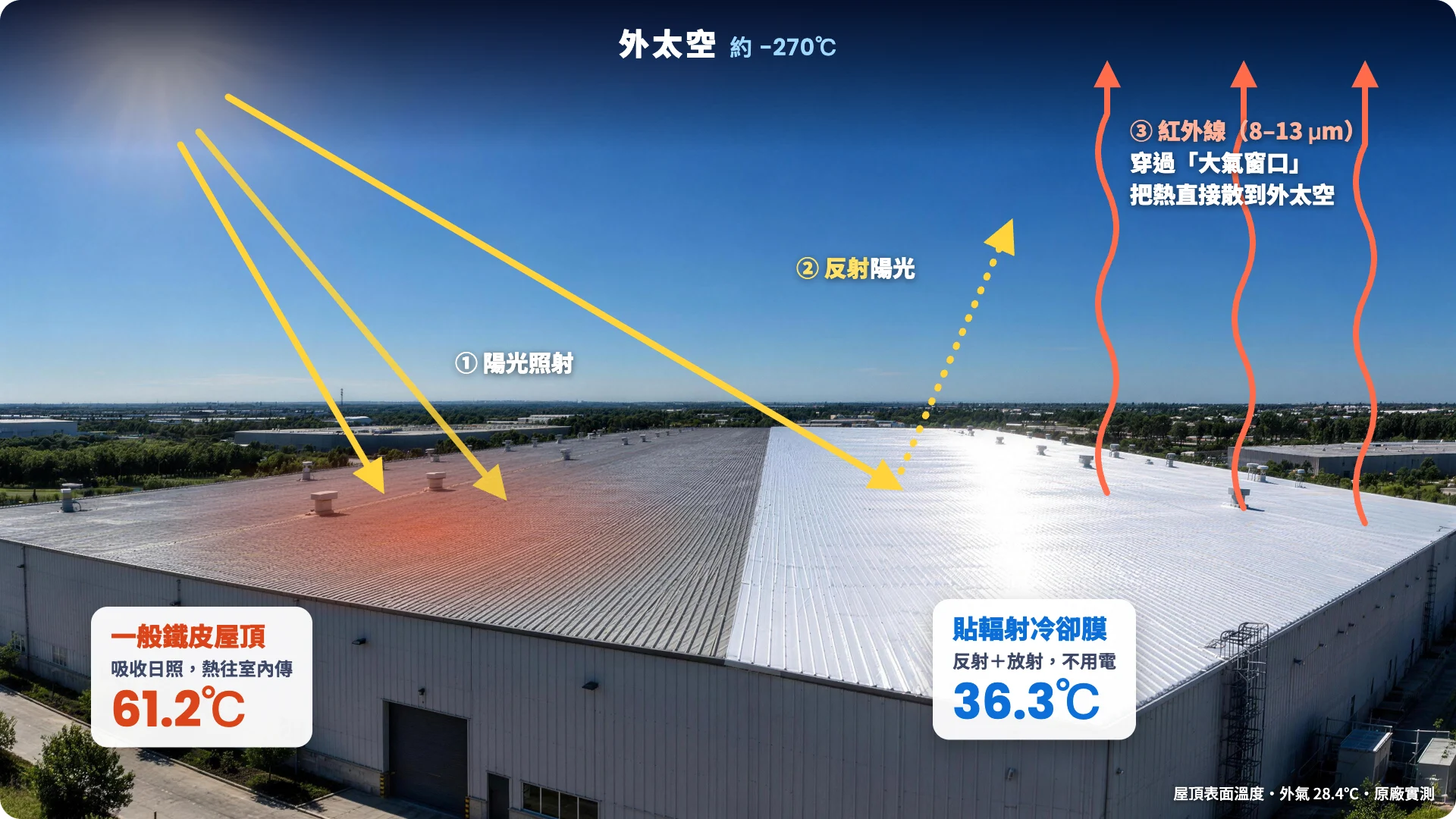
Ordinary white paint does only the first, so it can only "absorb less heat." Radiative cooling materials use special optical structures to do both; when heat out exceeds heat in, the surface drops below air temperature. In commercial products, for example, a reflective film has about 83% solar reflectance and a cooling paint about 86%, with emissivity above 90% at 8–13 μm for both.
vs. reflective paint and insulation
| Comparison | Reflective paint | Insulation | Radiative cooling |
|---|---|---|---|
| Principle | Reflects some sun | Slows heat flow | Reflects sun + radiates heat to space |
| Surface in sun | Above outdoor air | Above outdoor air | Below air temp |
| Heat already inside | Can't remove it | Trapped inside | Keeps shedding it |
| Energy use | No electricity | No electricity | No electricity |
In a side-by-side test on metal panels in Tokyo, the surface with radiative cooling film was 5.9 °C cooler than other products, and radiative cooling paint 3.7 °C cooler (outdoor air 17 °C, manufacturer's test).
How much cooler, how much saved?
| Site | Result |
|---|---|
| Prefab (Japan) | Roof surface 61.2 → 36.3 °C; indoor air 42.5 → 33.1 °C |
| Airport bridge (Singapore) | Roof −20–35°C; 44% saved over 2 years |
| Airport walkway (Japan) | Est. ~30% saved, ~109,000 kWh a year |
| Outdoor power cabinets | Surface −15–30°C; inside −7–16°C |
| Granaries (no AC all year) | Up to −10.4°C; −5°C average |
| Oil tanks (paint) | Surface −25°C+; oil −2°C |
| Glass dome (window film) | Radiant 33.7 → 26.4°C; discomfort 28% → 5% |
For full data, see "Airport boarding bridge case" and "Outdoor distribution enclosure case." Savings depend heavily on the building: the larger the roof's share of the exterior surface and the stronger the sun, the bigger the effect.
Colder in winter?
This is the most common question before adoption. The answer: slightly more, but by very little. The manufacturer compared two identical model houses in winter (indoor heating set to 21 °C, outdoor air 0–12 °C):
| Date | Outdoor temperature | Treated (kWh) | Control (kWh) | Increase in use |
|---|---|---|---|---|
| 1/4 | 10~12℃ | 6.77 | 6.75 | 0.3% |
| 1/17 | 4~7℃ | 8.42 | 8.31 | 1.3% |
| 1/27 | 3~8℃ | 7.97 | 7.91 | 0.8% |
| 2/6 | 2~8℃ | 8.06 | 7.89 | 2.2% |
| 2/16 | 0~4℃ | 11.14 | 10.79 | 3.2% |
Why is the winter effect small? The heat an object radiates is proportional to the fourth power of its absolute temperature (the Stefan–Boltzmann law), so with low outdoor temperatures in winter, cooling capacity naturally drops sharply, and even more so when the roof frosts over. Winters are short across most of Taiwan with little heating demand, so cooling energy saved in summer far exceeds the extra heating energy in winter.
Where it works, where it doesn't
- RoofsSunny metal roofs
- Power gearOutdoor cabinets, telecom
- WalkwaysBridges, containers
- GlassWest-facing glass (window film)
- SteelTanks and frames (paint)
- ShadedNo open sky
- InsulatedThick roof insulation
- DustyNever cleaned
- Cold climatesHeating-led
FAQ
What is radiative cooling?
Radiative cooling is when heat is emitted as 8–13 μm infrared, a band that passes straight through the atmosphere to outer space. Radiative cooling materials also reflect most sunlight, so they lose more heat than they absorb and stay below air temperature even in direct sun, with no electricity.
Are radiative cooling, radiant cooling, and passive radiative cooling the same?
Yes. They refer to the same technology under different names; the materials are often called radiative cooling film or radiative cooling paint.
Will it make heating use more energy in winter?
Slightly, but very little. In the manufacturer's winter test, the treated model house used only 0.3%–3.2% more heating energy than the control. Cooling capacity is proportional to the fourth power of temperature, so with low outdoor temperatures in winter, its ability to shed heat naturally drops.
Does it work on cloudy days or at night?
It works best on clear days with an open view of the sky. On cloudy days both sunlight and heat loss decrease, so the effect is smaller. At night there's no sun, but surfaces keep shedding heat and usually stay below air temperature.
Can radiative cooling replace air conditioning?
In most cases not entirely, but it greatly reduces the heat the AC has to handle. In a few cases it can: for example, a treated grain warehouse ran without AC all year and still stayed 10.4 °C cooler than the control.