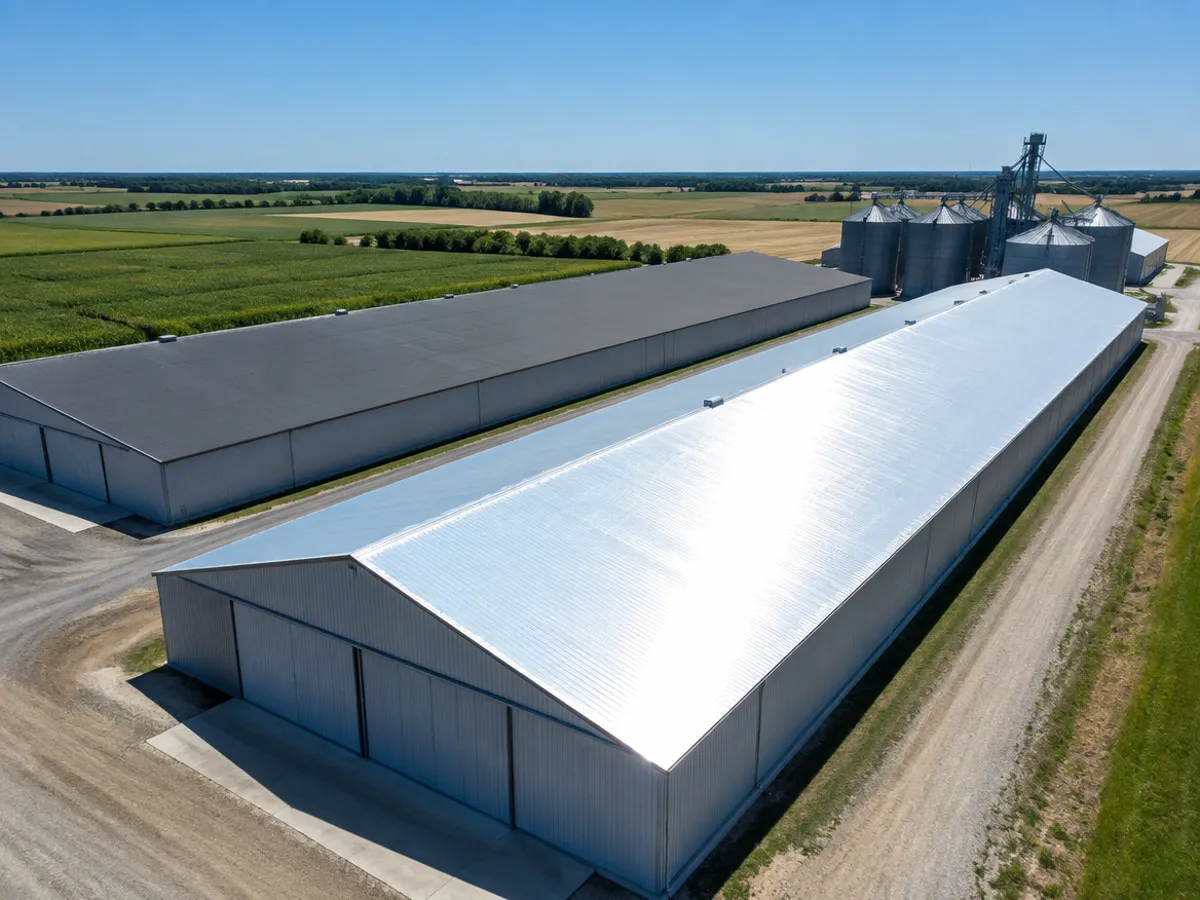
Summary: how much cooler do granaries get?
In a full-year store comparison, the test store with reflective radiative cooling film on its roof and AC off all year was up to 10.4℃ cooler than the control store and 5℃ cooler on average; surface grain was up to 4.5℃ cooler, peaking at only 24.6℃ for the year (control 28.5℃). At a roughly 5,700-ton squat silo, the roof surface was up to 26.1℃ cooler than the adjacent silo. Since 2020 the technology has been applied in 18 provinces across more than 1 million ㎡.
Why heat hurts grain
Grain is alive: the higher the temperature, the more active respiration and pests become, and the faster quality degrades. In summer the roof is in direct sun, heat passes in through the roof and walls, and grain near them warms first — the so-called "hot skin" effect. The usual fix is AC temperature control, but stores are large and the AC must run for long hours, so power and maintenance costs are high.
Add AC
- High upfront and power costs
- Equipment needs maintenance
- Heat keeps coming in through the roof
- Temperature control lost in outages or breakdowns
Roof cooling film
- No power, no energy use
- No moving parts
- Blocks solar heat at the roof
- Can be combined with AC to reduce run time
Full year, AC off: 5℃ cooler on average
Two granaries with similar conditions: the test store had reflective film applied to its roof and the control store was left as is; AC stayed off in both all year, with storage and grain temperatures recorded continuously from July 2020 to December 2021.
| Item | Result |
|---|---|
| Storage temperature | Up to 10.4℃ lower |
| Storage temp (2021 avg.) | −5℃ |
| Top grain temp | Up to 4.5℃ lower |
| Peak top grain temp | Control 28.5℃, test store 24.6℃ |
Except for the outermost ring, grain in the test store stayed below 25℃ all year. In storage regions with a suitable climate, that achieves temperature-controlled storage without AC, saving the AC's upfront, operating and maintenance costs.
Squat silo, 2 weeks: roof up to 26.1℃ cooler
A squat silo holding about 5,700 tons of paddy had reflective film and cooling coating applied to its roof (about 600 ㎡) and sides (about 2,000 ㎡), compared with an adjacent untreated silo. Neither had AC; measurements ran continuously from August 17 to 31, 2020.
| Measurement point | Max difference |
|---|---|
| Roof surface | −26.1℃ |
| Interior air | −5.6℃ |
| Top grain surface | −4.7℃ |
| Grain by the wall | −3.6℃ |
Two granaries: up to 10.6℃ cooler, no AC
| Store | Area treated | Result |
|---|---|---|
| Granary A | 1,524 ㎡ | Up to 6.4℃ cooler, stable all day |
| Granary B | 1,980 ㎡ | Up to 10.6℃ cooler; roof gap up to 31℃ |
Scale: 18 provinces, over 1 million ㎡
Since 2020 the technology has been used on different store types — arched-roof warehouse granaries, color-steel-roof warehouse granaries, triangular-truss stores and squat silos — with more than 1 million ㎡ applied across 18 provinces; about 300,000 ㎡ were delivered in 2023 alone.
Radiative cooling insulation retrofits for granaries have also been included in the national grain authority's "green grain storage improvement" direction (new-type radiative cooling materials may be introduced when building or upgrading high-standard granaries) and listed in a large national grain reserve enterprise's technology promotion catalog.
Which Taiwan warehouses fit?
Any warehouse whose roof is in the sun all day, lets heat in, and stores heat-sensitive goods: farmers' association and rice mill granaries, feed mill raw material stores, ambient food and beverage logistics warehouses, chemical and paint warehouses, and the common metal-roof warehouse.
These are the manufacturer's results at granaries across China; temperature reductions depend on local sun exposure, store type and roof material. Taiwan's climate is hot and humid, so we recommend treating one building or one roof section first and measuring it alongside an adjacent area before deciding.
FAQ
How much does radiative cooling film on a granary roof lower storage temperature?
In a full-year store comparison with AC off all year, storage temperature was up to 10.4℃ lower and 5℃ lower on average, and surface grain up to 4.5℃ lower. Actual reductions depend on sun exposure, store type and roof material.
With the film, can a granary do without AC?
In storage regions with a suitable climate, the test store kept grain below 25℃ all year without AC — effectively replacing AC temperature control. In Taiwan's hot, humid climate, a more realistic approach is to combine it with AC to reduce run time; test first, then evaluate.
Will the store get too cold in winter?
Radiative cooling power weakens as temperatures drop, so the cooling effect is smaller in winter than summer. In the manufacturer's winter comparison with all-electric heating, the treated model house used at most 3.2% more heating energy. Granaries want cool storage anyway, so slightly lower winter temperatures usually aren't a problem.
Can ordinary metal-roof warehouses use it too?
Yes. Reflective film can be applied to smooth or rough metal surfaces; color steel and aluminum-zinc coated steel roofs are common candidates, and cooling coating can be used on complex areas that are hard to cover with film.