Key takeaways: How does a chiller work, and what matters most in maintenance?
A chiller moves heat with a refrigerant cycle: the refrigerant absorbs heat from the chilled water in the evaporator, is pressurized and heated by the compressor, releases that heat in the condenser to cooling water (water-cooled) or outdoor air (air-cooled), and finally drops in pressure through the expansion valve before returning to the evaporator. The key to maintenance is keeping both heat exchangers clean—especially the condenser in water-cooled units, where minerals and microorganisms in the cooling water form scale on the inner walls of the copper tubes. According to engineering reference values, just 0.3 mm of scale can increase energy use by about 10%. To check for scaling, watch the condenser approach temperature (LTD): when clean it is typically 1–2°C, and a steady rise means it's time to act. Options include shutdown brushing/chemical cleaning or online automatic cleaning while the chiller runs.
How does a chiller work? Refrigerant carries heat between 4 components
A chiller doesn't blow cold air directly. Its job is to remove heat from the chilled water. The cooled water is sent to air handling units or fan coil units in each zone, picks up heat from the space, and flows back to the chiller in a continuous loop. The heat transfer is done by the refrigerant:
- ① Evaporator→Low-temperature refrigerant evaporates and absorbs heat from the chilled water, which leaves cooled
- ② Compressor→Pressurizes and heats the refrigerant gas; this is where the chiller uses the most power
- ③ Condenser→Hot refrigerant releases heat to cooling water or outdoor air and condenses into liquid
- ④ Expansion valve→Refrigerant drops in pressure and temperature, then returns to the evaporator to absorb heat again
A chiller's rated efficiency is measured under fixed conditions. Under AHRI 550/590, the standard commonly used by the US HVAC industry, the test conditions are 44°F (about 6.7°C) leaving chilled water and 85°F (about 29.4°C) entering condenser water (Energy Code Ace). In real operation, the hotter the cooling water and the dirtier the condenser, the harder the compressor has to work and the more power it draws.
Air-cooled vs. water-cooled chillers: what's the difference?
| Item | Air-cooled | Water-cooled |
|---|---|---|
| Where the condenser rejects heat | Outdoor air (fans blow across fins) | Cooling water, which a cooling tower then releases to the atmosphere |
| System components | A single unit, installed outdoors or on the roof | Chiller + cooling tower + condenser water pump |
| Efficiency | Strongly affected by outdoor temperature; lower efficiency in summer | Usually higher; suited to large capacity and long operating hours |
| Typical applications | Small and mid-sized buildings, or sites with no room for a cooling tower | Large systems in factories, hospitals, malls, and data centers |
| Maintenance focus | Clean condenser fins and inspect fans | Cooling water quality management and scaling in condenser copper tubes |
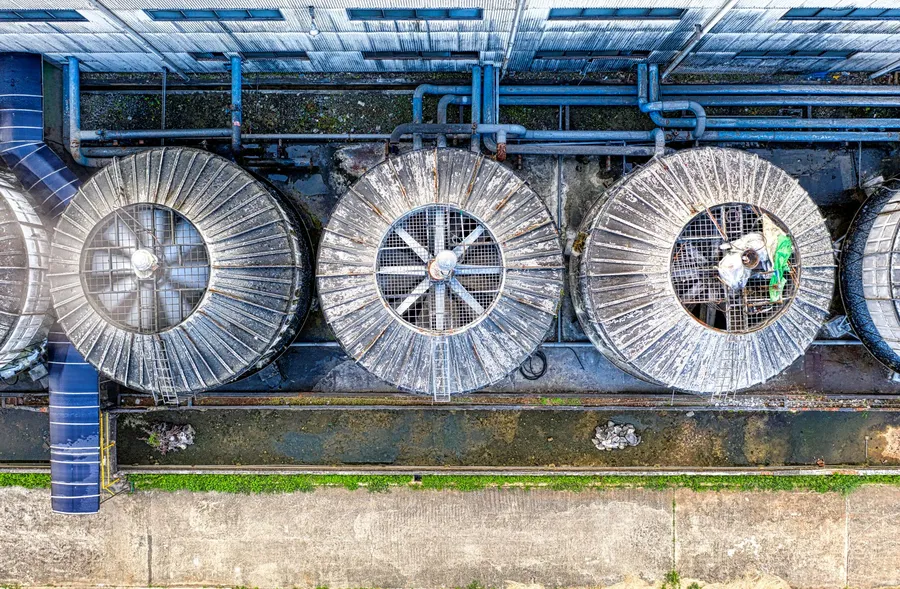
Compressor type also affects the capacity range. Common types are centrifugal (often called "turbo" in Taiwan), screw, and scroll; large water-cooled systems mostly use centrifugal or screw compressors. The condenser scaling and cleaning discussed below mainly apply to water-cooled, shell-and-tube condensers. Air-cooled condensers sit outdoors, and maintenance there focuses on clearing dust and lint from the fins.
Is your chiller losing efficiency? Check kW/RT and approach temperature
Your electricity bill won't tell you whether the chiller is degrading, because weather and load change every day. Two numbers are more reliable:
| Indicator | Meaning | How to read it |
|---|---|---|
| kW/RT | Power used to produce 1 refrigeration ton (RT) of cooling | Lower is more efficient; only meaningful when compared at similar load and cooling water temperature |
| Condenser approach temperature (LTD) | Difference between the condenser refrigerant temperature and the leaving cooling water temperature | Typically 1–2°C when clean; a steady rise means poorer heat transfer, usually from scaling |
Approach temperature is the most direct indicator of scaling, and most chiller control panels display both the refrigerant and cooling water temperatures. Record it at the same time each day or week and plot the trend, and you'll spot problems before efficiency drops noticeably. To see how much power the chiller, pumps, and cooling tower each use, you can add a power monitoring meter to the switchboard and measure circuit by circuit.
Why do condensers scale, and how much does it add to your power bill?
Cooling water repeatedly evaporates and concentrates in the cooling tower, and calcium, magnesium, and other minerals plus microorganisms attach to the inner walls of the condenser's copper tubes, forming scale and biofilm. This layer acts like insulation: heat can't escape, condensing pressure rises, and the compressor has to work harder. Based on reference values from US HVAC engineering literature (Philip Kotz, "Clean System Approach to Air Conditioning"), the relationship between scale thickness and energy use is roughly as follows:
For a 1,000 RT chiller (0.65 kW/RT, 80% average load, 6,000 operating hours per year, NT$3.78 per kWh), 0.3 mm of scale could add about NT$1.18 million in electricity costs per year. In one case at an automotive plant in Taiwan, the condenser approach temperature climbed from 1.3°C to 7.2°C within a year, indicating significant scaling (see the automatic condenser tube cleaning case study).
How should you clean the condenser? Periodic chemical cleaning vs. online automatic cleaning
| Item | Shutdown cleaning | Online automatic cleaning (ball type) |
|---|---|---|
| When it's done | After scale has built up and efficiency has dropped | Continuously, removing scale before it hardens |
| Shutdown required? | Yes; light to moderate chemical cleaning takes about 8–16 hours, severe cases 24–48 hours | No, it runs automatically while the chiller operates |
| Chemicals and waste | Yes; waste liquid must be collected and disposed of according to regulations | Greatly reduced |
| Efficiency over time | Recovers after cleaning, then gradually declines again | Stays close to clean-condition levels over the long term |
| Limitations | Requires a backup chiller or a production stop during shutdown | Existing hard scale must be cleaned once first; only for water-cooled shell-and-tube condensers |
Log daily
At a fixed time, record the condenser approach temperature, cooling water inlet/outlet temperatures, and chiller current, and plot the trend.
Manage water quality
Keep up cooling tower blowdown, chemical dosing, and water testing; automatic cleaning complements water treatment rather than replacing it.
Act when approach temperature rises
If the value keeps drifting from its clean-condition level, schedule cleaning instead of waiting for the annual maintenance visit.
Compare total cost before choosing a method
Add up the extra electricity used while scaled, downtime losses, and chemical cleaning and waste disposal costs, then compare periodic chemical cleaning with automatic cleaning. For what drives the cost, see condenser cleaning cost.
DEYly starts by using your chiller's kW/RT, approach temperature, and electricity rate to calculate how much scaling is costing you now, then assesses whether ball-type automatic cleaning is worth it. An electronics manufacturing plant in Taiwan saved 15% on energy after installing it on 400 RT and 800 RT centrifugal chillers. But if your approach temperature stays low and operating hours are short, periodic cleaning may be enough.
Beyond the chiller itself, the air handlers and fan coil units at the terminal end can also be improved without shutting down: an AC energy-saving panel placed on the return-air filter makes heat exchange more complete, and like condenser cleaning it is a measure that needs no new equipment.
FAQ
How does a chiller work?
A chiller uses a refrigerant cycle to remove heat from chilled water: the refrigerant absorbs heat in the evaporator, is pressurized and heated by the compressor, releases heat to cooling water or outdoor air in the condenser, and drops in pressure through the expansion valve before returning to the evaporator. The cooled water is sent to air handling units to cool the space.
Which is more energy efficient, an air-cooled or water-cooled chiller?
Water-cooled chillers are usually more efficient and suit factories and large buildings with high capacity and long operating hours, but they require a cooling tower and water quality management. Air-cooled systems are simpler but strongly affected by outdoor temperature, with lower efficiency in summer; they're common in small and mid-sized buildings.
How often should a chiller be serviced?
Rather than relying only on a fixed schedule, a better approach is to log the condenser approach temperature and chiller current daily. When clean, the approach temperature is typically 1–2°C; a steady rise means heat transfer is degrading and you should schedule inspection and cleaning. Cooling tower water quality management should be ongoing.
How can I tell if the condenser is scaled?
Check the condenser approach temperature (LTD)—the difference between the refrigerant temperature and the leaving cooling water temperature. A steady rise usually indicates tube scaling. You can also check whether kW/RT has worsened at similar loads.
Can automatic condenser cleaning be installed on an air-cooled chiller?
No. Ball-type automatic cleaning is installed in the cooling water piping and only works with water-cooled, shell-and-tube condensers. Air-cooled condensers are outdoors, and maintenance focuses on regularly cleaning the fins and inspecting the fans.