Chiller Tube Auto-CleaningSponge balls clean tubes while running — no shutdown, no chemicals
The automatic ball cleaning system installs on the condenser water piping of a water-cooled chiller and periodically sends sponge cleaning balls through the tubes, removing freshly deposited scale and biofilm while the chiller runs. No more waiting for efficiency to drop before shutting down for chemical cleaning — heat exchange stays close to clean, and the extra energy cost of fouling disappears.
ESG positioning: E (Environmental) + S (Social)How DEYly approaches ESG →
- Proven benefits
- Maintains condenser heat exchange efficiency, avoids the extra energy caused by fouling and reduces water use and waste from chemical cleaning (E); fewer shutdowns for tube brushing and acid cleaning lower staff exposure to chemicals (S).
- Limits
- Savings depend on current fouling levels and cleaning frequency; formal benefits are calculated from the chiller's kW/RT, approach temperature (LTD) and electricity price. Hard scale that has already formed must be cleaned once before deployment.
Cost of foulingWhat fouled tubes cost you
Calcium, magnesium and microorganisms in condenser water slowly build up on the tube walls as scale and biofilm. The layer acts like insulation: heat can't get out, so condensing pressure rises and the compressor works harder. Just 0.3 mm of scale can raise energy use by about 10%.
| Scale thickness | 0.3 mm | 0.6 mm | 0.9 mm | 1.2 mm | 1.6 mm |
|---|---|---|---|---|---|
| Heat exchange loss | 21% | 34% | 44% | 56% | 57% |
| Energy increase | +10% | +20% | +31% | +42% | +53% |
| Extra yearly cost, 1,000 RT | About NT$1.18M | About NT$2.36M | About NT$3.66M | About NT$4.96M | About NT$6.25M |
Assumptions for the added cost: 1,000 RT, 0.65 kW/RT, 80% average load, 6,000 operating hours a year, NT$3.78/kWh; clean-condition annual power cost about NT$11.8M. Heat exchange loss doesn't translate into the same percentage increase in power cost — this table only illustrates the order of magnitude of the risk. Source: Philip Kotz, "Clean System Approach to Air Conditioning," Heating/Piping/Air Conditioning.
How it worksHow ball cleaning works
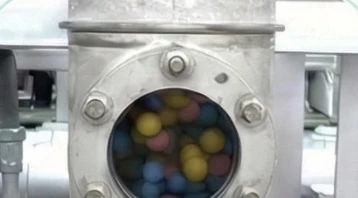
A ball injection and collection unit is added at the condenser water inlet and outlet. At set intervals (for example every 30 minutes), the control panel sends a batch of sponge cleaning balls into the condenser water piping; the balls travel through every tube with the flow, wiping away freshly deposited soft scale and biofilm, and a strainer at the outlet collects them for the next cycle. The whole process runs during chiller operation and takes about 2 minutes per cycle.
- 01StandbyBalls wait in the unit.
- 02InjectSent into the water on schedule.
- 03CleanBalls wipe every tube.
- 04CollectStrainer catches and returns them.
- OKStays cleanScale goes before it hardens.
Reactive vs. preventivevs. yearly chemical cleaning
The traditional approach is clean it once it's dirty: shut down for tube brushing or acid cleaning after efficiency has already dropped; efficiency recovers, then slowly degrades again. Automatic cleaning means not letting it get dirty, keeping efficiency close to clean. Don't just compare the price of one chemical cleaning — add the extra energy during fouling, shutdown losses and waste disposal.
| Item | Shutdown cleaning | Online auto-cleaning |
|---|---|---|
| When it's done | After fouling | Continuous |
| Shutdown | 8–16 h, up to 24–48 h if severe | No shutdown |
| Chemicals and waste | Yes; waste must be treated | Greatly reduced |
| Labor | Teardown, brushing, acid | Automatic |
| Equipment risk | Corrosion under thick scale; acid handling | Less chemicals and corrosion |
| Energy efficiency | Recovers, then declines | Stays high |
Budget reference for one chemical cleaning in Taiwan: about NT$20,000–60,000 for 100–300 RT, about NT$80,000–200,000 for 600–1,000 RT; actual prices depend on site survey and quotation. Lost production from the shutdown is often costlier than the cleaning itself.
Taiwan casesDeployments in Taiwan
Electronics plant · centrifugal chillers
2022, one 400 RT and two 800 RT chillers: 15% saved, plus a government energy award.
Car plant · six 600 RT chillers
2023. Before: LTD rose from 1.3℃ to 7.2℃. After: held at 1.1–1.6℃ — about 12–20% saved.
Approach temperature (LTD) is the difference between the condenser's refrigerant temperature and the condenser water leaving temperature; a larger number means poorer heat exchange — the most direct indicator of fouling.
ROI inputsData we need
We don't quote benefits from generic numbers — we use your chiller's data to calculate current fouling losses and payback. Having the following ready makes the assessment fastest.
Chiller
Capacity (RT), model, actual kW/RT
Operation
Hours per year, load, power price
Condenser condition
LTD, condenser water temps
Maintenance & water
Last cleaning date, cost and downtime per cleaning, hardness / pH / conductivity / silica
ImplementationHow to deploy
- 01DataCapacity, kW/RT, LTD, water, cleaning log.
- 02EstimateLosses, cleaning cost, payback.
- 03SurveyPiping, space, chiller setup.
- 04InstallBall units, panel, schedule.
- 05Track LTDLog LTD and energy.
Hard scale that has already formed must be cleaned once before deployment. Cooling tower water treatment must continue — automatic cleaning complements water treatment rather than replacing it.
FAQCommon questions
Why does a chiller's condenser foul?
A water-cooled chiller's condenser relies on condenser water to carry heat away. As the water repeatedly evaporates and concentrates in the cooling tower, minerals such as calcium and magnesium and microorganisms build up on the tube walls as scale and biofilm.
How much does fouling increase the power bill?
By engineering reference values, 0.3 mm of scale raises energy use by about 10% and 0.6 mm by about 20%. For a 1,000 RT chiller, 0.3 mm of scale could add about NT$1.18M a year in power costs. Calculate the actual impact from the chiller's kW/RT and approach temperature.
What is automatic ball cleaning?
Ball injection and collection units are added to the condenser water piping; at set times sponge cleaning balls are sent into the piping, travel through every tube with the flow wiping off soft scale and biofilm, and are collected by a strainer. The whole process runs automatically during chiller operation, about 2 minutes per cycle.
Does cleaning require a shutdown?
No. Cleaning happens while the chiller runs — no removing covers to brush tubes, no shutdown for chemical cleaning.
With automatic cleaning, do I still need chemical cleaning?
Automatic cleaning continually removes freshly deposited soft scale, greatly reducing the need for chemical cleaning. But hard scale that has already formed must be cleaned once before deployment, and condenser water treatment must continue.
Which chillers are suitable?
Water-cooled chillers with shell-and-tube condensers, including centrifugal and screw types. The larger the capacity, the longer the operating hours and the faster the fouling, the greater the benefit.
How can I tell if my chiller is fouled?
Check the condenser approach temperature (LTD) — the difference between refrigerant temperature and condenser water leaving temperature. When clean it's usually 1–2℃; a steadily rising value means heat exchange is degrading, most often due to fouling.
The fouling-vs-energy figures are reference values from US HVAC engineering literature; Taiwan case data are measured results from customers. Formal benefits are calculated from site data.