3:48 video: why NVIDIA paid upfront, what happens when chips absorb moisture, and how to staff packaging at new overseas plants.
Summary: NVIDIA prepays KYEC to build a US plant. What should new overseas plants watch for?
On October 13, 2026, KYEC announced a customer prepayment agreement with NVIDIA. NVIDIA pays upfront, KYEC builds test capacity in the US reserved for NVIDIA, and the prepayment is later offset against test service fees. The US investment is capped at US$1.4 billion (United Daily News, Commercial Times). After testing, moisture-sensitive chips still need dry packing per IPC/JEDEC J-STD-033, and a mistake at any step can get an entire lot returned. Most of this step is still manual, so new overseas plants should factor shipping-packaging labor into their plans. Lines with stable volumes and concentrated specs can consider a fully automatic inner-box packing machine paired with a back-end logistics packaging line.
KYEC × NVIDIA: what does the “customer prepayment agreement” mean in plain terms?
On October 13, 2026, KYEC announced that its board had approved a customer prepayment agreement with NVIDIA. In plain terms, NVIDIA puts money in first, and KYEC and its US subsidiary use it to build test capacity reserved for NVIDIA. Future test service fees are then gradually deducted from the prepayment. The announcement did not disclose the prepayment amount or when the new capacity will come online (United Daily News).
| Item | Details | Status |
|---|---|---|
| Arrangement | NVIDIA prepays; KYEC builds capacity reserved for NVIDIA, later offset against service fees | Company announcement |
| US investment | Capped at US$1.4 billion | Company announcement |
| Capex this year | Raised to NT$50 billion | Reported by Commercial Times |
| Timeline | Initial plan: low-volume operation starting in 2028 | Reported by Commercial Times; subject to progress |
| Location | Texas is most likely; may buy and convert an existing building | Supply-chain sources; unconfirmed |
Why pay upfront? AI chips keep getting more complex and each one takes longer to test, so even test capacity is now in short supply. Building in the US is expensive, and without a long-term contract, OSATs are reluctant to commit. A customer that puts money in first sends a clear message: go ahead and build, because the capacity is already booked.
What the news didn't mention: testing isn't the last step, because chips still need dry packing
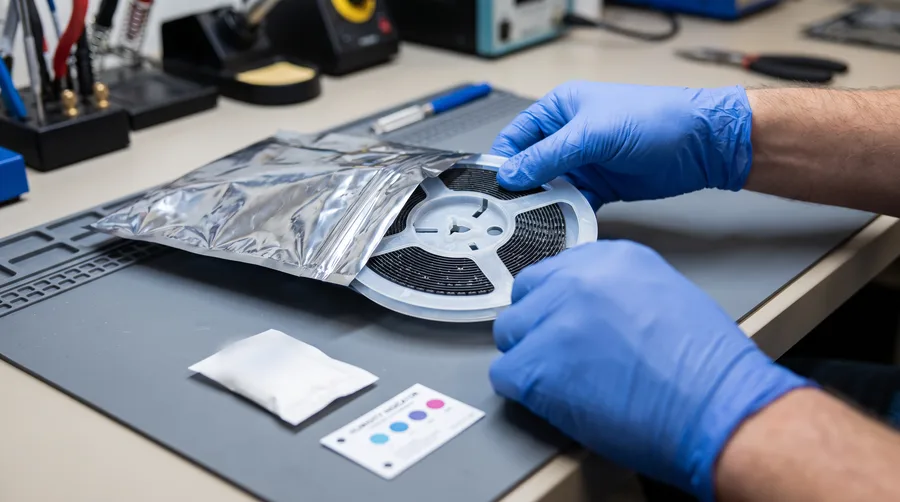
Many chips absorb moisture from the air. If moisture gets into the package, the temperature spikes during board reflow and the water vapor expands instantly, which can delaminate or crack the package. The industry calls this the popcorn effect. That's why moisture-sensitive devices must be dry packed per IPC/JEDEC J-STD-033 before shipping: add desiccant and a humidity indicator card, place them in a moisture barrier bag, vacuum, heat-seal, then label and pack into an inner box. How long a device can stay out of the bag depends on its moisture sensitivity level; see What is MSL.
This step looks simple, but it's the last checkpoint. However well the chips tested, a packaging mistake can still get the entire lot sent back once it reaches the customer.
- A pinhole in the bag or an incomplete seal→Humidity inside the bag slowly rises, the devices absorb moisture, and they may be damaged during reflow (see How to check vacuum aluminum foil bags for leaks)
- Missing desiccant or humidity indicator card→Fails dry-pack requirements, and the customer's incoming inspection may reject it outright
- Wrong part number or lot number on the label→Records and material don't match, and the entire lot must be recalled and repacked
At a new overseas plant, who will handle this step?
Whether the plant is in Taiwan or about to open in the US, shipping packaging is often still done by hand, one bag at a time: checking part numbers, labeling, sealing, folding bags and boxing, with people scheduled across three shifts. In Taiwan, you can still find the people. At a new overseas plant, the tools can run 24 hours a day, but you may not be able to hire people to stand in the packaging area in the middle of the night, sealing bags and checking labels one by one. Even if you can, they may not stay.
The result can be that test capacity you paid dearly to secure ends up bottlenecked at packaging. When planning a new overseas plant, everyone accounts for tools, buildings and cleanrooms, but back-end packaging labor and training is often an afterthought. For other hurdles in setting up overseas, see 5 steps for Taiwanese equipment makers expanding into overseas markets.
What can automation take over, and what are its limits?
We recommend handing this step to automation. Take the fully automatic semiconductor inner-box packing machine as an example. It comes in reel/tray and wafer-box models depending on the carrier, and one machine handles every step: record and material verification, labeling, vacuum aluminum foil bag sealing, per-bag vacuum detection, automatic bag folding and inner-box packing. It connects to host systems via SECS/GEM, loading and unloading can hand off to automated guided vehicles (AGV) and overhead hoist transport (OHT), and every bag has a traceable record. Paired with a back-end smart logistics packaging line, it can cut shipping-packaging labor by 40–50% on average (an average; actual results depend on line configuration).
| Line profile | Recommendation | Reason |
|---|---|---|
| Stable shipping volume, concentrated specs | Evaluate first | Few changeovers and high tool utilization, so labor savings are most visible |
| Many part numbers and packaging specs, frequent changeovers | Set up fixtures and parameters before deployment | Every carrier and bag size must be tuned in advance, or changeover time will eat into the benefits |
| Low shipping volume | May not pay off | Manual packing may cost less than the equipment investment |
| New overseas plant built for a major customer | Excellent fit | Concentrated products and carriers plus the most severe labor shortage: exactly where automation shines |
Automation doesn't mean layoffs, either. Bag folding, labeling and part-number checks go to the machine, while staff move to loading/unloading, tool monitoring, exception handling and quality sampling.
Planning a new overseas plant: 4 things to settle about shipping packaging
1. Take stock of shipping volume and carriers
How many reels, trays and wafer boxes ship each month, and in how many sizes? This decides whether to automate and which model to choose.
2. Build packaging labor into the shift schedule
How many people does a three-shift operation need? How long will local hiring and training take? Use pre-deployment shift staffing as the baseline so you can calculate the benefits later.
3. Confirm labeling and record rules
Settle the customer's label format, part- and lot-number rules, and whether to connect to MES early. The sooner they're final, the easier it is to plan the machines and systems.
4. Reserve space and material-handling routes
Reserve locations for the packing machines and back-end logistics line, plus AGV/OHT routes, at the facility planning stage. It's cheaper than retrofitting later.
FAQ
What is the customer prepayment agreement between KYEC and NVIDIA?
KYEC announced on October 13, 2026 that NVIDIA will pay upfront, KYEC will build test capacity in the US reserved for NVIDIA, and the prepayment will later be offset against test service fees. The US investment is capped at US$1.4 billion. The prepayment amount and capacity timeline have not been disclosed.
What is the popcorn effect in chips?
When a package has absorbed moisture, the temperature rises rapidly during board reflow and the water vapor expands instantly, which delaminates or cracks the package. That's why moisture-sensitive devices must be dry packed per J-STD-033 before shipping; see What is MSL.
Can semiconductor shipping packaging be fully automated?
Yes. A fully automatic inner-box packing machine can handle record and material verification, labeling, vacuum aluminum foil bag sealing, automatic bag folding and inner-box packing, and it connects to MES and AGV/OHT. Paired with a back-end logistics packaging line, it can cut shipping-packaging labor by 40–50% on average. Actual results depend on the line evaluation.
Which lines are a good fit for automated packing?
Lines with stable shipping volumes and concentrated carrier and packaging specs fit best, such as a new overseas plant built for a major customer. Lines with many part numbers and frequent changeovers should get fixtures and parameters right first. For low-volume lines, manual packing may be more cost-effective.
Source
- United Daily News (Economic Daily News), “KYEC to Build US Plant as NVIDIA Races for Capacity: Companies Sign Customer Prepayment Agreement,” 2026-10-14. Link
- Commercial Times, “Plant Not Yet Built, NVIDIA Pays First: KYEC's US Capacity Locked In, and Both Sides Have Their Own Calculations,” 2026-10-14. Link
- JEDEC, “J-STD-033 Handling, Packing, Shipping and Use of Moisture/Reflow Sensitive Surface Mount Devices,” current revision. Link