Packing equipment
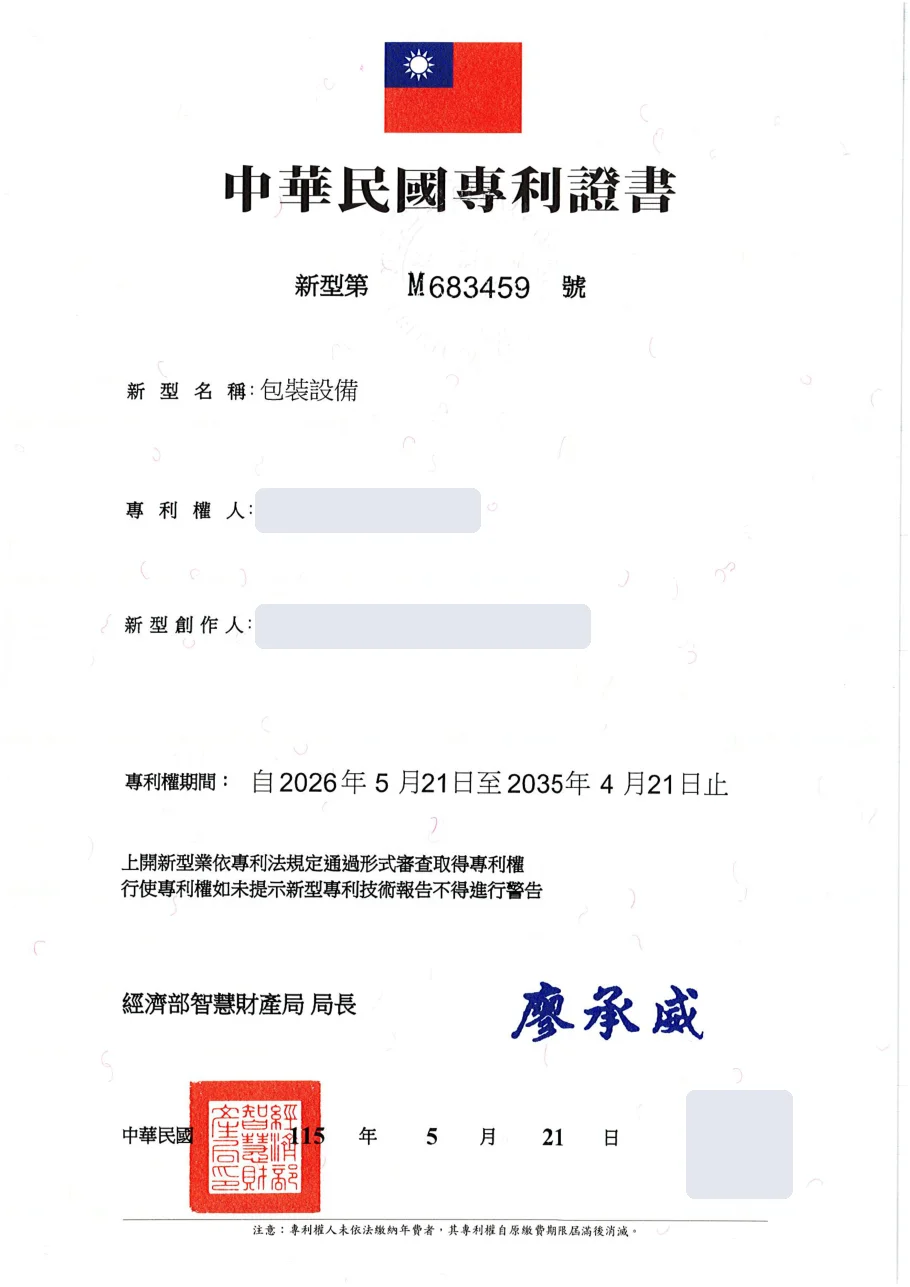
Equipment patent for the packer, granted by Taiwan IPO.
- Patent type
- Utility model
- Term
- 2026-05-21 to 2035-04-21
Reels, trays and wafer boxes — from bagging and bag folding to boxing, in one machine. The semiconductor inner-box automatic packing machine is shipping-packing equipment for the last station of an OSAT or wafer line. Models are configured by carrier — Reel/Tray and wafer box (FOSB) — and automatically handle record matching, labeling, vacuum sealing of moisture barrier bags, automatic bag folding and boxing, connecting to host systems via SECS and docking with AGV/OHT for automatic loading.
ESG: E + SSDG 8Decent WorkSDG 9Industry & InnovationOur ESG approach →
The inner-box packing machine sits at the last station of the line: reels and trays after final test, wafer boxes after wafer-level processing, go into this machine for bagging, folding and boxing. Inner boxes are stored in the logistics warehouse, and at shipment the Logistics Packing Line packs them into cartons and onto pallets. The two can be deployed separately or connected into one line.
Most used for: vacuum dry packing, labeling and boxing, wafer boxes, trays, tape and reel
Click a flowchart to open it with relevant stations outlined in orange; click a box for details. Based on our process flowcharts.
After vacuum heat sealing, the moisture barrier bag is larger than the product and must be folded down to about the product's size to fit neatly into the inner box. The bag is soft and wrinkles differently every time, so many lines still fold by hand. The inner-box automatic packing machine folds automatically after sealing for every carrier type and boxes directly, so "from bagging to boxing" never has to stop and wait for a person.
Moisture-sensitive parts are dry-packed per IPC/JEDEC J-STD-033: sealed with desiccant and a humidity card, good for at least 12 months. Poor packing lets parts absorb moisture and crack in reflow.
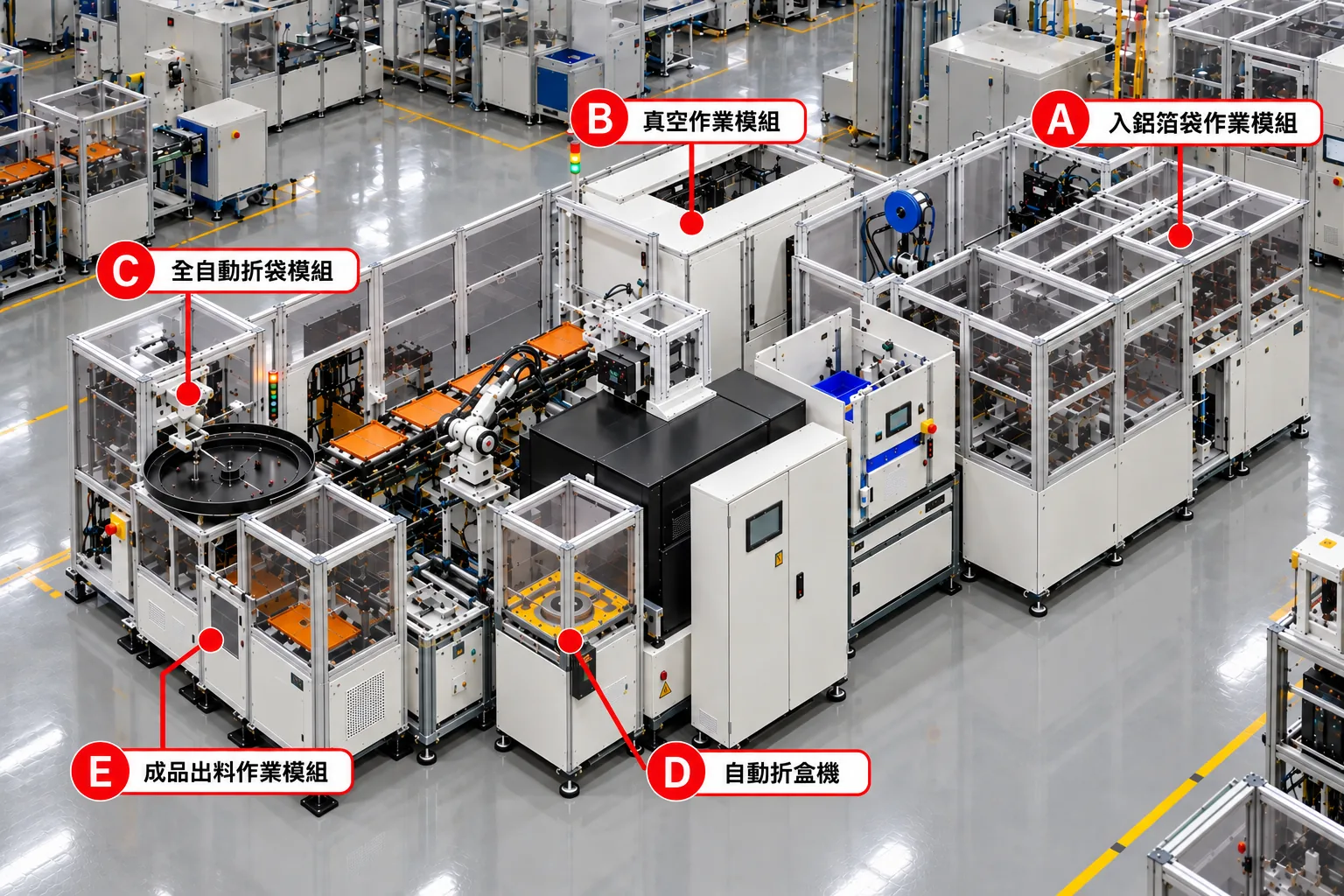
The inner-box automatic packing machine links five modules into one line: products are first placed into moisture barrier bags, go into the vacuum module for evacuation, heat sealing and per-bag leak detection, then automatic bag folding; on the other side an automatic box erector forms inner boxes in advance, and after boxing the outfeed module sends them out. Module layout is adapted to the carrier and line flow.
Illustrative
Frames from video of the wafer box model on a customer line, in packing order.


From customer video, so resolution is limited; configuration varies by carrier and line.
Models are divided by carrier into Reel/Tray models and wafer box (FOSB) models. Different sizes require machine configuration to the carrier specs; before deployment we evaluate your actual carrier types and sizes.
| Carrier | UPH | Sizes |
|---|---|---|
| Reel | About 60 boxes/hour | All sizes |
| Tray | About 60 boxes/hour | All sizes |
| Wafer box FOSB | About 45 bags/hour | All sizes |
| Item | Manual packing | Inner-Box Auto Packer |
|---|---|---|
| Record matching | Part, lot and quantity checked by hand | Automatic matching |
| Labeling | By hand; mislabel risk | Auto labeling |
| Vacuum sealing | Bag and sealer by hand | Auto vacuum sealing + leak check (patented) |
| Folding & boxing | By hand; quality varies | Auto fold, straight to box |
| Loading/unloading | Manual handling | Can dock with AGV/OHT |
| Data reporting | Manual records | SECS host link |
The equipment connects to the factory host system via SECS to receive commands and report status and packing records; loading can be done by operators, AGV or OHT. SECS/GEM is the common standard for communication between semiconductor equipment and factory hosts (SEMI E5/E30).
Compliant with SECS/GEM (SEMI E30) and can integrate with customer MES/EAP; load ports support E84 handshaking for automatic handoff with AGV and OHT. Reported data includes lot ID, carrier ID, packing quantity, sealing and nitrogen purge parameters, label barcode content, equipment status and alarm history.
Combined with the downstream Logistics Packing Line, shipping and packing staff drops 40–50% on average; the best case, on three shifts, went from 36 people to 6. Every customer's line is different, so actual benefits need to be estimated for your process.
Best case · 3 shifts · inner-box packer + logistics line (customer anonymized). Average 40–50%; depends on the line.
Before deployment we review every station with you, plan where people go, and use before/after staffing as the baseline.
Enter your current shipping and packing staffing; the estimate uses an average reduction of 40–50%. That's the average benefit of the front-section inner-box packing machine combined with the back-section smart logistics packing line; actual results depend on your line configuration.
Default cost is an assumption — use your own. Freed staff can be reassigned; not layoffs. Best case 36 → 6 on three shifts (~83%), not the average.
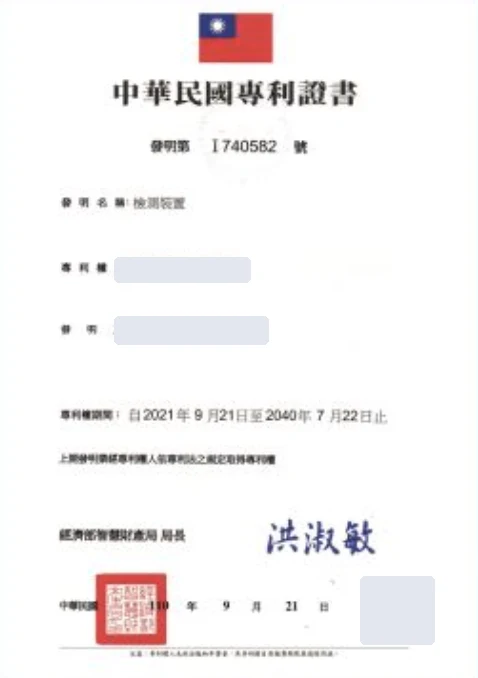
Get a formal estimateThe inner-box automatic packing machine holds two Taiwan (ROC) patents: a utility model patent for the packing equipment (No. M683459), covering the machine itself, and an invention patent for vacuum detection (No. I740582), which checks after sealing that each moisture barrier bag is truly evacuated, keeping leaking bags out of inner boxes and shipments.
Equipment patent for the packer, granted by Taiwan IPO.
Built into the vacuum module: every sealed bag is checked for leaks before folding and boxing.
Why check? A bag that isn't fully evacuated or leaks lets moisture in. Catching it before shipping costs far less than at the customer. Read: checking bags for vacuum leaks →
| Throughput (UPH) | Reel about 60 boxes/hour, tray about 60 boxes/hour, FOSB wafer box about 45 bags/hour |
|---|---|
| Packing process | Matching, labeling, vacuum sealing, folding, boxing |
| Robot arms | 6-axis and 4-axis robots |
| Vacuum detection | Every bag leak-checked after sealing (patent I740582) |
| Patents | M683459 (equipment), I740582 (detection) |
| Communications | SECS |
| Loading | Operator, AGV or OHT |
| Reliability (MCBI) | Set with the customer |
| Dimensions and power | Customized |
In our actual deployments, an inner-box automatic packing machine takes about a year from the first meeting to go-live. Most of the time isn't spent on the machine itself but on technical integration and discussion, and on building consensus across the customer's departments. Here's what you should know before deploying.
Most time goes to integration: fitting your carriers, line layout and host system, each confirmed with your engineers before we build and test.
Production cares about output, QA about packing quality, IT about connectivity. We gather every view, solve each concern and move on once everyone agrees.
Like any automation, it needs maintenance and occasional troubleshooting — no zero downtime. If you need "100% perfect, never stops," don't deploy yet.
In use for over a year: stable, normal maintenance.
Evaluating now? Bring production, QA and IT in from day one — fewer rounds later.
— Lawrence Hsu, COO, DEYly
Yes. After vacuum heat sealing the moisture barrier bag is larger than the product; the inner-box automatic packing machine folds the bag automatically after sealing for every carrier type and boxes it directly, with no manual folding.
Models are divided by carrier into Reel/Tray and wafer box (FOSB); different sizes require configuration to the carrier specs, evaluated against your actual sizes before deployment.
Yes. The equipment connects to host systems via SECS and can dock with AGV or OHT for automatic loading.
Combined with the downstream smart logistics packing line, shipping and packing staff drops 40–50% on average; the best case went from 36 to 6 people on three shifts. Actual benefits are estimated for each customer's line. Freed-up staff usually move to machine monitoring, exception handling and quality sampling — automation isn't layoffs.
Moisture-sensitive devices are dry-packed per IPC/JEDEC J-STD-033: sealed in a moisture barrier bag with desiccant and a humidity indicator card, with at least 12 months' shelf life after sealing, so they don't absorb moisture and get damaged during reflow.
The vacuum module has a built-in vacuum detection system (invention patent No. I740582) that checks each bag after sealing, keeping leaking bags out of inner boxes and shipments.
In our actual deployments, about a year from the first meeting to go-live. Most of the time goes into technical integration and discussion, and building consensus among the customer's production, QA and IT departments.
No. Every automated machine needs regular maintenance and time for troubleshooting. If your evaluation assumes 100% perfection with no downtime at all, we recommend not deploying yet. Customers have used it for over a year with high stability and normal maintenance.
Every line is configured differently — estimate first, then decide on the front section, back section or the whole line.