Key takeaways: how should you set contract capacity?
Contract capacity is the maximum demand you agree on with Taipower, and the basic charge is calculated from it. Under Taipower's tariff schedule, when the month's peak demand exceeds contract capacity, the excess up to 10% of contract capacity is billed at 2x the basic charge, and any excess beyond 10% is billed at 3x. So lower isn't always better and higher isn't automatically safer. Start with the peak demand on your last 12 monthly bills and check which months the peaks fall in and whether they are occasional or routine. Then use circuit-level metering to find the equipment causing the peaks, and bring them down with staggered startups, scheduling or demand control. Adjust contract capacity only after that. Factories that can cut usage during agreed periods can also look at Taipower's demand response programs in exchange for bill credits.
How do contract capacity, peak demand and the basic charge relate?
| Term | Meaning | Effect on your bill |
|---|---|---|
| Contract capacity | The demand limit agreed with Taipower (kW) | The basic charge is based on contract capacity and is payable whether you use it or not |
| Peak demand | The highest average demand over a metering interval recorded that month (kW) | Any amount above contract capacity incurs additional basic charges |
| Energy charge | Based on the energy actually consumed (kWh) | Unrelated to contract capacity; reduced through energy saving |
In short: contract capacity sets the basic charge, and energy consumption sets the energy charge. Many factories invest in energy saving and cut their kWh, but their peaks stay the same and their contract capacity is never adjusted, so they don't save a cent on the basic charge.
How are overages charged? 2x for the first 10%, 3x beyond that
Under Taipower's tariff schedule (the version filed with the Ministry of Economic Affairs on 2025-11-17), when the month's peak demand exceeds contract capacity, the excess is billed at the basic charge as follows (Taipower tariff schedule):
| Excess range | Billing |
|---|---|
| Excess up to 10% of contract capacity | Billed at 2x the basic charge |
| Excess beyond 10% of contract capacity | Billed at 3x the basic charge |
An example shows the scale: with a contract capacity of 1,000 kW, peak demand one month hits 1,150 kW, an excess of 150 kW. Of that, 100 kW (within 10%) is billed at 2x and 50 kW at 3x, so you pay basic charges on 100×2 + 50×3 = 350 kW, more than twice the actual excess. A single peak in the month is enough to trigger it. Common causes are air conditioning, air compressors and production equipment all running at full load on a summer afternoon, or multiple machines restarting at once after a shutdown.
How to set contract capacity: start with 12 months of peak demand
Compile 12 months of peak demand
Copy each month's peak demand from your bills, plot it as a one-year curve and see which months the peaks fall in.
Tell occasional peaks from routine ones
If you only go over in one or two months, the cause is usually equipment starting up at the same time, and the peak is what needs fixing. If you're close to the limit every month, your contract capacity really is too low.
Find the equipment causing the peaks
The main meter can't tell you what's causing the peaks. Add metering on the circuits for chillers, air compressors and major production equipment, and compare against when the peaks occur.
Bring down peaks first, then adjust the contract
Once the peaks are down, evaluate a lower contract capacity based on the new peak demand. For the conditions and application process for changing contract capacity, follow Taipower's business regulations and the guidance of your local service office.
A cautious contract capacity that sits unused means paying the basic charge on it every month. One that's too tight hands back all your savings with a single overage. The sensible approach is to set contract capacity close to the peak demand of a normal month and use demand control to handle the occasional peak.
Demand control: 4 ways to bring peaks down
| Approach | How it works | Watch for |
|---|---|---|
| Stagger startups | After a shutdown, don't start chillers, air compressors and heating equipment at the same time; bring them up in sequence a few minutes apart | Must be coordinated with the production schedule |
| Reschedule | Move flexible high-load tasks (such as batch heating or charging) to lower-demand periods | Watch the peak and off-peak periods of time-of-use rates |
| Split the load | Instead of running one machine at full load for long periods, share the load across several to avoid a single unit driving up current | Measure first to confirm the load profile |
| Demand controller | Monitors demand in real time and automatically pauses deferrable loads as you approach the limit | Define in advance which equipment can be shed |
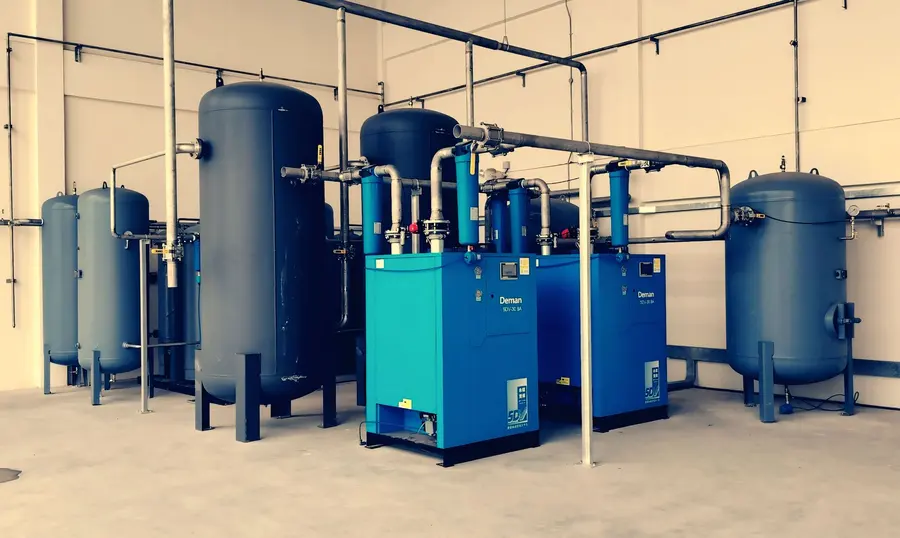
In one case at a factory in Japan, metering showed an air compressor running at 93% load for long stretches, drawing about 14 kW. After the load was split across two units, the average dropped to about 5 kW. By continuing to adjust operation based on the metering data, the plant used about 116,000 kWh less per year and cut its contract capacity from 171 kW to 143 kW. Japan's electricity tariffs differ from Taiwan's, but the sequence is the same: measure to find the source of the peaks, adjust how equipment runs, then adjust the contract. Circuit-level metering can be done with a power visualization meter, with CTs clamped on at the distribution panel and no shutdown needed.
In practice, air conditioning is usually the largest slice of the peak. Before adjusting contract capacity or installing a demand controller, cutting the AC’s own consumption is often cheaper, for example with energy-saving measures for existing AC that need no new equipment, or an AC energy-saving panel placed on the indoor unit filter.
Demand response: use less power during agreed periods in exchange for bill credits
Demand control is about avoiding overages. Demand response is an incentive offered by Taipower: customers who reduce demand during agreed periods receive credits on their bill. Taipower's demand response load management programs include planned load reduction during pre-agreed periods and real-time load reduction carried out when Taipower issues short-notice calls, among other types. Credits are calculated from the execution rate and the actual demand reduction (Taipower).
Whether it's a good fit depends on whether the factory has loads that can be paused or deferred without affecting production, such as some air conditioning, chiller operating combinations or batch processes. Before evaluating, you again need circuit-level consumption data to know how much you can reliably cut during the agreed periods. Eligibility and credit rates for each program may change every year, so check Taipower's latest announcements. To plan an energy audit and metering together, see “What Is an Energy Management System (EMS)?”.
FAQ
How much is the penalty for exceeding contract capacity?
Under Taipower's tariff schedule, when the month's peak demand exceeds contract capacity, the excess up to 10% of contract capacity is billed at 2x the basic charge, and any excess beyond 10% is billed at 3x. For example, with a 1,000 kW contract and peak demand of 1,150 kW, you pay basic charges on 350 kW.
Is it safer to set contract capacity a bit higher?
Not necessarily. The basic charge is based on contract capacity and you pay it even if you don't use it, so setting it too high over the long run means paying for nothing every month. A better approach is to set contract capacity close to the peak demand of a normal month and use demand control to handle the occasional peak.
What is peak demand?
Peak demand is the highest average demand over a metering interval recorded by the meter that month, measured in kW. It determines whether you exceeded your contract that month, and it's a different measure from how much energy you used (kWh).
How do I find out which equipment is causing the peaks?
The main meter only shows plant-wide consumption. Add metering on the circuits for chillers, air compressors and major production equipment and compare against when the peaks occur to find which equipment is running at full load or starting up at the same time.
What's the difference between demand control and demand response?
Demand control is the factory bringing down its own peaks to avoid overages and allow a lower contract capacity. Demand response means joining a Taipower program and reducing demand during agreed or notified periods in exchange for bill credits. Both require data on how much power each piece of equipment uses.