Key takeaways: why do semiconductor equipment parts need cleaning, and what methods are there?
During deposition and etch processes, deposits also build up on parts such as showerheads, shields and liners, quartz parts and ceramic parts. Deposits and part materials expand differently with heat, so after repeated heating and cooling the deposits tend to flake off as particles. A particle landing on a wafer can scrap an entire chip, so parts are removed and cleaned during preventive maintenance. Common methods include acid soaking (e.g., hydrofluoric plus nitric acid, which removes films fast but can eat into the part and enlarge holes), ultrasonic cleaning and spray rinsing (removes particles, but not always those deep in small holes), grit blasting and surface treatment (restores surface roughness and reapplies anodizing or coatings), and water-free dry cleaning such as CO₂ snow. The right method depends on material, contaminant and dimensional tolerance. After cleaning, parts should be inspected for particles, dimensions and hole diameters, weight and surface roughness.
Which parts need regular cleaning?
In short: while a semiconductor tool deposits and etches films on the wafer, the chamber parts are getting coated too. Once those deposits reach a certain thickness they flake off as particles that land on wafers, so parts have to be removed during preventive maintenanceWhat is preventive maintenance (PM)?PM stands for Preventive Maintenance. The tool is stopped on a schedule, the chamber is opened, and parts are removed for cleaning or replacement, then reinstalled and the tool is requalified.The goal is to deal with parts before they get dirty enough to cause trouble, so particles don't fall mid-process and yield doesn't suddenly drop. to be cleaned and reconditioned, then reinstalled.
Part ①
Showerheads and gas distribution plates
The showerheadWhat is a showerhead?A thick metal disc mounted at the top of the chamber, drilled with hundreds or thousands of small holes that spread process gas evenly over the wafer, like a shower head.The holes are small and numerous, so deposits stuck inside them are the hardest to clean. Once the holes get larger, gas distribution drifts. faces the wafer directly, and deposits build up on its surface and inside its small holes. The biggest risk in cleaning is enlarging the holes. If a hole goes out of tolerance, the part can no longer be used.
Challenge: deposits and particles in small holes
Part ②
Shields and chamber liners
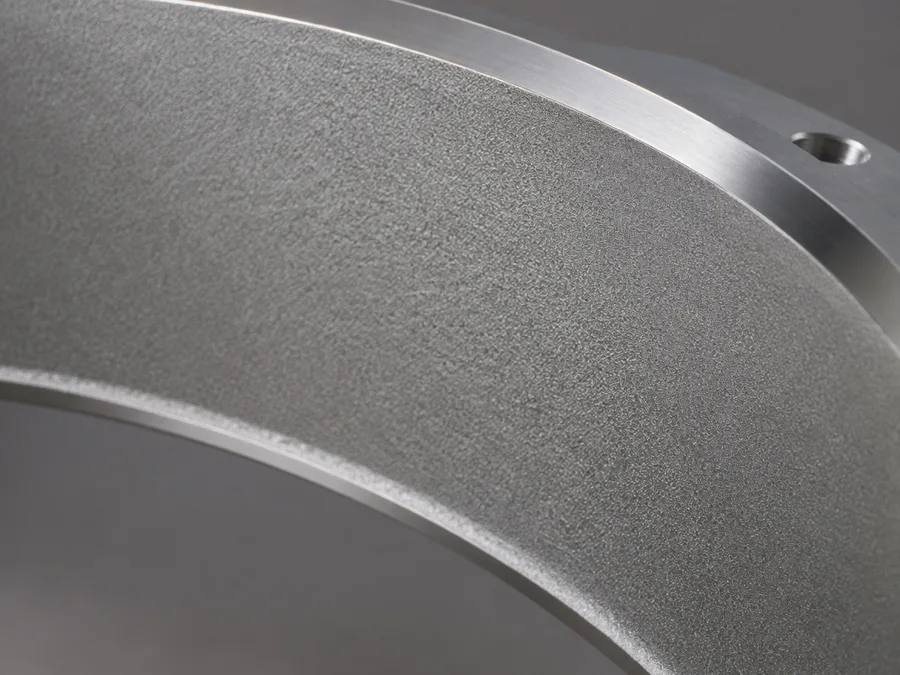
Metal shields around the wafer protect the chamber walls by catching deposits in their place. Their surfaces are usually roughened on purpose so deposits grip firmly and are less likely to flake off.
Challenge: removing deposits while restoring surface roughness
Part ③
Quartz parts
Quartz rings, quartz tubes, furnace boats and similar parts withstand high temperatures and are very pure. Deposited films are usually removed with hydrofluoric acid–based chemicals, but HF also slowly eats away the quartz itself.
Challenge: cleaning thoroughly without thinning the quartz
Part ④
Ceramic parts, coated parts and fixtures
Ceramics or ceramic coatings such as alumina and yttria resist plasma erosion. There are also fixtures for handling and holding wafers. Different materials and coatings tolerate different chemicals, temperatures and amounts of force.
Challenge: different materials need different methods
Take chemical vapor deposition (CVD) as an example. As the process grows a film on the wafer, it deposits the same material on chamber parts such as the showerhead, and those deposits must be removed regularly so they don't become a contamination source (US8398779B2).
There are two approaches: in-situ and ex-situWhat do in-situ and ex-situ mean?In-situ (in place): parts stay installed, and cleaning gas or plasma is run through the chamber to remove deposits.Ex-situ (off-tool): parts are removed and sent to cleaning tanks or a dedicated cleaning line, then reinstalled.. Running plasma cleaning inside the chamber without removing parts is in-situ. Removing parts to soak in chemicals or send out for cleaning is ex-situ. In-situ saves downtime and ex-situ cleans more thoroughly, so in practice the two are often combined.
Why cleaning is a must: deposits flake off as particles
Tiny particles are one of the biggest sources of loss in semiconductor manufacturing. As feature sizes shrink, a single particle on a wafer can make a whole device fail. Deposits on chamber parts are a major source of those particles (US7182816B2).
Why do deposits fall off? The tool keeps heating up and cooling down, and the deposits and the part material underneath expand and contract by different amounts. Under that repeated stress the deposit layer cracks, curls up and eventually flakes off piece by piece. The thicker the deposit, the more easily it flakes. So a part's cleaning interval is really a race against flaking: the deposits have to be removed before they get thick enough to start falling.
New parts aren't clean either. Even after acid cleaning, ultrasonic cleaning and spray rinsing, machining residue left from manufacturing can still leave tiny particles stuck in a showerhead's small holes. These particles may be conductive metal debris, and if they fall onto a wafer during processing they cause defects (US11848218B2).
Common cleaning methods compared
| Approach | Best for | Risks and limits | |
|---|---|---|---|
| Acid soaking | Soak in chemicals such as hydrofluoric plus nitric acid to dissolve deposited films | Deposited films on quartz and aluminum parts | The chemicals also attack the part itself: quartz gets thinner, weight and surface shape change, and showerhead holes get enlarged |
| Selective chemistries | Formulated to dissolve only the deposits while barely touching the base material | Precision-dimension parts such as showerheads | Must be developed for each deposit and base material; not a universal formula |
| Ultrasonic cleaning and spray rinsing | Ultrasonic tank agitation and pressurized water spray carry away loosened particles | Removing surface particles and machining residue | Particles deep in small holes may not come out |
| Grit blasting and surface treatment | Grit blasting restores surface roughness; anodizing or ceramic coatings are reapplied when needed | Shields, liners and other parts meant to hold on to deposits | Changes dimensions and surface, so it can only be done a limited number of times; residual grit must be fully removed afterward |
| CO₂ snow | Sprays very fine CO₂ snow that knocks off particles and thin oil films on impact | Precision parts that can't get wet or tolerate residue | Mainly cleans surfaces; thick deposited films still need chemicals or other methods |
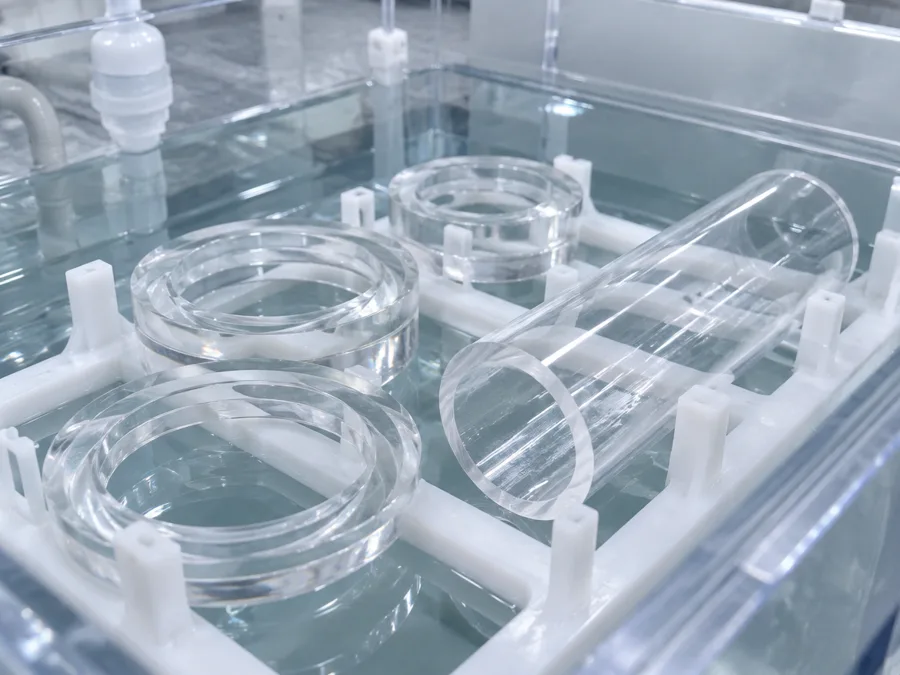
Acid is the most common method, and the one that calls for the most care. Quartz parts are often cleaned with hydrofluoric plus nitric acid, by immersion or spray, for at least about 30 minutes. Films and particles come off easily, but the quartz surface can also be over-etched and end up contaminating wafers. After several cleanings, the part's weight and surface shape change too (US7985297B2). Soaking showerheads in acid has the same problem: the acid eats the deposits in the holes but can also damage the part and shorten its life (US7789969B2). That's why the industry keeps developing selective chemistries that dissolve only the deposits without harming the aluminum, keeping showerhead hole diameters within tolerance so parts can be cleaned more times (US8398779B2).
Grit blasting isn't just cleaning. It is also surface engineering. Shields and similar parts are deliberately blasted to a set roughness, for example an average roughness Ra of at least about 4–5 µm as cited in one patent, so deposits grip more firmly. Some also get further surface treatment such as anodizing or alumina or yttria spray coating (US7182816B2). Removing the deposits together with the old surface and then restoring the roughness and coating is what is usually called part “refurbishment.”
For parts that can't get wet or are sensitive to chemical residue, consider dry CO₂ snow cleaning. Microbubbles are also used to clean resin, metal and ceramic parts; see microbubble cleaning for how it works. For how to combine dry and wet methods, see dry cleaning vs. wet cleaning. For how dry-ice blasting, CO₂ snow and supercritical cleaning differ even though all three use CO₂, see Three CO₂ cleaning methods compared.
How to choose a cleaning method: ask these 4 questions first
What is the part made of?
Aluminum, anodized aluminum, stainless steel, quartz, ceramic and ceramic coatings each have different weaknesses to chemicals and temperature. When a single part has both coated areas and bare metal, confirm the method won't damage either one.
What needs to be removed?
Is it deposited film (oxide, nitride, metal), loose particles, metal contamination or organic residue? Thick deposits usually need chemicals or grit blasting. For particles and thin films, ultrasonic cleaning, spray rinsing or CO₂ snow are options.
How tight are the dimensional tolerances?
Critical dimensions such as showerhead hole diameters, sealing surfaces and quartz thickness may lose a little with every cleaning. You need to know how much material the part can lose before you know how many cleanings it can take and how gentle the method must be.
Can it get wet or be exposed to chemicals?
Some parts have materials that absorb moisture, fine crevices or sections that can't tolerate chemicals. Once wet, they take a long time to dry or retain residue. These parts suit dry cleaning or shorter wet contact times.
No single method works for every part. In practice a combination is common: chemicals or grit blasting remove the thick deposits, then ultrasonic cleaning, spray rinsing or dry methods remove residual particles, followed by drying and packaging.
What to inspect after cleaning
Appearance
Check for leftover deposits, discoloration, scratches, coating delamination or residual blasting grit.
Dimensions, hole diameters and weight
Check that critical dimensions and showerhead hole diameters are still within tolerance. For quartz parts, comparing weight before and after cleaning shows how much was etched away.
Surface roughness
Parts that need a specific roughness, such as shields, should be measured to confirm roughness is back within spec. If it isn't rough enough, deposits will flake off sooner.
Particles and metal residue
Confirm there are no residual particles on the surface or inside small holes, and that no metal contamination was introduced by the chemicals or treatment. Test items and criteria depend on the tool and process.
Cleaning records matter too. How many times a part has been cleaned, and its dimensions and weight after each cleaning, tell you how many more uses it has left and when to replace it, so you don't find out only after it has been cleaned beyond use.
FAQ
Why do semiconductor equipment parts need regular cleaning?
In deposition and etch processes, deposits build up on chamber parts along with the wafer. Deposits and part materials expand differently with heat, so repeated heating and cooling of the tool makes them flake off as particles. Particles landing on wafers can cause defects, so parts are removed for cleaning or replacement during preventive maintenance.
Can quartz parts be cleaned with hydrofluoric acid?
Yes. HF-based chemicals are commonly used to remove deposited films from quartz parts, but HF also etches the quartz itself. Cleaning too long or too often thins the quartz, changes its weight and surface shape and can even end up contaminating wafers. Control the chemical formula and time, and record weight and dimensions after each cleaning.
What is the biggest risk in showerhead cleaning?
Enlarging the small holes. A showerhead relies on hundreds or thousands of small holes to spread gas evenly over the wafer. While acid dissolves deposits in the holes, it can also eat into the hole walls. Once hole diameters go out of tolerance, gas distribution changes and the part can no longer be used. Particles deep in the holes are also hard to remove with ordinary ultrasonic cleaning or spray rinsing.
Why are parts grit-blasted?
Shields, liners and similar parts are there to catch deposits, so their surfaces are deliberately roughened to help deposits grip and keep them from flaking. After cleaning removes the old deposits and surface, the part is grit-blasted again to restore roughness, and some also need anodizing or ceramic coating reapplied.
Can CO₂ snow be used to clean equipment parts?
Yes, for precision parts that can't get wet or are sensitive to chemical residue. Very fine CO₂ snow knocks off surface particles and thin oil films, and no drying is needed afterward. It mainly cleans surfaces, though. Thick deposited films still need chemicals, grit blasting or other methods.
Source
- Google Patents, “US8398779B2: Non destructive selective deposition removal of non-metallic deposits from aluminum containing substrates,” 2026-10-23. Link
- Google Patents, “US7182816B2: Particulate reduction using temperature-controlled chamber shield,” 2026-10-23. Link
- Google Patents, “US7985297B2: Method of cleaning a quartz part,” 2026-10-23. Link
- Google Patents, “US7789969B2: Methods and apparatus for cleaning chamber components,” 2026-10-23. Link
- Google Patents, “US11848218B2: Semiconductor chamber component cleaning systems,” 2026-10-23. Link